

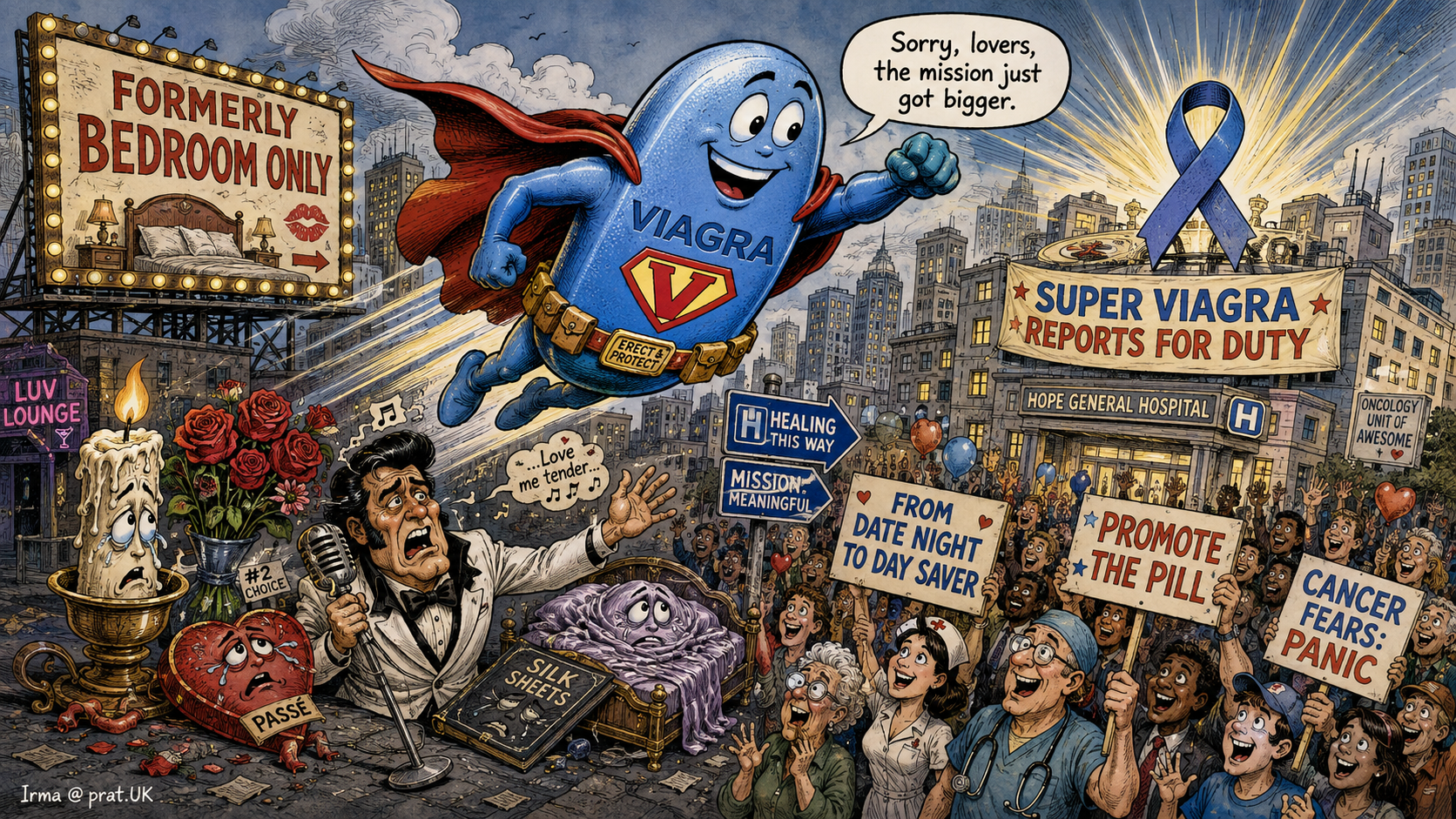
Viagra Discovers It May Fight Cancer, Immediately Demands Promotion From Bedroom Pill to Superhero
Little Blue Tablet Takes Second Job in Oncology While American Healthcare Prepares to Charge a Separate Copay for Hope
Viagra’s Unexpected Corporate Promotion
TEL AVIV, ISRAEL — Viagra, the little blue pill traditionally associated with romantic optimism, awkward television commercials and couples who somehow own outdoor bathtubs, may have discovered an entirely different professional calling. Researchers report that sildenafil, Viagra’s active ingredient, could interfere with the ability of cancer cells to spread by disrupting how they access cholesterol. The research involved cancer cells, mouse models and approximately twenty years of health records from five million members of Israel’s Clalit Health Services. The human evidence identified an association rather than proving cause and effect, according to reporting on the underlying study covered by outlets such as the National Institutes of Health.

The pharmaceutical industry immediately congratulated Viagra on becoming the first medication to maintain three completely different résumés without being accused of exaggerating on LinkedIn.
Originally investigated for cardiovascular problems, sildenafil became famous after researchers noticed that volunteers were unusually reluctant to return their unused medication. It subsequently dominated the erectile dysfunction market, transformed late-night television and gave Americans the phrase “consult your doctor” immediately before showing two retirees kayaking toward a suspiciously private cabin.
Now scientists suggest the same biochemical pathway responsible for increasing blood flow may also interfere with cholesterol transport inside cancer cells. Cancer cells need cholesterol to build membranes, migrate and establish tumors elsewhere in the body. Sildenafil increases a signaling molecule called cGMP, which researchers found can interfere with a protein responsible for moving cholesterol within cells, a mechanism broadly consistent with cancer metabolism research published by groups like the National Cancer Institute.
In ordinary language, Viagra may make it harder for certain cancer cells to pack their cholesterol luggage and leave town.
“That is the first scientific explanation I have understood since high school,” said Tel Aviv accountant Moshe Feldman, standing outside a pharmacy with sunglasses, a raincoat and a receipt he insisted belonged to his cousin. “Cancer cells are trying to travel, and Viagra hides the car keys.”
Feldman said the research had changed how he viewed his medication. “Yesterday it was private,” he explained. “Today I am practically performing public service.”
Men Nationwide Suddenly Become Oncology Enthusiasts
Across the United States, millions of men reportedly began reading cancer journals for the first time, although several accidentally searched for “peer-reviewed bedroom stamina” and were redirected to websites containing neither peers nor reviews.
Pharmacists described customers approaching the counter with unusual confidence.
“They used to whisper,” said Houston pharmacist Maribel Ortega. “Now they march up and say, ‘I would like my anti-metastatic metabolic intervention.’ Then they wink, which is not normally part of metabolic intervention.”
A customer behind her requested the largest available bottle “for preventive research.” Ortega reminded him that promising laboratory findings do not establish sildenafil as an approved cancer therapy, a distinction the FDA is still fairly particular about.
“He said he understood,” she recalled. “Then he asked whether his insurance would cover a clinical trial in Cabo.”
The National Association of Husbands Who Suddenly Understand Biochemistry issued a statement praising the study as “a courageous breakthrough in cholesterol trafficking, intracellular signaling and explaining unexplained pharmacy charges.”
Association president Dale Hickerson said members had already learned several important scientific terms. “We now understand PDE5, cGMP and metastasis,” Hickerson said. “We remain unclear on where the laundry hamper is.”
Statins Join the Team
Researchers also suggested that sildenafil-related drugs and statins may work together by attacking the cholesterol problem from two directions. Sildenafil may restrict access to stored cholesterol, while statins reduce cholesterol production. The combination produced stronger effects in the research models, although clinical trials would be needed to determine whether that promise translates into cancer treatment for people.
The announcement caused millions of men to reconsider statins, previously dismissed as medication for people who own blood-pressure cuffs and pronounce quinoa correctly.
“I told my doctor I didn’t want to take a pill every day,” said Florida contractor Randy Wilkins. “Then he explained which pill might be paired with it. I asked whether twice a day would show greater commitment to science.”
Medical professionals warned that patients should not combine prescription medications without clinical guidance. Wilkins responded by purchasing a white laboratory coat and asking his neighbor to call him “principal investigator.”
The pharmaceutical industry is reportedly considering a combination package tentatively named “Lipitor and Lift,” although regulators have already returned the proposed advertisement with seventeen red circles and a note reading, “Absolutely not.”
The Advertising Problem
Marketing executives now face the delicate task of promoting a medication associated with erectile dysfunction while discussing metastatic cancer research with appropriate seriousness.
An early advertising storyboard reportedly featured a mature couple walking through a vineyard while a narrator discussed lysosomal cholesterol trafficking. The husband then turned toward the camera and said, “Because sometimes the most important thing is preventing cellular migration.” The wife asked why he had packed champagne. “Control group,” he replied.
A second concept showed a cancer cell attempting to board an airplane while a blue tablet informed it that its cholesterol passport had expired. Federal regulators rejected the commercial because the cancer cell was wearing sunglasses, carrying golf clubs and saying, “What happens in the liver stays in the liver.”
Advertising consultant Naomi Weiss said the industry had never faced such a complex branding challenge. “You have oncology, cholesterol, blood flow and romance in one product story,” she said. “That is not a commercial. That is an entire season of cable television.”
Insurance Companies Discover a New Reason to Say No
Health insurers responded to the research by developing a billing code consisting of fourteen letters, six numbers and a tiny drawing of a locked door.
Under preliminary guidance, sildenafil prescribed for erectile dysfunction would remain subject to existing restrictions. Sildenafil requested as a potential cancer intervention would be denied because it is not currently established for that purpose. Sildenafil requested for both would be forwarded to a committee that meets once every leap year beneath a bridge.
“We support innovation,” said insurance spokesman Bradford Copayment. “Particularly innovation that has completed seven trials, twelve reviews and a forty-year waiting period.”
Copayment explained that patients could appeal a denial by submitting proof of medical necessity, proof of identity, proof of residence and an original handwritten note from cholesterol.
When asked whether insurers might cover sildenafil if future trials confirm an oncology benefit, Copayment said the company would examine the evidence carefully. “We never rush into these things,” he said. “Except premium increases.”
Government Forms Blue-Ribbon Committee
The Department of Health announced the creation of a blue-ribbon panel to study the little blue pill. The panel will include oncologists, cardiologists, pharmacologists, ethicists, insurance representatives and one senator who mistakenly believes PDE5 is an interstate highway.
Officials emphasized that the findings are intriguing but preliminary. “This research does not mean people should begin treating cancer with Viagra,” said department spokeswoman Elena Park. “It means researchers have identified a biological mechanism worth investigating through proper clinical trials.”
Within minutes, social media translated the statement into: “Government Confirms Viagra Makes Men Immortal.”
A congressional subcommittee scheduled hearings titled Repositioning Established Pharmaceuticals for Novel Therapeutic Purposes, but attendance tripled after staff shortened the title to The Viagra Hearing.
Philosophy Finally Becomes Useful
Local philosopher Dr. Shimon Barak said the discovery raised profound questions about human purpose.
“Aristotle believed everything has a natural function,” Barak explained from a café near Tel Aviv University. “Viagra appears to disagree. It has now pursued cardiovascular medicine, sexual medicine and possibly oncology. It is less a drug than a middle-aged man undergoing a series of increasingly ambitious career changes.”
Barak said the pill demonstrated that identity is not fixed. “A substance may become famous for one purpose while containing possibilities society has overlooked,” he said. “This is also what every philosophy graduate tells his parents while delivering groceries.”
Political scientist and dairy farmer Alan Nafzger offered a more agricultural interpretation. “Cancer cells need cholesterol to spread, cows need grass to produce milk and politicians need television to reproduce,” Nafzger said. “Block the supply chain and suddenly everybody stays where you put them.”
Three comedians observing the announcement reached similar conclusions. One noted that Viagra may be the only drug whose off-label possibilities have an on-label waiting list. Another said men would soon describe every romantic weekend as “preventive oncology.” The third predicted that drugstores would move Viagra from behind the counter to the superhero aisle, beside vitamins, protein powder and whatever supplement currently claims to make accountants fight bears.
A Genuine Reason for Cautious Hope
Behind the jokes lies a serious and potentially important line of research. Metastasis is responsible for much of cancer’s danger, and identifying an existing medicine that interferes with cancer cells’ ability to spread could offer researchers a valuable route for future trials.
Repurposing established drugs can be attractive because researchers already know a great deal about their manufacturing, dosing and common side effects. That does not eliminate the need for controlled clinical studies, particularly when observational data may be influenced by differences among the patients taking the drug.
Doctors therefore recommend neither panic nor pharmaceutical improvisation. Patients should not begin, stop or combine sildenafil, statins or cancer medicines based on headlines. They should discuss treatment decisions with qualified clinicians who understand their diagnosis, cardiovascular condition, medications and potential interactions, guidance echoed by organizations like the American Heart Association.
This leaves Viagra in a familiar position: full of promise, surrounded by expectations and waiting for somebody to conduct the proper follow-through.
Fifteen Humorous Observations
- Viagra began as a heart medication, became a bedroom medication and may now become a cancer medication. At this rate, by Christmas it will repair transmissions and negotiate peace treaties.
- Scientists discovered that sildenafil may interfere with cancer cells’ cholesterol supply, meaning cancer cells apparently have the same weakness as middle-aged men at a breakfast buffet.
- Every man who previously whispered about his prescription is now preparing to announce loudly at Thanksgiving that he takes it strictly for “advanced metabolic defense.”
- Viagra advertisements may soon replace couples holding hands in matching bathtubs with laboratory technicians pointing bravely at cholesterol.
- The little blue pill has accomplished more career reinvention than anyone who has ever described himself as a consultant on LinkedIn.
- Combining sildenafil with statins could produce the first prescription package marketed equally to cardiologists, oncologists and men who own convertibles.
- America may finally have a medication whose side effects require a medical chart, a dinner reservation and several apologies.
- Doctors will now need an additional twenty minutes to determine whether a patient is asking about cancer biology or planning a weekend in Las Vegas.
- Pharmaceutical companies spent decades trying to make every drug sound exciting. Viagra is the only medication whose scientific discoveries keep making the commercials less subtle.
- Cancer cells require cholesterol to help them move through the body, proving that even dangerous cells cannot go anywhere without stopping for something fried.
- Men who refused statins because they “didn’t like taking pills” may suddenly develop a deep personal respect for combination therapy.
- Insurance companies will probably cover the cancer-related portion of the pill but deny the remaining seventy-eight percent as recreational optimism.
- The study analyzed two decades of healthcare data involving roughly five million people, which is also the number of men who will claim they personally volunteered for the research.
- The drug may restrict metastasis by trapping cholesterol inside cancer cells, a strategy oncologists call promising and airport security calls Tuesday.
- Viagra has become the pharmaceutical equivalent of the employee hired to fix one problem who quietly ends up running the whole company.
Disclaimer: This article is satire inspired by published medical research. The study does not establish Viagra or sildenafil as a cancer treatment, and patients should not use prescription medication for cancer prevention or treatment without guidance from qualified healthcare professionals. The human findings are observational, while important portions of the research involved cells and mouse models.
This story is entirely a human collaboration between two sentient beings: the world’s oldest tenured professor and a philosophy major turned dairy farmer.