

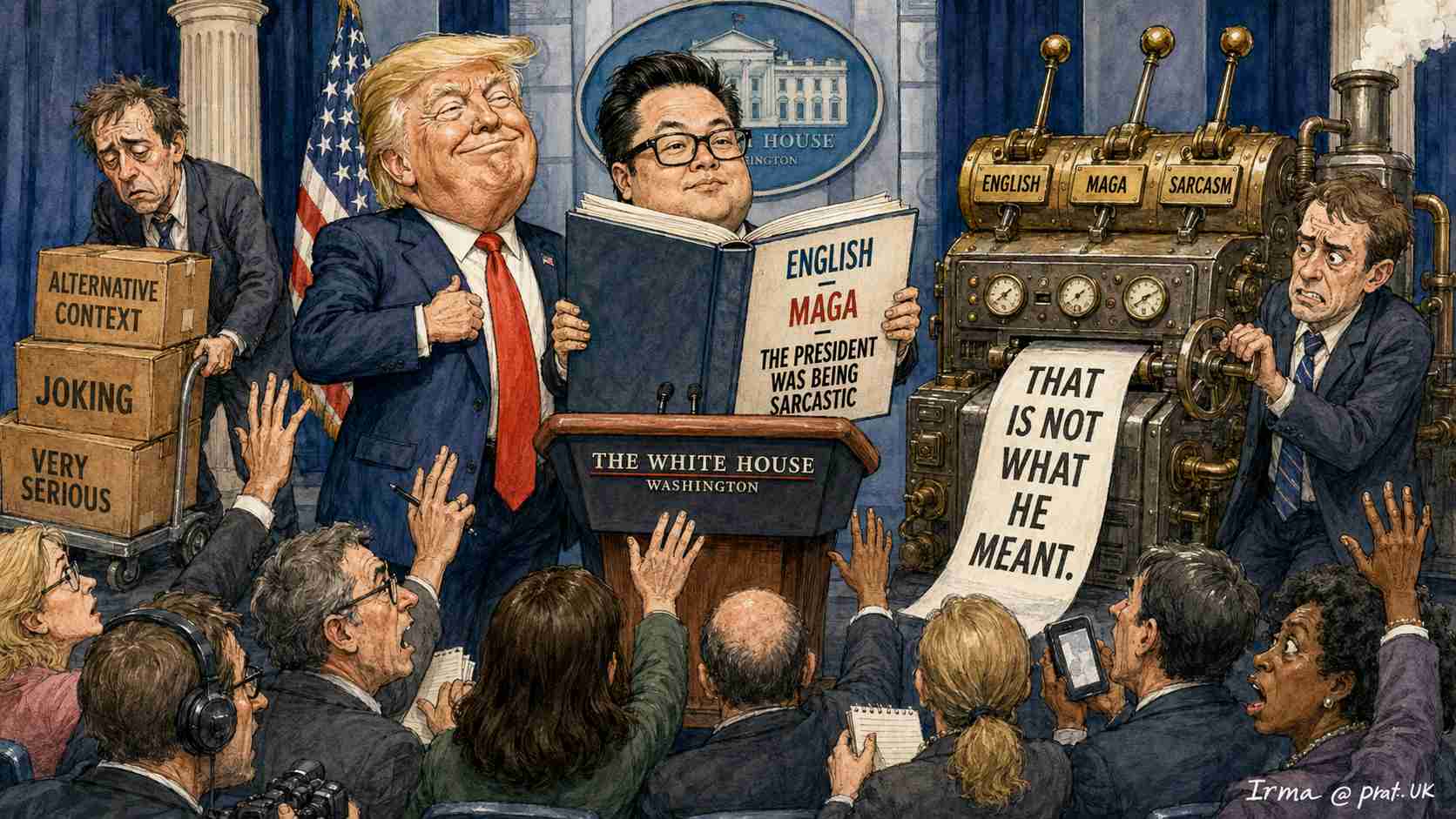
Trump Considers Steven Cheung for Press Secretary, White House Seeks Spokesman Fluent in English, MAGA and “The President Was Being Sarcastic”
Steven Cheung emerges as possible Leavitt replacement, promising reporters the same answers with 40% more elbows
WASHINGTON, D.C. — The White House is considering communications director Steven Cheung as a possible successor to departing press secretary Karoline Leavitt, according to reporting from the New York Post, raising the exhilarating possibility that the daily briefing may soon combine presidential communications, professional wrestling and the customer-service desk at an airport after all flights have been cancelled.
Leavitt, 28, is stepping down at the end of August to spend more time with her young family after recently returning from maternity leave. President Donald Trump praised her as one of history’s greatest press secretaries and said she will remain an outside adviser, allowing her to enjoy the traditional Washington retirement: leaving the building while continuing to work for everyone inside it.
No replacement has been announced. Cheung, currently the White House communications director, is reportedly among several names under consideration. Sources say his résumé is particularly attractive because he already speaks the three languages required for the position: English, MAGA and “The president was obviously being sarcastic.”
White House officials stressed that the search remains open.
“We are considering many highly qualified candidates,” said one administration aide. “The successful applicant must be able to explain tariffs, negotiate with television producers, identify a hostile adjective at 50 yards and say ‘That’s not what the president meant’ before the president finishes meaning it.”
White House Lists Essential Qualifications
A draft job advertisement circulating in Washington reportedly describes the position as “a fast-paced communications opportunity supporting one energetic executive with unlimited access to social media.”
Applicants must possess at least ten years of experience responding to questions nobody in the administration wanted asked. Familiarity with constitutional government is preferred, although the ability to point at a chart while calling CNN dishonest may be substituted on a year-for-year basis.
The successful candidate must also be comfortable beginning every morning with three separate realities: what happened, what the media reported happened and what Trump posted at 2:17 a.m. saying happened.
“This is not merely translation,” explained Dr. Milton Brisket, a political communications specialist who once successfully interpreted a 47-minute city council argument about parking permits. “Translation involves carrying meaning from one language into another. A Trump press secretary must carry meaning from Tuesday into Wednesday without spilling any on the carpet.”
Brisket said the job resembles being the official spokesman for weather.
“You walk into the briefing room and announce sunshine,” he explained. “A reporter points through the window at a hurricane. You reply that this administration inherited wind from Joe Biden.”
Cheung Offers Full-Contact Communications
Cheung’s reported candidacy has excited administration loyalists who believe the White House briefing has remained dangerously close to a verbal activity.
As communications director, Cheung is known for an aggressive style more commonly associated with hockey benches, discount furniture liquidations and fathers disputing Little League umpiring decisions. His defenders call him direct. His critics call him combative. The White House calls him before the critics finish their sentences.
One senior Republican strategist described Cheung as “the rare communications professional who can turn a request for comment into a request for medical attention.”
“Karoline delivered the administration’s message with speed, discipline and sharpness,” the strategist said. “Steven can deliver that same message while making the recipient reconsider journalism as a career.”
A preliminary White House study reportedly found that Cheung could provide the same answers as the current operation but with 40% more elbows, 60% fewer transitional phrases and enough strategic aggression to make the briefing room qualify as mixed martial arts.
That background may be literal as well as rhetorical. Before becoming one of Trump’s most visible communications warriors, Cheung worked in communications for the Ultimate Fighting Championship. Washington insiders say the experience prepared him perfectly for the capital, where every participant enters to theme music, attacks the opponent personally and later insists the entire performance was about public service.
“The UFC has rules, referees and clearly defined weight classes,” observed local philosopher Alan Nafzger. “So, naturally, Washington is considered the rougher profession.”
Reporters Begin Protective Training
Members of the White House press corps have responded cautiously to the possibility of a Cheung promotion. Several reporters were seen reviewing old briefing footage, purchasing mouthguards and learning how to ask a follow-up question while falling backward.
The White House Correspondents’ Association has reportedly requested several modest workplace accommodations, including padded lecterns, neutral corners and a large bell that can end the briefing if communications become too transparent.
“We are not intimidated,” said a network correspondent while being fitted for shoulder pads. “Journalists have a duty to ask difficult questions, seek truthful answers and know when to duck.”
Another reporter said Cheung’s possible appointment could streamline briefings.
“Under the current system, we ask a question, the press secretary disputes its premise, we ask it again and everyone argues for six minutes,” she said. “Cheung could call us idiots immediately and save taxpayers considerable time.”
A snap poll of briefing-room regulars found 53% expect Cheung to answer fewer questions, 31% expect him to answer questions with questions and 16% have already transferred to the gardening desk.
Administration supporters insist reporters deserve no sympathy because they routinely arrive with loaded questions. Cheung, they argue, merely believes loaded questions should be met with artillery.
Nation Awaits New Translation Service
The press secretary’s central responsibility has evolved significantly over the years. Earlier administrations used the briefing to explain policy. Modern administrations use it to explain why yesterday’s explanation was misunderstood by people who heard it.
Under Trump, the task requires particular flexibility. A single presidential remark may be serious, humorous, hypothetical, sarcastic, aspirational or something an aide insists was never said despite three television networks broadcasting it live.
The classification often depends on public reaction.
If a statement is popular, it was a bold promise. If unpopular, it was sarcasm. If markets rise, it was policy. If markets fall, it was negotiation. If foreign leaders object, they misunderstood American strength. If supporters cheer, they understood precisely.
“It’s an elegant system,” said Professor Sheila Croissant of the National Institute for Retrospective Intent. “The president’s meaning is determined after the audience responds, much like applause signs, focus groups and restaurant tips.”
Cheung is believed to be especially qualified for this interpretive work because he has spent years translating Trump’s spontaneous language into the more formal dialect of campaign warfare.
For example, “We’re looking at it” means officials recently learned about it.
“Many people are saying” means someone mentioned it near a television.
“We’ll have an announcement in two weeks” means the concept has entered the larval stage.
“The president was being sarcastic” means every microphone worked.
California Claims Rare Political Export
Cheung was born in Sacramento, prompting Californians to celebrate the possibility that the state may finally export something to Washington besides regulations, tax refugees and members of Congress who believe every national problem can be solved with a reusable shopping bag.
California officials have not confirmed whether Cheung’s move would require an environmental-impact report. However, every briefing-room chair may carry a warning that exposure to political communication is known to cause headaches, elevated blood pressure and aggressive podcast subscriptions.
Sacramento residents expressed pride in their native son.
“He went from California politics to Trump communications,” said eyewitness Raul Mendoza outside a coffee shop. “That is like leaving a small grease fire to manage a fireworks warehouse.”
Another resident called Cheung’s rise an inspiring American story.
“Only in this country can the son of immigrants grow up in California and become a leading candidate to tell reporters they are destroying America,” she said. “That is upward mobility.”
Trump Evaluates Finalists
Other possible candidates have also been mentioned, but White House advisers believe Trump’s choice will ultimately depend on loyalty, television presence and the ability to defend a presidential statement before learning what it was.
Candidates may undergo a practical examination. In the first section, Trump will deliver a 90-second answer containing four subjects, three nicknames, two historical claims and a story about a contractor in Queens. Applicants will have five minutes to identify the official policy.
The second section will test endurance. Candidates must face simultaneous questions about inflation, foreign policy and a Truth Social post written entirely in capital letters while an aide whispers, “He may post again.”
The final exercise is known as the Sarcasm Sprint. Applicants must determine whether a presidential statement was a joke before cable television decides it was a constitutional crisis.
Cheung is considered a formidable contender because he would not need extensive orientation. He already understands the president, the movement and the media battlefield. More importantly, he knows that White House communications is not about persuading everyone.
It is about reassuring supporters, enraging opponents and ensuring the clip has enough conflict to circulate before lunch.
Should Cheung receive the job, reporters can expect familiar answers delivered with renewed physical confidence. The podium will remain. The briefing room will remain. The questions will remain unanswered.
But they may travel farther.
Disclaimer: This satirical report comments on the real departure of Karoline Leavitt and reporting that Steven Cheung is among the possible successors. Any polls, institutes, witnesses and job requirements deployed for comic purposes should be approached with the same caution normally reserved for anonymous Washington sources and gas-station sushi. This story is entirely a human collaboration between two sentient beings—the world’s oldest tenured professor and a philosophy major turned dairy farmer.
SOURCE: New York Post