

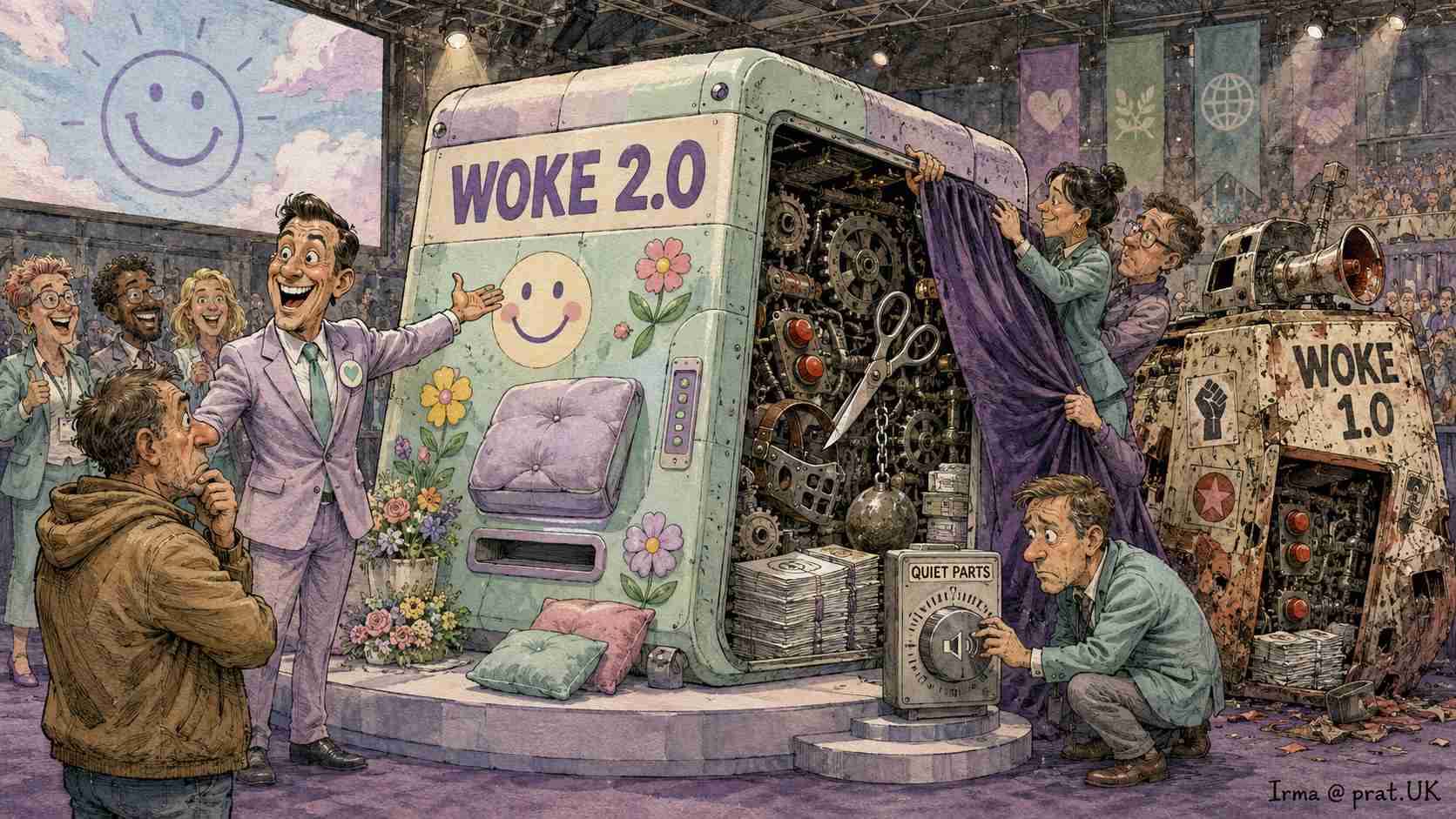
Progressives Promise Woke 2.0 Has Learned From Every Mistake of Woke 1.0, Beginning With the Mistake of Saying the Quiet Parts Out Loud
New progressive upgrade reportedly keeps the operating system while deleting several politically inconvenient desktop icons
WASHINGTON, D.C.
The American progressive movement is preparing to roll out Woke 2.0, a sweeping ideological software update designed to correct the principal defect discovered in Woke 1.0: ordinary voters occasionally understood what activists were saying.
The Great Progressive Rebranding Campaign
The rebranding arrives amid a real debate on the political left over the rhetoric and tactics associated with the 2020-era progressive movement. Rep. Alexandria Ocasio-Cortez recently repeated the phrase “Woke 1 was crazy” while discussing earlier rhetoric around policing, and even sympathetic outlets have examined whether progressives are abandoning unpopular language without necessarily abandoning the underlying goals. Fox News characterized the episode as an attempt by AOC to distance herself from the earlier era, while Vox described a broader shift away from identity-heavy rhetoric toward economic and class-based appeals.
In other words, the revolution has hired a branding agency.
15 Early Warning Signs That Political Language Is Getting a Corporate Makeover
Woke 2.0 will no longer demand that you “check your privilege.” It will simply send you an Outlook invitation titled “Optional Mandatory Personal Context Review.”
“Defund the Police” becomes strategic obfuscation. The phrase will transform into “Community-Centered Public-Safety Resource Rebalancing,” because apparently crime becomes less frightening when the budget cuts have six syllables.
Cancel culture will disappear completely. Anyone claiming otherwise will immediately undergo a Consequence-Based Community Reputation Management Process and vanish from LinkedIn by Thursday.
DEI will no longer be called DEI. Consultants will spend approximately $14 billion deciding that the safest replacement acronym is DEI, but pronounced differently.
Nobody will be called a socialist. They will become market-curious public ownership enthusiasts.
Reparations gets a financial makeover. They will become historical account reconciliation, which sounds less like politics and more like something your accountant discovers shortly before refusing to return your calls.
“Equity” will survive. But only after being placed inside the phrase “broad-based opportunity architecture.”
No organization will abolish anything anymore. It will transition existing structures toward noncontinued operational status.
The word “problematic” gets the axe. It will be retired because it became problematic.
Progressive messaging shifts to economic appeals. Woke 2.0 will focus heavily on affordability, primarily because consultants discovered Americans become unusually attentive when they cannot afford groceries.
Every policy comes with built-in plausible deniability. Each will come with a moderate name, a progressive objective and a 73-page glossary explaining why you misunderstood both.
Accountability now requires “intervention.” Activists will stop telling voters that disagreement constitutes harm. Instead, disagreement will constitute an opportunity for guided accountability intervention, after which you will apologize anyway.
Corporate HR absorbs activist language. College terminology will be eliminated from campaigns and transferred directly into corporate HR departments, where nobody can escape.
Radical becomes moderate through strategic framing. Politicians will no longer say the country needs radical transformation. They will announce commonsense modernization, generally followed by radical transformation.
Euphemism achieves corporate efficiency. Most importantly, Woke 2.0 will never make the mistake of Woke 1.0 by saying what it means in fewer than 40 words.
Same Operating System, New Logo and Corporate Marketing Strategy
According to people who have spent the last six years discovering that elections contain voters, Woke 2.0 represents the greatest technological achievement in progressive politics since someone figured out how to put “justice” after virtually any noun.
Climate justice. Housing justice. Transportation justice. Food justice. Parking justice.
Eventually somebody at a nonprofit is going to announce Justice Justice, thereby achieving ideological nuclear fusion.
The Woke 2.0 demonstration reportedly resembles an Apple product launch. A progressive consultant in minimalist glasses walks onto a stage beneath a giant screen.
“Today,” she announces, “we’re changing everything.”
The audience gasps.
A slide appears:
DEFUND THE POLICE
She clicks.
It disappears.
The crowd erupts.
She clicks again.
COMMUNITY-CENTERED PUBLIC-SAFETY RESOURCE REBALANCING
Same folder. Same file. New filename.
The Fatal Flaw of Political Transparency
The central lesson of Woke 1.0 appears to be that political movements should never underestimate the danger of communicating clearly.
“Defund the police” had a terrible defect as political language: it contained a verb, an object and a discernible meaning. That was reckless.
People heard “defund the police” and concluded that perhaps somebody wanted to defund the police.
Fortunately, Woke 2.0 has solved this with terminology so padded that a voter can fall down three flights of rhetoric without suffering an identifiable policy position.
Police departments will no longer lose money. They will experience alternative fiscal prioritization.
Prisons will not close. They will undergo carceral footprint reduction.
Borders will not disappear. They will become geographically inclusive arrival experiences.
Taxes will not rise. Citizens will participate in enhanced compulsory prosperity sharing.
This is the beauty of Woke 2.0. By the time you determine what happened, the focus group has ended.
Radical Policies Now Available in Moderate Packaging
The manufacturers of Woke 2.0 reportedly studied one of civilization’s greatest inventions: the food label.
Nobody buys “industrial corn syrup paste.” Call it a breakfast bar.
Nobody orders “cow muscle heated over flame.” Call it filet mignon.
And nobody campaigns on “we intend to substantially restructure institutions you currently depend upon.” Call it building a fairer future for working families.
That phrase can mean anything. Lower taxes? Working families. Higher taxes? Working families. Nationalize the electric company? Working families. Sell the electric company to Norway? Still working families.
Political consultants have discovered that “working families” is the WD-40 of American campaigning. Spray it on any policy and suddenly the hinges stop squeaking.
How Version Numbers Provide Moral Dry Cleaning for Political Movements
The phrase “Woke 1” itself is magnificent because adding a version number performs moral dry cleaning.
Nobody has to say, “We were wrong.”
They can say, “That was Version 1.”
Windows Vista wasn’t a catastrophe. It was part of the journey.
New Coke wasn’t a mistake. It was beverage beta testing.
The Hindenburg? Aviation 1.0.
This is why “Woke 1 was crazy” has such enormous political potential. It separates yesterday’s activist from today’s candidate by almost 24 hours.
Vox notes that some progressives using the “Woke 1” label are not necessarily repudiating racial justice or broader progressive objectives. The argument is often that certain tactics, rhetoric and sweeping identity-based language proved divisive or electorally counterproductive.
Which means Woke 2.0 may contain 100 percent of the original ingredients with 40 percent less vocabulary.
Coca-Cola should be furious it didn’t think of this.
Finding Hidden Features in Progressive Campaign Messaging
Under Woke 2.0, users who wish to locate “Defund the Police” must open Settings, select Social Justice, click Institutional Transformation, accept the Community Safety Terms of Service and scroll past 46 paragraphs explaining that “defund” never actually meant defund except on the occasions when proponents explicitly said it did.
At the bottom is a tiny checkbox:
☐ Reimagine traditional public-safety funding paradigms
There it is. Police unions are reportedly hiring teenagers to locate the setting.
The Rebranding of Accountability as Corporate Process
Good news: Woke 2.0 officially abolishes cancel culture.
Bad news: saying “cancel culture” is now considered an outdated framing that perpetuates harmful narratives surrounding accountability ecosystems.
So there is no cancel culture. There is merely a process in which you say something, thousands of strangers demand your employer fire you, your professional association denounces you and your speaking engagement disappears.
Totally different.
Cancel culture had terrible branding. Consequence-Based Community Reputation Management sounds like something Deloitte charges $780 an hour to explain.
An employee entering Woke 2.0 HR will no longer hear, “You’re fired.” That language is unnecessarily adversarial.
Instead: “Your continuing presence is no longer aligned with our evolving belonging architecture.”
“What does that mean?”
“Security has your belongings.”
Corporate Diversity Programs Upgrade to Version 2.0
Corporate America has already demonstrated an astonishing ability to rename things whenever the old terminology attracts legal, political or public scrutiny. Woke 2.0 merely industrializes the process.
DEI becomes Definitely Entirely Inclusive. Equity becomes opportunity optimization. Quotas become representation aspirations with numerical enthusiasm. Mandatory training becomes voluntary education required for continued employment.
The average worker will eventually require a linguistics degree merely to discover whether the Wednesday seminar has lunch.
The Strategic Advantage of Never Answering Direct Questions
Woke 1.0 activists occasionally committed the amateur mistake of answering questions.
Woke 2.0 candidates will not.
“Do you support abolishing the police?”
“I support safe communities.”
“So no?”
“I support communities in which safety is centered.”
“Will there still be police?”
“Every family deserves dignity.”
“Yes, but police?”
“My opponent is trying to divide us.”
Within four minutes, everyone has forgotten there was a police department.
This is not evasion. It is narrative sustainability.
The Complete Noun Transformation Protocol
Political language has always involved euphemism, but Woke 2.0 turns euphemism into competitive gymnastics.
A simple noun enters headquarters wearing jeans and comes out three hours later with a graduate degree.
Illegal immigrant becomes undocumented migrant becomes newcomer.
Spending becomes investment. Government program becomes public solution. Bureaucracy becomes infrastructure. Activist becomes organizer. Loss becomes transition. Failure becomes conversation. Election defeat becomes an opportunity to deepen community engagement.
At this rate, death itself will soon be described as long-term participation reduction.
Understanding the 900-Page Manual Proving Woke Is Finished
Democrats will assure Americans that nobody talks this way anymore.
This assurance will be contained in a 900-page PDF titled: “Moving Beyond Woke: An Intersectional Framework for Post-Terminological Equity-Centered Democratic Narrative Transformation”
Page one says: “Please do not use the word woke.”
Pages two through 899 explain why.
Page 900 is blank because silence creates space.
Political scientists will debate the document for decades before discovering it was originally an email.
The Workplace Revolution Through Terminology Replacement
The greatest achievement of Woke 2.0 may occur in the workplace. Nobody will ever again be offended, disciplined, excluded, downgraded, transferred or fired.
They will merely experience belonging transitions.
Imagine the conversation.
“Gary, your position has been eliminated.”
“I’m being laid off?”
“We reject deficit-oriented terminology.”
“Do I still have a job?”
“We prefer to say your employment journey is entering an externally compensated phase.”
“So I’m fired.”
“Gary, this resistance is precisely why your journey is entering an externally compensated phase.”
The security guard then performs a workspace departure facilitation.
The Ultimate Achievement of Obscuring Policy Through Language
For all the parody, the underlying political strategy is hardly unique to progressives. Political parties have renamed unpopular ideas since the first caveman proposed raising the mammoth tax.
Republicans rename things. Democrats rename things. Corporations rename layoffs. Universities rename departments. Governments rename wars. Your cable company renames a price increase “new plan benefits.”
Human civilization may simply be one long effort to discover a pleasant phrase for something people dislike.
But Woke 2.0 could represent the Sistine Chapel of euphemism.
Its genius is not abandoning anything. Its genius is making you spend 45 minutes determining what is being proposed.
Woke 1.0 marched into the room carrying a megaphone.
Woke 2.0 arrives carrying a PowerPoint presentation, a consultant and a QR code.
Woke 1.0 shouted, “Defund the police!”
Woke 2.0 says, “We invite stakeholders to participate in a community-centered exploration of alternative public-safety resource allocations.”
The police officer raises his hand.
“Do I still get paid?”
The consultant smiles.
“Thank you for beginning this important conversation.”
And somewhere in America, a political strategist closes a laptop and whispers:
“Perfect. Nobody knows what we said.”
Disclaimer
This is political satire examining campaign language, euphemism, ideological rebranding and the remarkable human ability to replace one controversial phrase with six less comprehensible ones. References to the contemporary “Woke 1” debate are grounded in current reporting from Vox, Fox News, and statements by Rep. Alexandria Ocasio-Cortez; the comic institutions, corporate jargon and absurd scenarios are satire. This story is entirely a human collaboration between two sentient beings: the world’s oldest tenured professor and a philosophy major turned dairy farmer. No focus groups were harmed, although several nouns have requested legal counsel.