

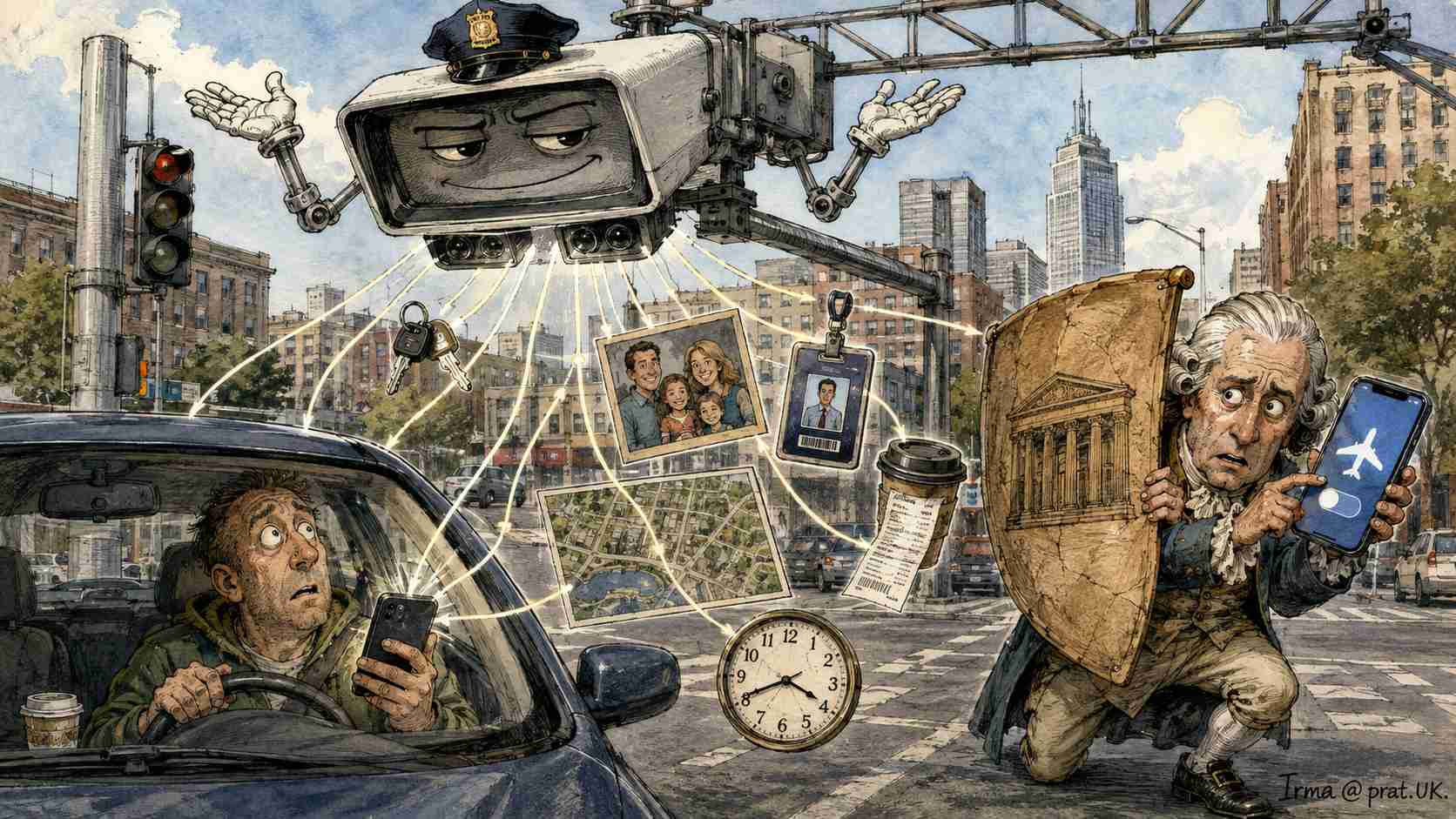
License Plate Readers Can Now Track Your Phone, Fourth Amendment Quietly Switches to Airplane Mode
Police Camera Says It Doesn’t Identify People, Merely Knows Their Car, Phone, Friends, Home and Daily Routine
Oxon Hill, Maryland
According to a report on the new SignalTrace surveillance system, roadside technology can associate license plates with electronic signals broadcast by nearby phones, smartwatches and other devices. Its manufacturer says the system does not identify people; it merely collects recurring electronic signatures and connects them to vehicles, locations and one another—which is reassuring in the same way a burglar saying he never learned your name is reassuring.
The Camera That Knows Everything Except Your Name
OXON HILL, MARYLAND—America’s roadside surveillance network has reportedly learned how to detect the electronic signals accompanying vehicles, allowing investigators to associate cars with phones, watches and other wireless devices while maintaining the comforting legal position that nobody is being identified until somebody identifies them.
SignalTrace, marketed by the security company Leonardo, is designed to operate alongside automatic license-plate readers. It can recognize groups of consumer devices that repeatedly travel together, associate those patterns with vehicles and search for them later—even when an investigator does not know the license plate.
The system’s explanatory material says it “does not identify people.” This is technically true in the same way that a detective who follows you home, photographs your family, records your commute and searches your rubbish may still not know whether you prefer “Robert” or “Bob.”
“We do not identify Mr. Robert Jenkins of 814 Maple Street,” explained a fictional surveillance spokesman standing beside a screen labeled ROBERT JENKINS—814 MAPLE STREET. “We merely observe that Electronic Signature 7F:93 travels every morning in a Honda registered to Robert Jenkins, spends every night at 814 Maple Street and visits Robert Jenkins’s dentist twice a year.”
When asked whether Electronic Signature 7F:93 might therefore be Robert Jenkins, the spokesman said such reckless speculation demonstrates why ordinary citizens cannot be trusted with surveillance technology.
SignalTrace Collects Only Completely Identifiable Anonymous Data
Defenders of the technology emphasize that an electronic signature is not necessarily a person’s legal identity. A roadside sensor does not automatically receive a device owner’s name simply because it detects Bluetooth or another wireless signal.
Critics respond that anonymity becomes rather decorative when an electronic signature repeatedly appears beside one registered vehicle, outside one residence and beside the same family of devices.
Research published in Scientific Reports found that only four time-and-place points were sufficient to distinguish 95 percent of individuals in a large mobility dataset. The research did not test SignalTrace, but it illustrates a broader principle: people’s movements are often as distinctive as fingerprints, only with more stops at Taco Bell.
This means the government may not know your name initially. It merely knows you leave one particular house each morning, enter one particular car, travel to one particular office and return to the same house at night.
At that point, discovering your identity requires investigative resources roughly equivalent to opening the glove compartment.
“Our technology protects anonymity,” the fictional spokesman continued. “It reduces every citizen to a unique, persistent and searchable electronic profile that can be connected to known records. You cannot get much more anonymous than being the only possible person.”
Your Smartwatch Has Joined Law Enforcement
The arrival of device-tracking license-plate readers also represents a dramatic change in the relationship between Americans and their gadgets.
Until now, a smartwatch’s principal duty was to inform its owner that he had failed to walk around enough. It was a tiny wrist-mounted fitness critic, endlessly disappointed that purchasing it had not transformed a middle-aged accountant into an Olympic decathlete.
Now it may serve a second function: establishing that the accountant was inside Gary’s Buick on the evening Gary allegedly stole six patio chairs.
Gary insists the accountant was not present. The Buick insists otherwise. The phone remembers the route. The watch confirms the proximity. The patio chairs have declined to comment pending representation.
Privacy scholar Dr. Lenora Blindsworth, a wholly satirical authority at the Institute for Things Everyone Already Suspected, described the development as “a fundamental realignment of constitutional rights.”
“The citizen once had the right to remain silent,” she said. “Unfortunately, his phone, watch, car, headphones and Bluetooth-enabled blood-pressure monitor have formed a separate legal strategy.”
According to Blindsworth, the average American now carries seven devices capable of betraying him and twelve charging cables incapable of fitting any of them.
Carpooling Becomes Probable Cause With Cupholders
SignalTrace can reportedly recognize groups of devices that regularly move together. This could help investigators detect patterns, but proximity does not necessarily explain relationships or conduct.
A recurring cluster might represent a family, coworkers sharing a commute, passengers on a bus or four people who all happen to hate paying airport parking fees.
The technology can observe that devices are close. It cannot automatically know why.
Nevertheless, police attention can be influenced before identities or explanations are established. A passenger may become interesting because his phone repeatedly appears beside another device associated with an investigation.
Thus, carpooling—once promoted as an environmentally responsible activity—has evolved into conspiracy with lumbar support.
The Department of Transportation is expected to replace roadside signs reading SHARE THE RIDE with EVERY ADDITIONAL PASSENGER CREATES A SEARCHABLE ASSOCIATION.
One commuter said she immediately resigned from her office carpool after learning the implications.
“I’ve ridden with Diane for nine years,” said Oxon Hill bookkeeper Marcy Bell. “I thought she was an assistant purchasing manager. Now I realize I have no independent way to prove that.”
Diane said she was hurt by the accusation but understood Marcy’s position.
“I would defend her,” she said, “except her phone was near mine 1,847 times, which admittedly looks organized.”
Supreme Court Discovers Phones Contain Personal Information
The United States Supreme Court has previously recognized that records revealing a person’s movements can raise Fourth Amendment concerns.
In Carpenter v. United States, the Court held that obtaining historical cell-site location information constituted a search requiring constitutional protection. More recently, the reported analysis discusses Chatrie v. United States, involving anonymized location information that investigators narrowed until actual users could be identified.
The legal challenge is obvious. Traditional rules imagine that police begin with a suspect and investigate that person. Newer systems may begin with patterns—devices, routes, associations and recurring proximity—and work backward until a suspect emerges.
It is the difference between saying, “We think Charlie committed a crime, so let us follow Charlie,” and saying, “Let us follow everybody until one of them becomes Charlie.”
Constitutional attorney Marvin P. Habeas offered a concise assessment while wrapping his phone in foil and placing it inside a biscuit tin.
“The Fourth Amendment protects people against unreasonable searches,” he said. “Modern surveillance solves that inconvenience by temporarily pretending there are no people.”
Habeas added that the Founders never mentioned Bluetooth, automatic license-plate readers or radio-frequency identification.
“They also never mentioned helicopters, DNA databases or TikTok,” he said. “Yet somehow we did not conclude that James Madison wanted the government reading teenagers’ direct messages.”
Police Promise System Will Only Develop Leads
Law-enforcement supporters are likely to argue that SignalTrace does not determine guilt. It creates investigative leads that must be corroborated using traditional methods.
That distinction matters. A recurring device signal may be useful, but it is not proof that a particular person carried the device, drove the vehicle or participated in criminal activity.
Phones are borrowed. Watches are forgotten. Devices remain in cars. Signals can be detected near vehicles without being inside them. Teenagers leave phones everywhere except the one place their parents told them to put them.
A machine may accurately determine that a phone travelled with a vehicle. It cannot determine whether the phone belonged to the driver, a passenger, a mechanic, a child or a kidnapped DoorDash order.
Police officials insist trained investigators understand these limitations.
“We never blindly accept what technology tells us,” said fictional Deputy Commissioner Hal Aperture. “First the computer generates a lead. Then an officer examines the lead. Then another computer creates a chart proving the first computer was right.”
A departmental review found that human judgment remained firmly involved throughout the process, primarily to click “CONFIRM.”
America Chooses Between Crime and Curtains
Supporters of expanded surveillance frequently present the debate as a choice between catching criminals and allowing civilization to dissolve into a lawless parking structure.
Opponents are then asked why they want murderers to escape merely to protect some selfish personal preference known as constitutional liberty.
This is a false dilemma. Technology can support legitimate investigations while still being subject to warrants, retention limits, audits, disclosure requirements and restrictions on bulk collection.
But careful regulation is difficult. It requires legislators to understand Bluetooth, databases and the difference between “anonymous” and “nobody has typed the name yet.”
Congress has therefore announced a bipartisan commission to study the issue immediately after completing its 19-year investigation into printer settings.
A preliminary poll conducted by the fictitious Pew-Pew Research Center found that 78 percent of Americans oppose pervasive electronic surveillance, while 82 percent support it when described as “a tool for catching whichever people frighten you personally.”
The remaining respondents were unable to participate because their phones had already answered for them.
Helpful Advice for the Newly Trackable Citizen
Motorists concerned about privacy should begin by understanding what their devices broadcast and reviewing Bluetooth and wireless settings. Turning off unnecessary connections may reduce exposure, although it cannot guarantee invisibility and may prevent the car stereo from automatically playing the same podcast episode for the seventeenth time.
Citizens can also ask local governments what surveillance equipment is deployed, how long information is retained, who can search it and whether data is shared with other agencies. Public oversight is especially important because a system advertised for serious investigations today can become tomorrow’s convenient method for locating unpaid parking tickets, political demonstrators or the mayor’s missing leaf blower.
Most importantly, Americans should reject the idea that concern about surveillance implies guilt.
Privacy is not the desire to conceal wrongdoing. Sometimes it is merely the reasonable wish to visit a doughnut shop without creating a permanent, searchable relationship between oneself, a Honda Civic and three glazed old-fashioneds.
SignalTrace may not initially attach a human name to every electronic pattern. But if the system can recognize a device, follow its movements, associate it with a vehicle and connect it to other people, the central question is no longer whether the data contains a name.
The question is whether the name remains meaningfully hidden.
America’s roadside cameras have already supplied their answer.
They do not see citizens.
They merely see everything citizens do.
Fifteen Observations From the Newly Anonymous America
- SignalTrace does not know who you are. It only knows where you live, what you drive and which phone sleeps beside you.
- The government has finally discovered a privacy policy it likes: your privacy is protected until the information becomes useful.
- A license plate reader used to read license plates. Apparently that lacked ambition.
- Your smartwatch can now testify against you, despite spending most of Tuesday congratulating you for standing up.
- Police cameras promise not to identify humans, only the electronic ecosystem surrounding each human.
- The system treats passengers as anonymous signals, much as airlines treat them as anonymous wallets.
- Carpooling has become an informal conspiracy assembled every weekday at 7:45 a.m.
- A borrowed phone can implicate the borrower, owner, driver and whichever cousin forgot it under the seat.
- The Fourth Amendment was written before Bluetooth, so naturally Bluetooth wins.
- The system can recognize your car without seeing its plate, making vehicle registration feel like an unnecessary confession.
- Investigators may infer friendships from repeated proximity, which means marriage can finally be proved scientifically.
- Anonymous data stops being anonymous the moment it is combined with all the other anonymous data bearing your unmistakable life story.
- Surveillance firms call this “developing leads,” because “digitally following strangers until something looks suspicious” tested poorly with consumers.
- Cameras can track millions of innocent people but remain unable to determine who abandoned a shopping trolley behind the supermarket.
- America has reached the stage where your toaster is two firmware updates away from becoming a confidential informant.
Disclaimer: This satire concerns surveillance technology, constitutional privacy and the comforting modern belief that information remains anonymous until a database finishes loading. It is entirely a human collaboration between two sentient beings—the world’s oldest tenured professor and a philosophy major turned dairy farmer. Any resemblance to a functioning privacy policy is purely coincidental.
Source: TechSpot — License Plate Readers Can Now Track Phone