

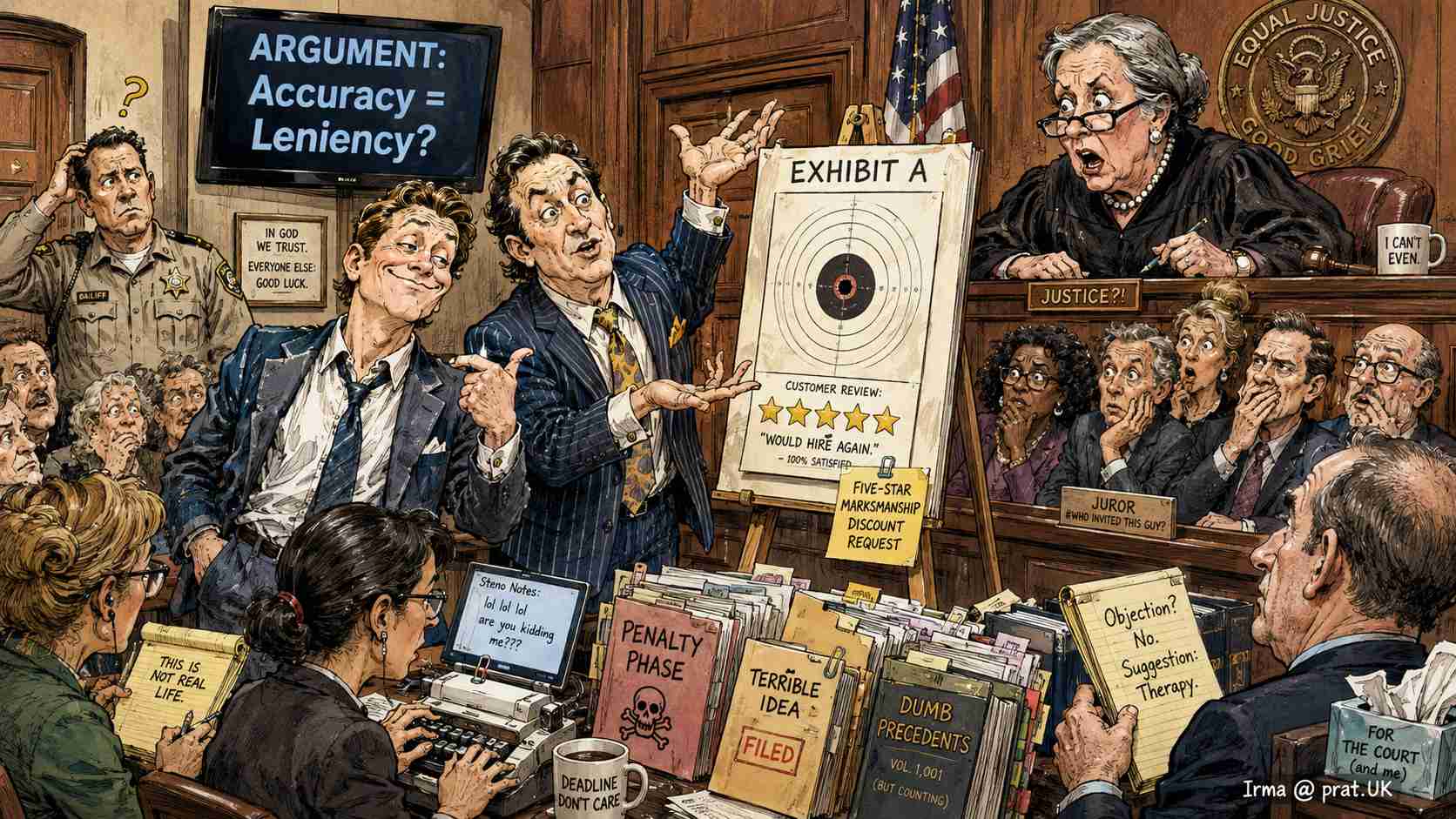
Accused Charlie Kirk Killer Says He Should Avoid Death Penalty Because Bullet Hit Only Intended Target, Requests Five-Star Marksmanship Discount
Tyler Robinson’s Lawyers Argue Crowd Was Never in Danger Because Alleged Assassin Was Apparently Too Accurate to Be Aggravating
OREM, Utah — Attorneys for Tyler Robinson, the man accused of fatally shooting conservative activist Charlie Kirk, are arguing that Robinson should avoid the death penalty because the bullet allegedly passed above the surrounding crowd and struck only its intended target, according to court filings reported by the New York Post.
The defense has therefore introduced American jurisprudence to an exciting new concept: the Five-Star Marksmanship Discount.
Under the proposed arrangement, a defendant accused of firing a rifle at a human being during a crowded public event could receive sentencing points for accuracy, ammunition conservation and not accidentally killing anyone standing slightly to the left.
“It is important to distinguish reckless public gunfire from premium, precision-guided public gunfire,” explained one courthouse observer. “One is a menace to society. The other apparently qualifies for a favorable customer review.”
Robinson has been charged with aggravated murder and other offenses but has not entered a plea. Prosecutors are seeking the death penalty, while his attorneys dispute whether the evidence establishes an aggravating factor required under Utah Code § 76-5-202: knowingly creating a great risk of death to people besides the alleged intended victim.
Defense attorneys reportedly argue that the fatal bullet traveled above the crowd, rather than through it, and that there is no evidence Robinson believed he would miss.
In ordinary English, this translates roughly as: “Yes, there were thousands of people nearby, but our client was feeling unusually confident.”
Confidence Is Now Protective Equipment
The legal argument has stunned Americans who had previously believed that firing a rifle toward a crowded university event was inherently dangerous.
That outdated belief arose during the primitive era when the public judged risk by what a person did. Modern legal thinking asks a more sophisticated question: How optimistic was he while doing it?
If a man throws a refrigerator from a tenth-floor balcony, for example, prosecutors might say he endangered pedestrians. But what if he sincerely believed it would land in an empty parking space?
Suddenly, it is no longer reckless endangerment. It is appliance delivery with a positive attitude.
The same principle could revolutionize traffic law.
A motorist traveling 110 miles per hour through a school zone could explain that he never expected to hit a child because he considers himself an excellent driver. A drunk pilot could point out that the aircraft arrived at the intended airport. A surgeon operating with barbecue tongs could demand professional recognition because only the correct organ was removed.
“At some point, results must count for something,” said Marvin Clutch, a self-appointed legal analyst who earned his law degree by watching courtroom dramas while assembling patio furniture. “If recklessness ends exactly where the defendant hoped it would end, was it really reckless? I’m not saying yes or no. I’m saying my podcast launches Thursday.”
The theory could also establish the first criminal-defense rewards programme.
Hit no unintended targets and receive twenty percent off aggravating factors. Bring your own rifle and receive complimentary parking. Collect ten constitutional crises and the eleventh is reviewed without cameras.
The Other Three Bullets Were Apparently Emotional-Support Ammunition
Prosecutors reportedly note that Robinson allegedly loaded four rounds into the rifle, which they say supports an inference that he understood he might miss and need additional shots.
The defense counters that it is just as likely the shooter did not believe he would miss.
This leaves the court with an intriguing mystery: Why would an allegedly supremely confident marksman load four rounds?
Perhaps the remaining cartridges were decorative.
Perhaps they were there for morale.
Every first bullet deserves to know that three colleagues believe in it.
Gun owners traditionally call this a magazine. The defense may soon call it a workplace-support network.
“The additional ammunition proves nothing,” said Dale Buckminster, an eyewitness who was not present at the event but has studied the case extensively through people arguing beneath online videos. “When I pack four sandwiches for a journey, I don’t expect the first three to miss my mouth.”
Buckminster’s analogy was immediately accepted by several strangers with eagle avatars and rejected by several others whose profile pictures appeared to be photographs of motorcycles they do not own.
A snap courthouse poll found that 82 percent of respondents believed loading four bullets suggested anticipation of possibly needing more than one. The other 18 percent were defense attorneys, ammunition retailers and one man who thought the question concerned a loyalty programme at Bass Pro Shops.
Murder Law Meets Customer-Service Logic
The argument carries the reassuring spirit of an airline apology.
“We regret that one passenger experienced a fatal disruption. However, the remaining 3,000 attendees reached the conclusion of the incident without being shot.”
It is also the sort of reasoning used by restaurants defending food poisoning: only the customer who ordered the prawns became ill, demonstrating a remarkably focused bacterial event.
If adopted nationally, the doctrine could transform aggravating circumstances into performance metrics. Prosecutors would no longer ask whether the accused created extraordinary danger. They would submit a scorecard covering grouping, trajectory, wind adjustment and bystander satisfaction.
Judges might announce sentences like Olympic results.
“Premeditation: 9.4. Political motive: 9.7. Crowd exposure: under review. Accuracy: exceptional. Overall penalty reduced after the Romanian judge awarded an inexplicable 6.2.”
The National Association of Imaginary Sentencing Consultants has already proposed a medal ceremony. Bronze would go to defendants who missed everyone. Silver would go to those who hit only property. Gold would be reserved for a fatal shot so precise that defense counsel could describe the surrounding crowd as beneficiaries of professional restraint.
A Crowd of Thousands Becomes Legally Invisible
The deeper absurdity is that the argument asks the court to evaluate danger retrospectively.
Because the bullet did not strike someone else, the defense says the required risk to others has not been established. It is the legal equivalent of saying Russian roulette was safe because the first chamber was empty.
Risk, however, is not the same as outcome. Driving blindfolded through a playground does not become prudent because every child happened to jump away. A falling piano does not become harmless because it lands on the particular person toward whom it was pushed.
Yet hindsight possesses magical powers in court. Once an event is over, every disaster begins to look like a carefully managed success with one regrettable fatality.
Government officials responded by reaffirming their commitment to the ancient Utah principle that pointing rifles toward public gatherings remains generally discouraged, even when performed by someone who has confidence in his abilities.
“We urge residents not to test this doctrine independently,” an imaginary public-safety spokesman said. “The state does not issue accuracy coupons, and aggravating factors cannot be redeemed for sporting goods.”
Political Violence Apparently Comes With Technical Specifications
Prosecutors also allege that Robinson targeted Kirk because of his political views, an accusation that could affect sentencing, an argument bolstered by legal analysis of Utah’s aggravating-circumstance statute. The defense has challenged the prosecution’s interpretation of motive evidence, and the disputed facts will ultimately be addressed through the judicial process.
That process matters because political assassination is not merely a disagreement conducted at rifle velocity.
A democratic society depends on the assumption that people may speak publicly without someone in the distance deciding to provide a ballistic rebuttal. Once murder becomes a form of commentary, every debate requires sandbags, every lecture needs counter-snipers and every campus question-and-answer session begins with a wind-speed calculation.
Kirk was speaking at a public event when he was killed. Thousands had assembled to hear political arguments, not participate involuntarily in a live-fire demonstration of viewpoint diversity.
The defense is entitled to test every element of the prosecution’s case. That is not a loophole; it is one of the foundations of due process. Prosecutors must prove the charges and any aggravating circumstances under Utah’s capital sentencing process. Robinson remains legally presumed innocent unless convicted.
But a lawful right to make an argument does not prevent the argument from sounding as though it was developed by an insurance company trying to deny a claim.
“Your husband’s death is excluded under the policy because the projectile reached its scheduled destination without an unauthorized stop.”
America Awaits the Yelp Review
The judge must now consider legal standards, evidence and competing interpretations rather than the nation’s emotional temperature. This is sensible, although it disappoints television panels that prefer every criminal proceeding to operate like a game show hosted by outrage.
If the defense succeeds, future law-school textbooks may commemorate the Robinson Accuracy Exception: the proposition that a defendant who allegedly fires toward a crowd should receive legal consideration when the bullet performs exactly as instructed.
If it fails, the justice system will return to the old-fashioned assumption that bringing a loaded rifle to a crowded political gathering and allegedly firing it at a speaker might create a serious risk, even without collateral casualties — a risk-to-bystanders theory that is, per Axios’s review of Utah capital case history, a rarely used aggravator in the state’s past 50 years of executions.
Until then, the Five-Star Marksmanship Discount remains pending.
No points have been awarded.
No complimentary upgrade has been approved.
And the court has not yet accepted “I was certain I wouldn’t miss” as a substitute for public safety.
Disclaimer
This is satire concerning allegations in an unresolved criminal case. Tyler Robinson is presumed innocent unless and until proven guilty, and the court—not comedians, commentators or men conducting constitutional analysis beside a gun-shop vending machine—will determine the facts and applicable punishment. This story is entirely a human collaboration between two sentient beings: the world’s oldest tenured professor and a philosophy major turned dairy farmer.