

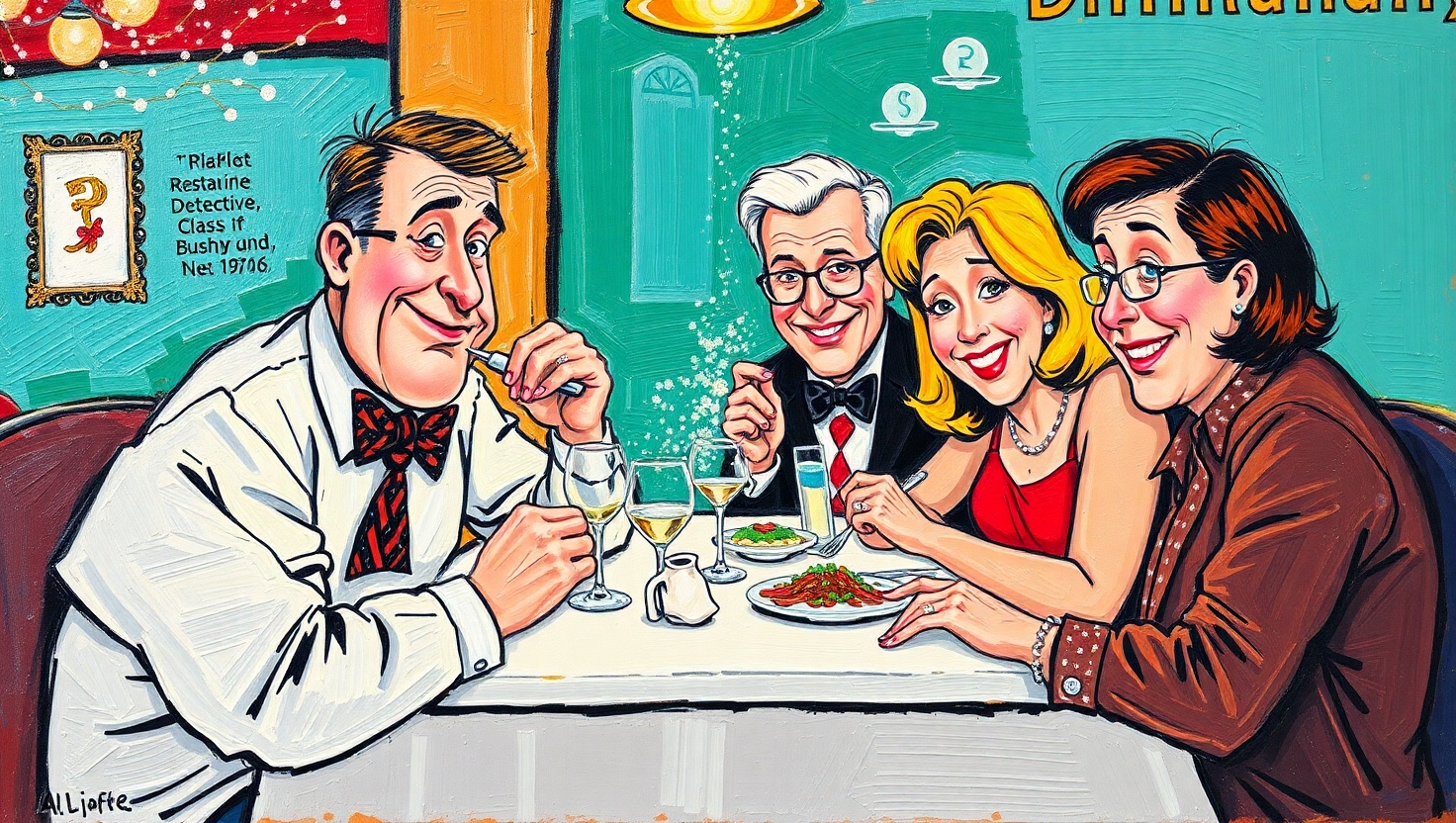
The Great Restaurant Class Detective: How to Spot the Unworthy Diners Among Us
Breaking: Local Food Critics Discover Revolutionary Method to Judge Human Worth by Fork Technique
In a stunning development that absolutely no one asked for, VegOut Magazine has cracked the code on humanity’s most pressing issue: determining someone’s socioeconomic background based on their restaurant behavior. Because apparently, we’ve solved world hunger, climate change, and healthcare, so now we can focus on the real crisis—people who dare to complain about $25 burgers.
Jerry Seinfeld once observed, “You know what I love about restaurants? Everyone’s an expert. ‘This soup is too salty.’ Oh really? Did you go to soup college?” Well Jerry, apparently some people actually did attend Soup College, and they’ve graduated with degrees in Advanced People-Watching and Class Categorization.
The Scientific Method of Social Superiority
The groundbreaking research methodology appears to involve sitting in restaurants with a notepad, furiously scribbling observations about fellow diners like some sort of anthropological David Attenborough: “Here we observe the lower-middle-class male in his natural habitat, awkwardly calculating tips while his mating ritual involves ordering the largest available protein.”
Amy Schumer hit the nail on the head when she said, “I’m not a foodie. I’m just someone who likes to eat food. I don’t need to Instagram my salad.” But according to our new class-detection system, your entire genealogy can be determined by whether you photograph your appetizer or simply eat it like some sort of barbaric peasant.
The Price Complaint Phenomenon: A National Emergency
Apparently, expressing shock at paying $8 for a beer immediately brands you as lower-middle-class. This revelation will surely devastate millions of Americans who foolishly believed that noticing when they’re being financially violated was a basic human right. The sophisticated response, we’re told, is to smile serenely while being charged $15 for what is essentially flavored water with bubbles.
Ron White perfectly captured this mentality: “I believe that if life gives you lemons, you should make lemonade… And try to find somebody whose life has given them vodka, and have a party.” But our restaurant behaviorists would probably analyze White’s vodka preference as indicative of his rural Texas upbringing, missing the point entirely.
The new etiquette demands that truly classy individuals absorb price shock internally, like sophisticated human sponges soaking up financial pain. Expressing displeasure at being charged mortgage-payment prices for casual dining is apparently the modern equivalent of showing up in flip-flops to the Met Gala.
The Tipping Trapeze: A High-Wire Act of Social Judgment
The article’s analysis of tipping behavior reads like a sociological Catch-22. Tip too much? You’re overcompensating. Tip too little? You’re cheap. Tip exactly the right amount? You’re probably overthinking it, which is also wrong. It’s like a mathematical equation designed by sadists: there is no correct answer, only varying degrees of social failure.
Dave Chappelle once joked, “The worst thing to call somebody is crazy. It’s dismissive. ‘I don’t understand this person, so they’re crazy.'” The same logic applies here: “I don’t understand this person’s tipping calculation, so they must be lower-middle-class.”
The sophisticated approach, apparently, is to possess some mystical tipping intuition that bypasses all conscious thought. True aristocrats, we’re told, simply know the exact tip amount through genetic memory passed down from generations of restaurant-going ancestors.
The Steak Supremacy Complex
Ordering “the biggest steak you’ve got” has been officially classified as a social crime. This devastating revelation will shock steakhouses nationwide, where countless men have unknowingly revealed their humble origins through protein preference. The sophisticated alternative remains unclear—perhaps whispering seductively about wagyu marbling while making intellectual observations about grass-fed terroir?
Bill Burr addressed this perfectly: “I love when people go, ‘You know what your problem is?’ Oh, you’re gonna sum me up in 30 seconds? Really? I’ve been living with myself for 40 years, but you’ve got me figured out.” Restaurant behavior analysts have apparently mastered this 30-second summation technique.
The implication that meat preference reveals social standing opens fascinating possibilities. Are chicken nugget enthusiasts working-class? Do hot dog lovers represent the proletariat? Is there a secret vegetarian aristocracy we haven’t discovered yet?
Staff Interaction: The Service Industry Rorschach Test
The analysis of how men treat restaurant staff reads like a psychology textbook written by aliens. Being too polite? Social climbing. Being too casual? Showing your roots. Being exactly appropriate? Probably calculating it, which is suspicious. It’s a behavioral minefield where every interaction is evidence of class insecurity.
Chris Rock captured this absurdity: “You know what’s weird about money? Everyone wants it, but nobody wants to look like they want it.” Restaurant etiquette has apparently evolved into an elaborate performance where caring too much or too little about any aspect of dining reveals your unworthiness to participate in civilized society.
The golden mean of staff interaction remains mysterious. Perhaps true sophistication involves communicating with servers through interpretive dance or telepathy.
The Food Return Drama Academy
Sending food back has been elevated to performance art, with some diners apparently treating kitchen mistakes like personal affronts requiring Shakespearean responses. The sophisticated approach involves suffering in elegant silence, because nothing says “upper class” like paying full price for disappointment with a smile.
Jim Gaffigan perfectly summarized restaurant psychology: “You know what’s weird about eating out? You pay someone to cook for you, then you tell them exactly how to do it.” But now we’re told that expressing dissatisfaction with this transaction reveals your social origins like DNA evidence.
The preferred method for handling restaurant errors apparently involves subtle eye contact with the server and perhaps a gentle, aristocratic sigh that conveys disappointment without vulgarity. Think Victorian mourning, but for overcooked salmon.
The Bill Calculation Olympics
Performing mathematics at the dinner table has been declared a class violation. The sophisticated response to receiving a check involves glancing at it with the casual indifference of someone reviewing their morning horoscope. Calculating tips, splitting checks, or showing any awareness of monetary exchange marks you as financially anxious nouveau riche.
Ali Wong nailed the absurdity: “I think about money every day. I wake up and I’m like, ‘Do I have money?’ And then I check my bank account and I’m like, ‘No, but I’m alive.'” But restaurant sophisticates have apparently transcended such pedestrian concerns through sheer force of breeding.
The ideal response to restaurant bills requires developing supernatural confidence in mathematical intuition. True aristocrats simply know what they owe through aristocratic osmosis.
Chain Restaurant Enthusiasm: The Ultimate Social Sin
Expressing genuine appreciation for chain restaurants has been classified as the dining equivalent of wearing socks with sandals. The sophisticated palate, we’re told, can only be satisfied by establishments that require reservations booked during previous geological epochs.
Trevor Noah brilliantly observed: “People love to judge other people’s food choices. ‘Oh, you’re eating at McDonald’s?’ Yes, Karen, sometimes I want food that costs less than my car payment.” But our restaurant anthropologists have determined that chain restaurant appreciation reveals your cultural limitations like a food-based scarlet letter.
The implication that Olive Garden enthusiasm disqualifies you from polite society raises questions about the millions of Americans who apparently failed to receive the memo about breadstick shame.
The Sacred Leftovers Ceremony
Taking restaurant leftovers seriously has been identified as a poverty tell-tale, like hoarding behavior for the dining set. The sophisticated approach involves leaving food uneaten as a display of abundance, because nothing says “successful” like casual waste.
Sarah Silverman captured this perfectly: “I like my coffee how I like myself: dark, bitter, and too hot for you.” But restaurant behaviorists would probably analyze her coffee preferences as revealing her working-class Boston roots rather than her comedic genius.
The leftover stigma creates a fascinating contradiction: environmental consciousness is supposedly sophisticated, but actual food conservation reveals social climbing. It’s virtue signaling without the virtue.
The Psychology of Restaurant Policing
What drives this obsessive categorization of dining behavior? Perhaps it’s the fundamental human need to create hierarchies in environments where traditional status markers aren’t immediately visible. When everyone’s sitting at similar tables eating similar food, behavioral analysis becomes the social sorting mechanism.
Ricky Gervais addressed this tendency: “Just because you’re offended doesn’t mean you’re right.” Restaurant behavior analysis represents the ultimate expression of taking offense at other people’s perfectly reasonable responses to overpriced food and service situations.
The real revelation isn’t about social class—it’s about the desperate need some people have to feel superior through microscopic behavioral analysis. It’s anthropology for people who think they’re too sophisticated for reality television but engage in the same judgmental voyeurism.
The Great Dining Divide
This restaurant behavior guide reveals more about its creators than its subjects. The assumption that certain behaviors are inherently wrong or embarrassing suggests a worldview where authenticity is less valuable than performance, where genuine responses to situations are inferior to calculated sophistication.
Gabriel Iglesias perfectly captured authentic dining: “I’m not fat, I’m fluffy. And fluffy people know good food.” But fluffy people who show food appreciation too enthusiastically apparently reveal their humble origins through enthusiasm itself.
The guide assumes that growing up with financial awareness is something to be hidden rather than honored. It treats resourcefulness as embarrassment and authenticity as social liability.
Beyond the Restaurant Theater
The broader implications extend beyond dining etiquette into fundamental questions about social mobility and authenticity. Are we supposed to shed all evidence of our origins like snakes molting skin? Is successful assimilation complete cultural amnesia?
Louis C.K. observed: “The meal is not over when I’m full. The meal is over when I hate myself.” But restaurant sophisticates have apparently evolved beyond such pedestrian concerns as fullness or value consciousness.
The expectation that upward mobility requires behavioral lobotomy creates a society of social imposters, each performing sophistication while secretly calculating tips and wondering about prices.
The Verdict on Dining Detection
This restaurant behavior analysis represents peak social insecurity disguised as cultural expertise. It’s the dining equivalent of claiming you can determine someone’s intelligence by their shoe choice or their moral character by their parking technique.
The real tragedy is that we’ve turned dining out—one of life’s simple pleasures—into an anthropological minefield where every choice carries sociological weight. Instead of enjoying food and company, we’re all secretly wondering if our breadstick enthusiasm is revealing too much about our childhood grocery budget.
The real sophistication lies in recognizing that human worth isn’t determined by tipping calculations or steak preferences. True class involves treating others with respect regardless of their behavior patterns, price sensitivity, or leftover enthusiasm.
Restaurant behavior policing ultimately reveals more about the observer’s insecurities than the observed’s social status. The desperate need to categorize and judge others’ dining habits suggests a profound anxiety about one’s own social standing masked as cultural authority.
Wanda Sykes summed it up best: “I hate people who think they’re better than other people. But I think I’m better than those people.” At least she’s honest about the contradiction.
Perhaps the most sophisticated response to restaurant behavior policing is simply enjoying your meal, treating staff decently, and saving your anthropological analysis for actual sociological research rather than judgmental dinner entertainment.
After all, we’re all just people trying to eat food without being socially prosecuted for our dining technique. That shouldn’t require a PhD in Restaurant Performance Art.
IMAGE GALLERY
