

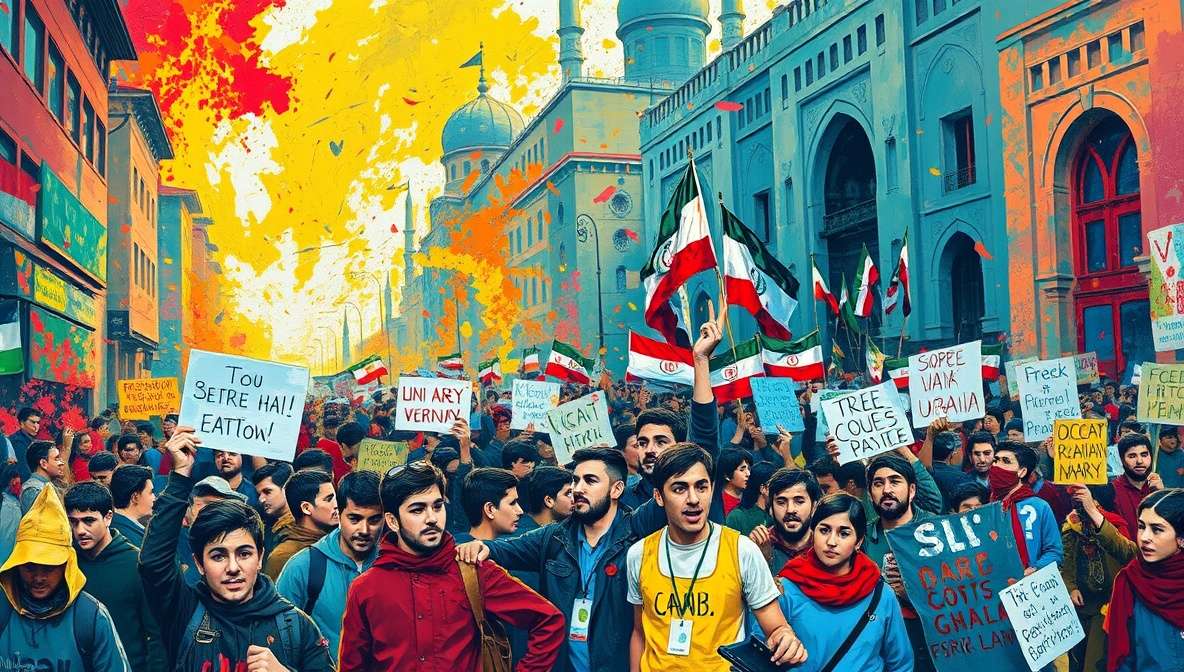
Five Observations About the Khamenei Era and Student Protest Culture
- Students in Iran appear to be the only people in the Middle East who can simultaneously study engineering, dodge tear gas, and chant revolutionary slogans before lunch. Universities there seem less like campuses and more like political boot camps with optional calculus.
- Every Iranian regime announcement seems to follow the same public-relations strategy: deny everything, blame foreigners, then arrest several philosophy majors for “thinking suspicious thoughts.”
- The phrase “Death to the Dictator” has become so common in Iranian student protests that linguists are considering adding it as a required vocabulary word in first-year Persian textbooks.
- Iranian security forces keep storming universities as if they expect to find dangerous weapons inside dorm rooms. What they actually find are half-written dissertations, instant noodles, and students explaining why the revolution would run more efficiently with spreadsheets.
- Student protesters chanting slogans about freedom are apparently terrifying to authoritarian governments everywhere, mainly because nothing scares a dictatorship more than a 19-year-old with Wi-Fi and a political science minor.
Iranian Students Accidentally Discover the Regime Is Unpopular
TEHRAN, IRAN — In what political scientists are calling “the most shocking discovery since gravity,” Iranian university students have reportedly noticed that the government running their country may not be particularly popular with them.

The revelation came after large student demonstrations erupted across multiple universities following a cascade of wartime disasters, economic meltdowns, and the general sense that the Islamic Republic had perhaps not delivered on its original promises of paradise on Earth.
Witnesses say the moment of realization happened gradually.
First, students noticed that food prices had tripled, the currency had collapsed, and security forces kept showing up at campus rallies carrying shields, tear gas, and a very strong opinion about free speech. Then someone looked around and said, “Wait a second… maybe the government isn’t doing a great job.” And just like that, a movement was born.
The Revolutionary Discovery of Campus Economics
Experts say the protests are fueled by a complicated mix of economic collapse, political repression, and the timeless student tradition of realizing adulthood is a scam.
According to reports, the protests that began in late 2025 were triggered partly by soaring inflation and rising food prices that left many families struggling to survive — and by a national currency that declined so dramatically even the government stopped checking the exchange rate out of sheer embarrassment.
For Iranian students, this meant the national economy had reached a dangerous tipping point known academically as “The Ramen Threshold.”
“When noodles become the luxury meal,” explained one anonymous economics professor, “revolution becomes statistically inevitable.”
Campus Life in a Revolutionary Republic
Student life in Iran has evolved dramatically in recent months.
Instead of typical campus events like poetry readings and awkward improv nights, Iranian universities now serve as the primary battleground for anti-government demonstrations, with activities including:
- Anti-government demonstrations
- Tear gas avoidance workshops
- “How to Chant Without Losing Your Voice” seminars
- Guest lectures titled So You’ve Been Arrested: A Beginner’s Guide
Security forces have responded by flooding campuses with officers who reportedly search dorm rooms for illegal materials such as protest signs, satire, and the extremely dangerous political ideology known as “questions.”
The Regime’s Strategic Communications Plan: Arrest Everyone
Government officials insist the unrest is not caused by economic hardship or political repression. Instead, they believe the protests are the result of a sophisticated international conspiracy involving Western intelligence agencies, social media, and possibly Starbucks.
“Our nation is perfectly stable,” said one unnamed government spokesman while standing behind three riot police and a burning campus barricade. “If students are unhappy,” he added, “it is clearly because foreign enemies have convinced them they should want electricity, jobs, and political rights.”
The Science of Student Revolutions and Political Unrest
Political historians note that students have historically been one of the most dangerous groups for authoritarian governments. Why? Because they possess three terrifying tools:
- Free time
- Group chats
- The stubborn belief that the future should belong to them
Iran’s student protests have repeatedly targeted the country’s leadership with chants calling for political change and democracy, echoing earlier waves of protests in recent years. Experts say the regime’s response strategy remains consistent: deny the protests exist, then arrest several hundred people for participating in them.
Eyewitness Testimony From the Revolution
One engineering student described the atmosphere on campus.
“It started with a few people chanting,” he said. “Then everyone joined. Then the police showed up. Then someone livestreamed it. Then suddenly my aunt in Canada was texting me saying I was trending on Twitter.”
Another witness added: “I came to university to study physics. Now I’m studying riot formations.”
The World Reacts to Iran’s Student Uprising
International observers say the protests reveal a generational divide inside Iran. Young people increasingly want economic opportunity, social freedoms, and the radical political concept known as “a normal life.” Older political leaders, meanwhile, want everyone to stop asking so many questions.
Diplomats say the clash between these two ideas may continue for some time. Possibly decades. Or until someone finally fixes the economy.
What the Funny People Are Saying About Iran
“Nothing terrifies a dictatorship like a bunch of college kids who just finished reading their first political theory book.” — Jerry Seinfeld
“Authoritarian governments hate students because they ask questions. And questions are basically the gateway drug to freedom.” — Jon Stewart
“You can shut down newspapers, you can shut down TV, but you cannot shut down 20,000 university group chats.” — Trevor Noah
The Future of the Iranian Student Revolution
Analysts say the protests show no sign of disappearing. After all, history shows that once students start chanting for change, governments have two options: reform the system — or build a much larger prison system. Iran’s leaders appear to be experimenting enthusiastically with the second option.
Meanwhile, students continue marching across campuses, holding demonstrations, and asking the most dangerous political question ever invented: “Why are things like this?”
Political scientists say if that question spreads, the real revolution might not come from armies or missiles. It might come from a classroom discussion. And that, experts warn, is extremely hard to suppress.
This satirical article is a humorous commentary on current events and political dynamics. It is entirely a human collaboration between two sentient beings: the world’s oldest tenured professor and a philosophy major who accidentally started a revolution while trying to finish a sociology paper. If you found this story enlightening, confusing, or mildly alarming, congratulations. You now understand politics.
Auf Wiedersehen, amigo!
Iranian university students — long the most politically volatile segment of the country’s population — erupted in protests beginning in late December 2025 after Iran’s national currency collapsed to historic lows and food prices became unaffordable for millions of families. The demonstrations, which spread to more than 100 cities and dozens of campuses including Sharif, Amirkabir, Tehran, and Khajeh Nasir universities, quickly expanded beyond economic grievances into open calls for the end of Supreme Leader Ali Khamenei’s rule and the Islamic Republic itself. Chants of “Death to the Dictator” and “Seyyed Ali will be toppled this year” echoed across campuses as Basij militia forces cracked down with live ammunition. Human rights groups confirmed at least 7,000 deaths during the January 2026 crackdown, though the Iranian government acknowledged only 3,117. University students, who spearheaded Iran’s 1979 Islamic Revolution, have once again emerged as a primary force for political change — a fact that appears to terrify the very government that revolution created.