

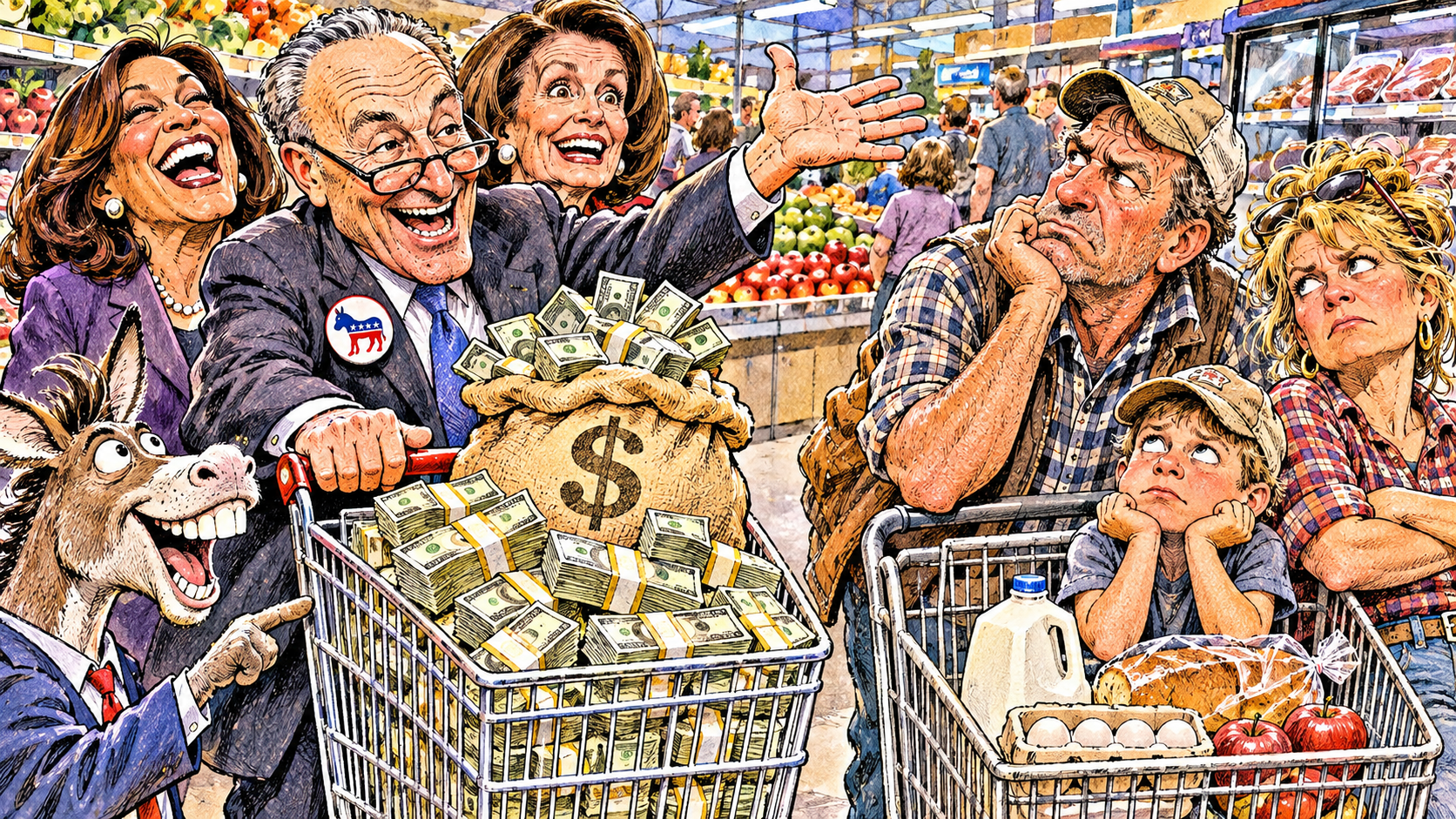
Economists ask whether Congress has ever visited a supermarket
WASHINGTON, D.C. – Democrats are preparing to assume control of Congress after campaigning on economic affordability, and progressive strategists have already identified their preferred solution to expensive groceries: additional government programs funded by people who still have groceries.
According to Associated Press election reporting, Democrats captured both chambers of Congress amid public frustration over high prices, the Iran war and government corruption. Al Jazeera reported that House Democratic leader Hakeem Jeffries promised an affordability focus after the win, which is the sort of promise that arrives well ahead of the groceries.
The results produced a familiar progressive conclusion.
Americans need more government involvement in the economy.
The fact that government already occupies an enormous portion of the economy was dismissed as an irrelevant technicality.
Grocery Prices: Socialists Discover the Money Fairy
“Every American deserves affordable food,” declared policy adviser Amanda Sharewell.
She proposed federal grocery credits, price-monitoring agencies, household assistance programs and a new Office of Nutritional Economic Justice.
A reporter asked who would pay for everything.
“The wealthy.”
“What happens if the wealthy stop investing?”
“We’ll tax their investments.”
“What happens if the investments disappear?”
Sharewell explained that the reporter was displaying an unhealthy obsession with arithmetic.
The proposed grocery credit, according to a draft handed to this newspaper, comes with fine print on page two. It states that the credit is “subject to funding, availability, eligibility determination and the continued existence of the program,” which covers every condition under which a person would notice the credit.
Supermarket Manager Discovers Washington Doesn’t Understand Shelves
A grocer in Pennsylvania offered lawmakers a different perspective.
“My prices depend on wholesale costs, wages, rent, electricity, transportation and competition. Lower those costs and I’ll gladly lower prices.”
A progressive consultant suggested imposing a maximum price on chicken.
The grocer asked whether suppliers would continue delivering chicken below their costs.
The consultant replied that corporate responsibility demanded sacrifice.
The grocer asked whether the consultant would personally provide chickens for free.
The consultant explained that agriculture was outside her area of expertise.
Her area of expertise was telling agriculture what to charge.
For readers who prefer their food prices from a source other than a consultant, the Department of Agriculture’s food price outlook and the Bureau of Labor Statistics’ consumer price index track what groceries cost, with fewer sacrifices and no Office of Nutritional Economic Justice.
The grocer’s own receipt for a routine delivery, shown to this newspaper, lists the wholesale price of a case of chicken, a fuel charge, a regulatory compliance fee and a line labeled “Miscellaneous Government.” The subtotal for the case is $63.20. The subtotal for the government is $11.85, and it never needed to be refrigerated.
Farm Costs: Farmers Discover Their Profits Have Already Been Redistributed
American farmers have endured volatile commodity prices, expensive equipment, higher borrowing costs and substantial operating expenses.
Washington’s proposed solution routinely involves additional regulations intended to make food more affordable.
A Kansas farmer asked whether anybody had considered reducing compliance costs.
A policy adviser explained that regulation protected consumers.
The farmer agreed that sensible safeguards matter but questioned whether every new form required a separate government employee.
“Last year, I filled out enough paperwork to qualify as a novelist,” he said.
“I still couldn’t afford a new combine.”
The adviser suggested he apply for a grant.
The grant application required a business plan explaining how he would become financially independent of government assistance.
Americans Want Prices Lowered, Not Prices Explained
Democrats face genuine limits on their ability to reverse inflation, particularly with a Republican president holding veto power.
But the broader economic argument remains straightforward.
Greater competition, more housing construction, productive investment and fewer unnecessary regulatory obstacles can expand supply.
Subsidies and spending programs can help particular households, but they do not automatically produce more goods or services. The nonpartisan Congressional Budget Office is available to tell lawmakers what their ideas cost, though few of them ask until the ideas have already been announced.
Unfortunately, expanding supply is less politically exciting than announcing that billionaires will purchase everybody’s dinner.
A frustrated shopper in Michigan offered a practical suggestion.
“Stop making everything more expensive to produce, then congratulating yourselves for giving me a coupon.”
Congressional advisers promised to examine the proposal.
First, however, they must establish a bipartisan task force on coupon equity.
Its projected operating budget is $38 million.
A study by the Institute for Retail Economics, based on checkout counters in eleven states, found that the average shopper spends 6 minutes at the register and 41 seconds using a coupon. The savings from the coupon averaged $1.12, which is about the cost of the task force’s coffee.
The socialist affordability plan remains unchanged: take money from the economy, send it through Washington, subtract administrative expenses and return what’s left as evidence of government generosity.
Five Observations on the Affordability Plan
- The plan to lower grocery prices is more government programs. That’s like fixing a leaky boat by hiring more people to explain the leak.
- Who pays? The wealthy. What if the wealthy leave? Tax their investments. What if the investments vanish? You’re obsessed with arithmetic. That’s not an economic plan, that’s an argument with my brother-in-law at Thanksgiving.
- A price cap on chicken. Chicken! The chicken’s not in on it. The chicken didn’t sign anything.
- The Kansas farmer filled out enough paperwork to qualify as a novelist and still couldn’t afford a combine. The only thing that guy’s harvesting is forms.
- Thirty-eight million dollars for a task force on coupon equity. For that kind of money you could give every American a coupon for a coupon.