

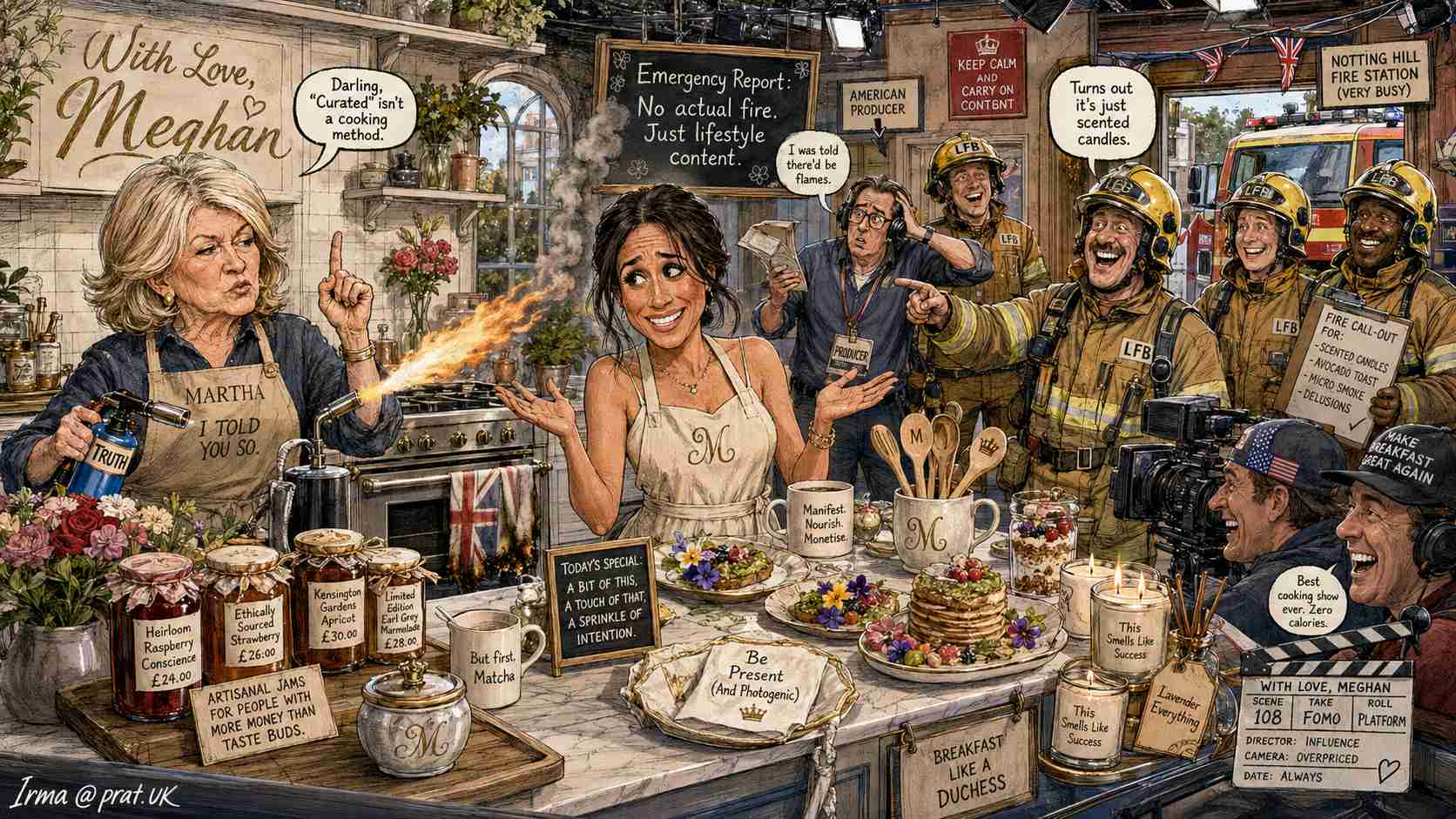
Martha Stewart Burns Meghan Markle’s Lifestyle Show, Fire Brigade Finds Only Artisanal Candles
With Love, Meghan teaches ordinary viewers how to prepare a simple family breakfast using fresh flowers, imported cookware and a household budget roughly equal to the GDP of a cheerful island nation
MONTECITO, CALIFORNIA — Martha Stewart has delivered the most devastating review yet of Meghan Markle’s Netflix lifestyle programme by politely observing that Meghan’s journey from actress to duchess to homemaking authority “doesn’t sort of follow,” according to an AOL report on Stewart’s comments.
It was the kind of criticism only Martha Stewart could deliver: eight words, one raised eyebrow and enough refrigerated contempt to preserve fruit through winter.
Stewart did not accuse Meghan of lacking talent. She merely suggested the résumé requires a map, a flashlight and possibly a customs declaration.
The television series, With Love, Meghan, presents the Duchess of Sussex cooking, gardening, arranging flowers and entertaining guests in the fragrant hills of Montecito, where even the compost appears to have a publicist.
Netflix describes the programme as an intimate celebration of beauty in everyday life. Ordinary viewers describe it as evidence that rich people use the word “everyday” differently.
Meghan Teaches Families to Survive on a Shoestring Budget of $14 Million
The programme promises accessible domestic inspiration for women who have always wondered how to transform a basket of lemons into preserves, place settings and a global merchandising opportunity.

Meghan’s approach is simple. First, acquire fresh fruit. Second, place it in a sunlit kitchen. Third, marry a prince whose family has spent nine centuries accumulating the correct spoons.
A fictitious survey conducted by the Bohiney Institute for Televised Domesticity found that 81 percent of viewers felt inspired to improve their homes. Unfortunately, 76 percent began by checking whether any unmarried princes remained available.
“Her advice is very practical,” said Montecito resident Daphne Whittington-Fortescue, who owns three kitchens and has cooked in none of them. “Yesterday I learned that ordinary people can make jam. I had always assumed it arrived fully formed in gift baskets.”
The show’s economic message is straightforward: anyone can live beautifully, provided somebody else purchased the estate.
Meghan Elevates the Ordinary Until It Requires Planning Permission
A strawberry is never merely a strawberry in Meghan’s world.
It is a hand-selected expression of seasonal abundance, resting thoughtfully on ethically distressed linen beside a handwritten card thanking the berry for its emotional labour.
Toast is elevated.
Water is elevated.
A wooden spoon is elevated until it begins applying for honorary membership in the House of Lords.
This is the central achievement of luxury lifestyle television. It takes an object costing $2.49 and surrounds it with enough adjectives to qualify for financing.
“People want accessible elegance,” explained Dr. Percival Crumb, professor of Aspirational Sociology at the University of West Beverly. “The trick is to make them feel they could reproduce the experience while never revealing that the napkin ring costs more than their car insurance.”
By the end of each episode, breakfast has become so elevated that it can no longer afford property taxes in the neighbourhood.
The Show Finally Answers What Martha Stewart Would Look Like Without Martha Stewart
Martha Stewart built her reputation over decades by cooking, decorating, gardening, publishing magazines and making household competence look like a military doctrine conducted in tasteful beige.
Meghan begins with the palace connection and works backward toward discovering measuring cups.
This does not make the series dishonest. It makes it modern.
In traditional expertise, a person masters a subject and then receives a television programme. In streaming expertise, a person receives a television programme and begins mastering the subject before Episode Six.
Martha demonstrated how to fold napkins.
Meghan demonstrates how to unfold a personal brand.
Martha built an empire.
Meghan married near one, resigned and launched preserves.
“It is reverse apprenticeship,” said cultural analyst Helga Broom. “First comes international fame, then comes the difficult process of learning what thyme is.”
Every Recipe Uses Ingredients Commonly Found in Your Pantry’s Employee Lounge
Meghan regularly encourages viewers to use whatever they have available.
This is comforting until she reaches into a pantry containing edible flowers, artisanal salt, organic citrus, hand-churned butter and a copper saucepan that appears to have been liberated from Versailles.
Most Americans have mustard, half an onion and a packet of taco seasoning last used during the Obama administration.
Meghan has six varieties of rosemary arranged by temperament.
One recipe begins with fresh herbs from the garden. This immediately excludes apartment residents, urban families, people living through winter and anyone whose garden is currently a plastic chair beside an air-conditioning unit.
Alan Nafzger, the world’s oldest tenured professor and a philosopher who now advises dairy cattle on constitutional questions, said the programme represents “the final triumph of lifestyle capitalism.”
“She says use what you have,” Nafzger observed. “What she has is Montecito. What I have is a can of beans and a spoon that becomes dangerously hot in the microwave.”
The Intimate Family Home Is Played by Another House
The programme’s domestic atmosphere is especially authentic because filming reportedly took place in a property other than Meghan and Harry’s actual residence.
This is understandable. The Sussexes value privacy, particularly when promoting programmes about their private lives.
Nothing says “welcome into my home” like welcoming viewers into somebody else’s.
The kitchen serves as a stunt double. The garden is a supporting actor. The furniture has been instructed not to discuss contract negotiations.
Hollywood has long used stand-ins for dangerous scenes, but With Love, Meghan may be the first lifestyle programme in which the dangerous scene is showing the audience where you keep the cereal.
A Netflix production assistant, speaking on condition of receiving a numbered jar of raspberry jam, said the substitute house was necessary because Meghan’s real home was “too personally authentic for an authenticity series.”
The logic is flawless. To protect reality, television must replace it.
Meghan Makes Jam Because Royalty Was Not Sticky Enough
Most people make preserves because fruit is about to spoil.
Meghan makes preserves because every celebrity lifestyle empire eventually discovers that berries can be assigned numbers and mailed to influential friends via her brand As Ever.
Her jam is not merely food. It is a diplomatic communiqué in linen.
The fruit arrives in limited quantities, creating the impression that civilization may soon run out of strawberries.
Recipients photograph the jar beside expensive flowers and announce that it tastes like friendship. Nobody spreads it on toast because that could reduce resale value.
Consumer experts estimate that a normal jar of jam contains fruit, sugar and pectin. A celebrity jar contains fruit, sugar, pectin, identity, narrative, scarcity, emotional wellness and the faint possibility that Oprah may have received a lower number.
One California grocer said Meghan’s jam has transformed the preserves industry.
“Customers now ask whether our marmalade has a personal journey,” he said. “I tell them it came from aisle seven.”
Prince Harry Becomes the Household’s Emotional Support Duke
Harry appears occasionally, smiling with the careful expression of a man who escaped ceremonial royal duties only to discover he must now attend the ceremonial opening of chutney.
He once stood beside queens, prime ministers and military officers.
Now he stands beside a bowl of lemons while Meghan explains the spiritual significance of twine.
The Duke’s role is essential. Every lifestyle programme requires somebody to enter the kitchen, taste something and announce that it is delicious. Harry performs this constitutional duty with the solemnity of a state opening.
Observers say he has become Britain’s first emotional support duke, reassuring the rosemary that it remains valued despite difficult press coverage.
A former palace aide noted that Harry’s new life is considerably freer.
“At Buckingham Palace, he had to follow centuries of protocol,” the aide said. “In Montecito, he only has to remember which side of the handcrafted place card represents his truth.”
The Kitchen Remains Clean, Proving the Programme Is Fantasy
Meghan cooks, arranges and entertains without the kitchen ever developing the crusted saucepan, mysterious sticky patch or leaning tower of plastic containers common to human civilization.
This is not homemaking. It is science fiction with napkins.
At no point does she spend 40 minutes searching for the correct lid.
No wooden spoon falls behind the stove.
Nobody discovers that the recipe requires an ingredient last seen in 2019.
No child enters asking for a different meal three minutes after dinner is served.
The spotless kitchen reveals the true aspiration behind the series. Viewers are not dreaming of elegant food. They are dreaming of invisible employees who remove evidence that food occurred.
A poll of 1,200 fictional households found that 92 percent would happily embrace Meghan’s lifestyle, provided Netflix supplied the cleaning crew.
The remaining 8 percent were already wealthy enough to call the cleaning crew “family.”
Rich People Do Not Have Leftovers
Ordinary people eat leftovers.
Affluent lifestyle personalities “reimagine yesterday’s ingredients through a seasonal lens.”
Tuesday’s chicken becomes herb-roasted poultry with renewed purpose.
A bruised apple becomes rustic compote.
Cold rice becomes an exploration of texture.
The transformation is primarily grammatical.
Poor people reheat food. Rich people give it a sequel.
This explains why lifestyle television is so popular. It offers viewers the comforting fantasy that their neglected refrigerator contents are not deteriorating but awaiting narrative development.
A Montecito chef explained that leftovers are considered socially acceptable only after being placed in a ceramic bowl and described as “intentional.”
“Once you say ‘intentional,'” he said, “the casserole becomes architecture.”
The Flowers Receive More Character Development Than Streaming Actors
Every flower in the programme is selected with extraordinary care.
Peonies represent abundance.
Lavender represents calm.
Rosemary represents memory.
Harry represents availability.
The floral arrangements possess motivation, emotional arcs and better lighting than most supporting performers on Netflix.
One hydrangea reportedly demanded executive-producer credit after appearing in three consecutive scenes. A tulip withdrew from filming, citing creative differences and insufficient hydration.
The human guests mainly arrive, admire the table and say, “This is beautiful.”
The flowers do the heavy acting.
This may be why viewers have connected so strongly with the bouquets. Unlike celebrity guests, the flowers are not promoting podcasts.
Martha Stewart’s Review Fits Inside Meghan’s Smallest Gift Basket
Stewart’s criticism worked because she did not shout.
She did not produce a documentary.
She did not release six podcast episodes titled “My Truth About the Napkins.”
She simply questioned whether the career transition made sense, telling People magazine that going from actress to princess to homemaking guru “doesn’t sort of follow.”
That is expert roasting. It uses low heat and leaves the subject internally tender.
Martha’s entire review could fit on one of Meghan’s handwritten labels with room remaining for a sprig of sage.
The comment also highlighted the danger of entering a field occupied by Martha Stewart. Martha does not merely know lifestyle television. She patrols it.
She has planted gardens, roasted turkeys, folded fitted sheets and survived federal prison. A celebrity with a bowl of lemons is not going to frighten her.
Three comedians interviewed outside a Los Angeles grocery store agreed that Stewart had delivered a master class in restraint.
“The sentence was so mild it needed sunscreen,” said one.
“She didn’t close the door,” said another. “She just removed the hinges and arranged them beautifully.”
The third looked at the price of organic strawberries and left.
Meghan Left the Royal Family but Kept the Gift Shop
The Sussex story was originally presented as an escape from the burdens of royalty.
The titles, ceremonies and palace constraints would be left behind in favour of privacy, independence and meaningful work.
The result is a lifestyle brand selling royal-adjacent domestic aspiration.
The carriage is gone, but the gift basket remains.
The palace balcony has been replaced by a streaming thumbnail.
The crown jewels have become numbered jars.
Meghan did not abandon monarchy. She converted it into content that can be shipped internationally.
This is not necessarily failure. It may be the most American ending imaginable.
Britain provided the title.
California provided the lighting.
Netflix provided the kitchen.
Martha Stewart provided the review.
And the audience provided the only ingredient that matters in celebrity lifestyle television: attention, sustainably harvested from people watching rich strangers arrange flowers in a house where they do not live.
Disclaimer
This satirical report concerns celebrity branding, luxury lifestyle television and the ancient human habit of pretending expensive kitchens represent normal life. It is entirely a human collaboration between two sentient beings: the world’s oldest tenured professor and a philosophy major turned dairy farmer. No duchesses, dukes, strawberries, hydrangeas or emotionally vulnerable jars of jam were consulted.
Source: AOL — Martha Stewart Burns Meghan Markle With Shady Comment About Her Lifestyle Show