

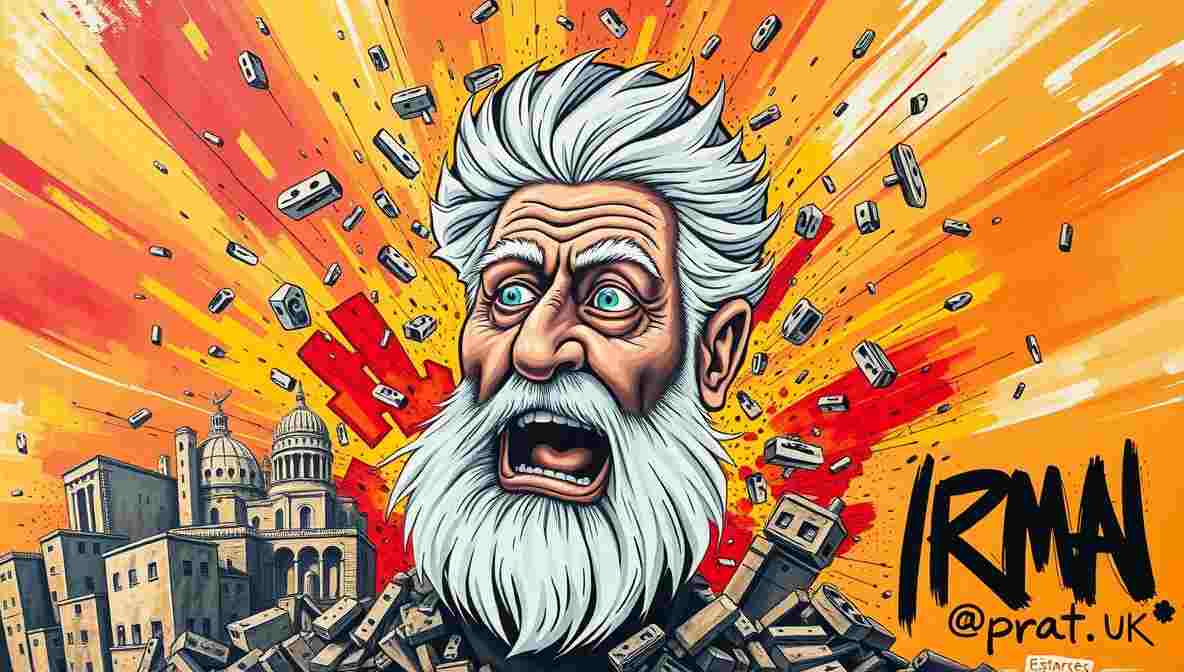
15 Observations About The U.S. Attacks on Iran – Operation Epic Fury
Five Quick Observations Before The Missiles Even Landed
America now announces military operations the way Netflix drops a series. Surprise premiere, dramatic title, binge the explosions all weekend. Popcorn not included, but the Department of Defense did post an American flag emoji, so that’s something.

When the U.S. Department of Defense called it Operation Epic Fury, half the country thought it was a new energy drink. The other half assumed it was a Fast & Furious sequel. Both groups were equally prepared.
The phrase regime change sounds like something you do when the washing machine starts shaking. Just redistribute the load. Add a dryer sheet. Hope for the best.
The stock market treats Middle East escalation like it treats pumpkin spice. Seasonal, predictable, oddly profitable. Oil futures were already printing money before the first missile cleared the flight deck.
Airspace closures across the Gulf mean even pilots are saying, you know what, maybe we just circle for a bit. Commercial aviation: the only industry that responds to geopolitical crises by going into a holding pattern and charging you for the snack box anyway.
Operation Epic Fury: The Statements Nobody Asked For
The President, Donald Trump, told Iranians this might be their only chance for generations. Generations. That is not a deadline, that is a Costco membership. Bulk history. Buy twelve jars of freedom, get a free tote bag.
Meanwhile, Benjamin Netanyahu described the strike as existential. Everything in the Middle East is existential. You order coffee wrong, it is existential. You mispronounce hummus, it is existential. Someone takes the last falafel, it is a war crime.
Tehran Bunker Chic and The IRGC’s Telegram Strategy
Operation Epic Fury
Over in Tehran, Ali Khamenei reportedly moved to a secure location. Leaders in bunkers always look calm on television. That is because the lighting is better underground. Also, nobody can ask follow-up questions.
Iran’s response through the Islamic Revolutionary Guards Corps was swift. Missiles, drones, statements on Telegram. In 2026, geopolitics runs on encrypted apps and espresso. The IRGC’s social media manager deserves hazard pay.
Expert Analysis From People Who Were Definitely Right About Everything
Experts say escalation was likely. I love that phrase. Likely. Dr. Farhad Moussavi of the London Institute for Strategic Guessing explained, “When two nations threaten each other daily for weeks, something statistically interesting tends to happen.” That is academic for boom. Peer-reviewed boom.
An anonymous staffer at a Gulf air base said, “We built an armada, but nobody told us it would be this busy.” The phrase armada sounds majestic until you have to file overtime paperwork. Naval glory: less romantic in triplicate.
A poll released by the Center for Extremely Timely Surveys found that 52.7 percent of Americans learned about the strikes from social media, 31.4 percent from cable news, and 15.9 percent from a cousin who said, did you see this. Democracy in action. Beautiful, chaotic, poorly sourced democracy.
Shelter-in-Place, Pita Bread, and the Human Cost of All This Absurdity
Operation Epic Fury
In Haifa, an eyewitness named Yossi described heading into a shelter with three kids and a bag of pita bread. “We practice for this more than we practice piano,” he said. That might be the most Middle Eastern sentence ever spoken. Also the saddest. Also somehow the funniest. Welcome to the region.
Oil prices jumped faster than a cat in a room full of rocking chairs. Economists call it volatility. Regular people call it filling up the tank before it hits six dollars. Same phenomenon, different vocabulary, same empty wallet.
Diplomats around the world urged restraint. That is their job. Urge restraint while everyone ignores them. It is like being the designated driver at a wedding where the bride and groom brought tequila. You are technically in charge. Nobody is listening.
The Media Coverage Was Also A Production
Cable news graphics grew larger, louder, and more red. If a war does not have at least three animated arrows and a glowing map, did it even happen. There should be a Jeopardy! category: Real Conflicts or CGI Trailers. America genuinely could not tell.
The phrase major combat operations was delivered with the seriousness of a Broadway opening night. Curtains up. Critics waiting. Casualties are not box office, but the ratings spike. Somewhere, a network executive is quietly pleased with the overnight numbers. This is fine.
Some lawmakers immediately questioned legality. Nothing says unity like arguing about paperwork while missiles are in the air. The Constitution: still technically in play, loading slowly, please stand by.
And Finally: History Repeats Itself, Now With Better WiFi
History repeats itself, but now it has better WiFi. In the past, people waited for morning newspapers. Now we refresh, refresh, refresh, as if geopolitics were a sports score. The world feels smaller, louder, and somehow still confused. We have five-bar signal and zero answers. Progress.
What the Funny People Are Saying About Operation Epic Fury
“If you call it Epic Fury, at least spell fury right. We are not twelve.” — Jerry Seinfeld
“I like a war with branding. If you are going in, at least bring a logo.” — Ron White
“You ever notice regime change always sounds like it should come with a receipt?” — Larry David
This satirical journalism piece reflects commentary on publicly reported events and does not celebrate violence or conflict. It is written as a collaboration between two sentient beings, one of whom once taught political philosophy for forty years and the other who now milks cows and reads geopolitics at dawn. If the world feels absurd, that is because sometimes it is. Stay thoughtful. Stay human. Auf Wiedersehen, amigo!
On February 28, 2026, the United States and Israel launched a coordinated military operation against Iran dubbed “Operation Epic Fury” by the Pentagon, with Israel calling its parallel mission “Operation Roaring Lion.” The joint strikes targeted Iranian military installations, ballistic missile sites, and reportedly the locations of Supreme Leader Ali Khamenei and President Masoud Pezeshkian. The operation follows months of escalating tensions over Iran’s nuclear program and comes eight months after a previous 12-day air campaign. Iran retaliated with missile barrages aimed at northern Israel, triggering air raid sirens and a state of emergency declared by the Israeli Defense Minister. Airspace across the region was closed, oil prices surged, and the internet inside Iran was reported shut down. World leaders called for restraint. The missiles did not get the memo.