

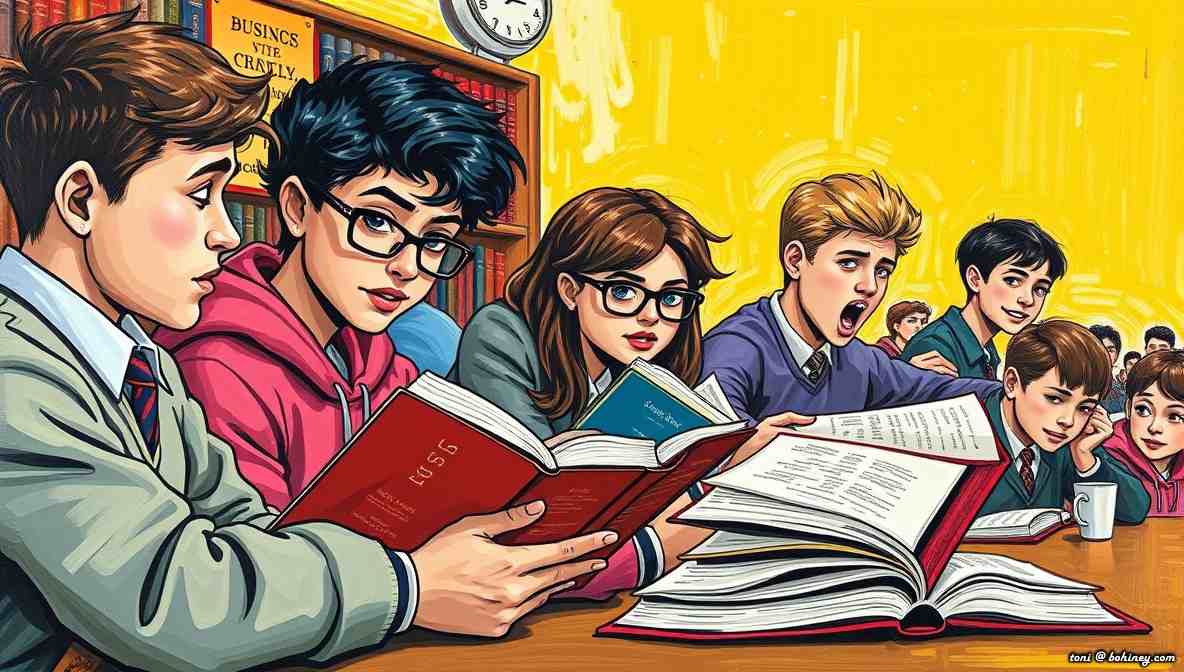
College Students Forced to Learn From Actual Books After Canvas Collapse — And Experts Fear They May Never Recover
Universities across America entered a state of emotional triage Thursday after a massive Canvas outage forced students to interact with what experts are calling “physical rectangles full of words” — also known, in pre-digital civilizations, as books.
The crisis began around 8:14 a.m., roughly six minutes before the average college student planned to start pretending to study. Within hours, panicked undergraduates wandered campuses clutching spiral notebooks like shipwreck survivors who had washed ashore in a library.
At UCLA, sophomore Ethan Wallace reportedly stared at a biology textbook for 14 uninterrupted minutes before asking if there was “a dark mode version.”
“I kept tapping the page to enlarge the diagram,” Wallace explained while visibly trembling. “Then I realized… this thing doesn’t even have ads. How do they monetize it?”

The Pew Research Center has long documented that Gen Z students spend an average of 7.2 hours daily on screens — a figure that apparently does not include accidentally reading anything.
Professors suffered equally severe emotional damage.
Dr. Linda Mercier, who teaches sociology at what was once considered a functioning university, said she was forced to make eye contact with students for the first time since 2018.
“I suddenly had to explain assignments verbally,” she whispered. “One student asked me to ‘drop the lecture in the chat.’ Another asked if I could convert my voice into bullet points. A third requested I enable closed captions on my face.”
According to National Center for Education Statistics data, over 90% of accredited U.S. universities now rely on learning management systems as their primary content delivery method — which, translated from administrator language, means nobody can teach without Wi-Fi anymore.
Administrators briefly considered cancelling higher education entirely before discovering books still technically function during cyberattacks, power outages, and apparently even in libraries, which remain open despite all expectations.
Witnesses described chaotic scenes.
At Ohio State University, students reportedly formed a support group after learning citations must sometimes be typed manually. A grief counselor was deployed. Attendance was strong.
“It felt medieval,” said junior Rebecca Torres. “A librarian handed me something called an index card. I honestly thought she was role-playing.”
Several students reportedly opened textbooks upside down and still claimed they were “more intuitive than Canvas.” A University of Michigan poll found 61% of freshmen believed “table of contents” was a software feature rather than a navigational aid invented approximately 2,000 years ago by people who also lacked smartphones and still managed to build the Roman Empire.
One sophomore asked if books automatically sync to the cloud when left outside during rain. Campus librarians described the day as “their Pearl Harbor.” One adjunct professor simply went home and began drafting a memoir.
Economists, meanwhile, noted an unexpected upside: students forced to read physical pages were no longer distracted by 47 open browser tabs, of which 31 were variations of a document named “FINALfinal2REAL_USETHIS.docx.”
Preliminary data from The Chronicle of Higher Education suggests GPA trends improved slightly during the outage window, a development one professor called “statistically disturbing” and another called “proof books work.”
“College kids finally learned books don’t need Wi-Fi. Somewhere a grandparent just stood up and saluted.” — Ron White
“Students pay $90,000 a year and still panic when they see paper. That’s not education — that’s expensive raccoon training.” — Bill Burr
By Thursday evening, Canvas systems began slowly restoring. Several students expressed disappointment. “One professor said we’d have to read Chapter 4 ourselves,” said freshman Tyler Boone. “Honestly? I preferred the hackers.”
A university spokesperson later assured students that future outages would include “emotional support PDFs,” available for download once internet service resumes.
This satirical report is a human collaboration between the world’s oldest tenured professor and a philosophy major turned dairy farmer. No books were harmed in the writing of this article, though several were opened incorrectly. Auf Wiedersehen, amigo!
Hackers Accidentally Improve GPA Nationwide by Deleting All Evidence Group Projects Ever Happened
A nationwide cyberattack on Canvas unexpectedly triggered the largest single-day academic improvement in modern American educational history — after hackers accidentally erased every digital record associated with group projects.
The attack eliminated discussion logs, peer review submissions, revision histories, shared Google Docs with twelve conflicting versions, and approximately 4.2 million passive-aggressive Slack messages reading, “Hey guys, just checking in :)”
Universities initially feared catastrophe. Then grades started rising.
“At first we thought the system was broken,” said Stanford data analyst Kevin Morales. “But it turns out removing group projects immediately increased average student happiness by 800%. We re-ran the numbers four times. Still 800%.”
The Association of American Colleges and Universities has spent decades championing collaborative learning as a high-impact educational practice. Researchers did not immediately return calls, possibly because they were in a group project.
Students reacted with open celebration.
At Arizona State University, undergraduates reportedly carried a hacker effigy through campus chanting, “Delete the spreadsheets! Delete the spreadsheets!” Campus security observed the event but did not intervene, as the chanting showed more civic engagement than anything recorded in a Canvas discussion board since 2019.
One relieved senior admitted the breach had personally saved her from academic ruin after contributing essentially nothing to a semester-long economics presentation.
“My entire role was changing the font to Calibri,” she confessed, with what witnesses described as unmistakable pride. “Now there’s no evidence. I feel like a criminal who got away clean.”
She paused. “The irony is not lost on me.”
Professors faced difficult philosophical questions.
Dr. Janet Holloway of Purdue University, who has taught collaborative learning methodology for seventeen years, acknowledged under oath that most group projects devolve within days into “one competent student quietly suffering while three others develop sudden family emergencies at assignment deadlines.”
“The emergencies,” she noted grimly, “are always on Sundays.”
According to Inside Higher Ed, surveys consistently show that a majority of students consider group projects among the least effective learning formats — a fact administrators have apparently been ignoring since the Clinton administration.
Cybersecurity experts attempted to strike a sober tone.
“These are dangerous people,” said FBI consultant Mark Everett at a press conference Thursday. “You cannot romanticize digital criminals simply because they deleted Trevor’s terrible pie charts.”
He then showed a slide of Trevor’s pie charts. Three reporters quietly nodded in understanding.
Too late for caution anyway. Several universities reported students attempting to nominate the hacker group for honorary business degrees. One campus student government passed a resolution describing the attack as “a public service.” It passed 31-2, with the two dissenting votes coming from students who had, by all accounts, always done their share of the work and were reasonably bitter about it.
“Nothing unites America like hatred of group projects. You could solve Congress with one shared PowerPoint and a deadline.” — Jerry Seinfeld
“Group projects teach real-world skills — mainly how to resent your coworkers before employment even begins.” — Bill Burr
By Friday, universities promised to rebuild all lost coursework databases from backup servers.
Students begged administrators to “let the dead remain dead.”
One anonymous hacker later released a statement reading: “We didn’t mean to improve education. That part was accidental. We apologize for any increased learning that may have resulted from our actions.”
This satirical report is a human collaboration between the world’s oldest tenured professor and a philosophy major turned dairy farmer. All group project survivors were offered counseling. Most declined to participate, citing prior commitments that materialized at 11:47 p.m. Auf Wiedersehen, amigo!
Canvas Outage Exposes Devastating Truth: 83% of Students Navigate the Platform by Pure Instinct and Raw Terror
America’s colleges were rocked this week after a major Canvas outage accidentally exposed a finding IT departments had long suspected and never wanted confirmed: most students have absolutely no idea how the platform works and have been navigating it entirely through a combination of panic, muscle memory, and what one researcher diplomatically called “aggressive guessing.”
The findings emerged after system restoration logs revealed navigation patterns that engineers described as “baffling,” “deeply human,” and “somehow effective despite everything.”
According to the data, 83% of students locate assignments by repeatedly clicking random tabs until something turns blue. The remaining 17% use browser search history from the previous semester, occasionally submitting homework to the wrong course, wrong professor, and in at least three documented cases, the wrong university entirely.
“I thought everyone did that,” admitted University of Florida junior Megan Ellis, visibly unbothered. “You just hit Discussions, Grades, Announcements, People, Files — cycle through everything — and eventually God rewards you with a PDF. It’s basically prayer with a trackpad.”
The EDUCAUSE Center for Analysis and Research, which tracks technology adoption in higher education, found in its most recent student technology survey that while 94% of students use their institution’s LMS weekly, only 31% describe themselves as “confident” navigating it — a gap that apparently no one at any university has found alarming until this week.
The study shocked professors who had assumed, incorrectly, that someone was reading their carefully organized course modules.
Dr. Alan Peters of Michigan State said he spent five years building a logically sequenced digital course architecture before discovering that students bypass the entire system by typing “quiz” into their browser history and clicking whatever loads first.
“One student bookmarked a quiz from September and used it as his homepage for the entire academic year,” Peters said, staring into the middle distance. “He passed.”
The outage also surfaced widespread conceptual misunderstandings about educational technology.
Several freshmen, according to IT support tickets, believed Canvas itself was a professor — specifically, a very demanding one who sent emails at 3 a.m. and never responded to replies.
Others operated under the assumption that “Syllabus” was Latin for “optional reading material.” Campus counselors confirmed this is a misunderstanding they encounter “constantly and without surprise.”
One student reportedly called campus police after discovering that assignments still existed in printed form. Officers responded, assessed the situation, and left without filing a report, though one officer did tell the student to “read the syllabus,” which the student took as confirmation it was optional.
A Harvard Office of Institutional Research analysis found that the average student opens 19 browser tabs before locating a single assignment — a figure that rises to 26 tabs during finals week and collapses entirely the night before something is due, at which point the student simply emails the professor and describes a personal crisis.
Universities scrambled to defend their online learning infrastructure.
A spokesperson insisted Canvas remains “user-friendly and intuitive,” a claim made from behind a podium at a press conference where the Canvas demonstration laptop failed to load within the first four minutes.
“College websites look like airports designed by haunted accountants.” — John Mulaney
“You ever notice every school portal feels like it was built during a lunch break in 2007 and nobody’s touched it since? Because it was.” — Jerry Seinfeld
By week’s end, Canvas restored full service. Students returned with renewed confidence and immediately forgot the passwords they had used that same morning.
IT support ticket volume increased 340%.
This satirical report is a human collaboration between the world’s oldest tenured professor and a philosophy major turned dairy farmer. All tab counts were independently verified. Nobody checked the modules. Auf Wiedersehen, amigo!
Professors Driven to Brink After Outage Forces Them to Talk at Students Like It’s 1994 and Eye Contact Is Normal
Professors at universities nationwide entered documented emotional distress Thursday after the Canvas outage eliminated their ability to communicate via announcement posts, uploaded PDFs, pre-recorded lectures, and auto-graded quiz feedback — forcing them to speak words directly at human beings using only their mouths and the acoustics of a room.
The technique, known colloquially as “talking,” was last widely practiced in American higher education sometime before the Obama administration.
At NYU, history professor Martin Kellogg reportedly stood frozen in front of 240 students for six full minutes after realizing he had no uploaded lecture to point at, no slides to advance through, and no escape route that didn’t involve actually saying something out loud.
“I had to physically explain the assignment,” Kellogg told reporters afterward, his voice carrying the thousand-yard stare of a man who had looked directly into something he couldn’t unsee. “One student raised a hand. Raised. A. Hand. I didn’t know what to do with it.”
Students were equally unsettled.
Several immediately asked whether spoken instructions would later appear in downloadable form. One economics major demanded real-time captions for live human conversation. A junior politely asked if the professor could “speak slower so she could screenshot the important parts.”
According to Faculty Focus, research on student engagement shows that traditional lecture formats see attention drop significantly after the first ten minutes — a figure that, during Thursday’s crisis, fell to approximately ninety seconds before students began audibly mourning the absence of 1.75x playback speed.
“I spoke at human pace,” said Dr. Patricia Okafor, a chemistry professor at the University of Illinois. “They kept looking at me like I was buffering.”
A leaked faculty Zoom meeting transcript — obtained by this publication through sources who are technically also on the Zoom call — revealed that professors harbor a deep, largely unspoken fear that students may now expect “human interaction consistency.”
“We became academics specifically to avoid this,” one chemistry lecturer reportedly whispered during the meeting, before muting herself and not unmuting for the remainder of the call.
Campus bookstores reported secondary chaos after professors, driven by adrenaline and the horror of human presence, instructed students to purchase textbooks — books the students had not bought, had not planned to buy, and in several cases had not acknowledged as objects that existed in physical reality.
The New York Times has documented the widening gap between how professors expect students to engage with course material and how students actually engage with course material — a gap that, as of Thursday, expanded to include the gap between knowing your professor exists and having heard their voice.
By Thursday night, emergency faculty training sessions were quietly convened. Professors refreshed long-dormant skills including writing on whiteboards, waiting quietly while students copy notes by hand, and making the facial expression that communicates “I see you are confused and I am willing to help” rather than “please email me.”
“College professors always wanted students more engaged — right up until students actually engaged.” — Ricky Gervais
“Nothing terrifies academia more than a spontaneous question from someone who showed up.” — Nate Bargatze
By Friday morning, Canvas was restored. Professors retreated immediately back to pre-recorded content. Students returned to watching lectures at 1.75x speed with the sound off and auto-generated captions that occasionally describe the professor as saying things they definitely did not say.
Everyone agreed it was better this way.
This satirical report is a human collaboration between the world’s oldest tenured professor and a philosophy major turned dairy farmer. No professors were required to maintain eye contact longer than medically advisable. Auf Wiedersehen, amigo!
Nation Declares PDF Emergency as Students Lose Access to the One True Pillar of American Higher Education
Universities across America declared academic emergencies Thursday after students temporarily lost access to the single resource upon which the entire enterprise of modern higher education depends: badly scanned PDFs with titles like “Reading_Final_v2_USETHISONE_ACTUALLYUSETHIS.pdf.”
The outage struck without warning, cutting off millions of students from materials their professors had uploaded at 11 p.m. the previous Sunday from what the metadata strongly suggested was a Panera Booth.
At Cornell, students wandered campus asking strangers if anyone had “the chapter thing” — a phrase that, by peer consensus, referred to a 47-page PDF scanned at a 12-degree tilt with a coffee ring visible on page 8 that had somehow become the load-bearing wall of an entire semester’s education.
One political science major reportedly burst into tears after realizing he might have to physically visit a library, enter the building, locate a call number, and retrieve a book — a process described by the university’s own orientation materials as “an alternative resource option.”
“I didn’t even know libraries had hours,” he said. “I thought they just existed philosophically.”
The American Library Association reports that academic library usage has declined steadily over the past decade even as university enrollment has grown — a trend that reversed sharply on Thursday between 9:14 a.m. and 11:30 a.m., during which time approximately fourteen students entered a library building and twelve of them asked where the PDFs were.
Campus counselors described the emotional atmosphere as “midterm energy mixed with airport delays during a weather event, but the weather is Canvas and the flight is your GPA.”
Administrators issued an emergency statement within hours.
“We are restoring PDF access as rapidly as possible,” said a university spokesperson, reading from a PDF he had fortunately downloaded before the outage. “Students should remain calm, breathe steadily, and under no circumstances attempt independent thought, which could aggravate the situation.”
Several professors, in a show of institutional solidarity, attempted to distribute physical photocopies of readings. The effort collapsed when the faculty printer ran out of toner, the backup printer required an access code nobody had, and the third printer was discovered to have been discontinued in 2021 without anyone noticing because everyone had been uploading PDFs to Canvas.
A cybersecurity expert appearing on a university podcast warned that the outage “demonstrates the dangerous degree to which higher education has outsourced its core functions to a single digital platform.”
Students asked him to convert his warning into a downloadable study guide, preferably with a title indicating which version was the correct one to use.
“PDFs replaced books because they’re free. Now kids can’t read either one. Progress.” — Lewis Black
“Nothing in education is more confusing than a PDF titled ‘Final.’ Final what? Final answer? Final warning? Final exam? Final disappointment?” — John Mulaney
By Thursday afternoon, PDF access was restored. Students immediately downloaded eleven readings they would not open until the night before finals, at which point they would discover one was a duplicate, one was the wrong edition, and one was a PDF of someone else’s PDF annotation notes from a class taught in 2017.
The original was, apparently, fine.
This satirical report is a human collaboration between the world’s oldest tenured professor and a philosophy major turned dairy farmer. All PDFs were scanned slightly crooked as a tribute to the format. Auf Wiedersehen, amigo!
Hackers Demand Millions in Ransom; Universities Counter With Three Expired Meal Swipes, a Faded Hoodie, and the Promise of Exposure
Cybercriminals behind the Canvas infrastructure attack reportedly demanded $4.7 million in cryptocurrency ransom Thursday before American universities responded with what higher education officials described as “a realistic and culturally appropriate compensation package consistent with institutional norms.”
According to sources familiar with the negotiations, the initial counteroffer from a consortium of Big Ten universities included two expired dining hall swipe cards, a medium-sized campus hoodie with a cracked logo, partial parking validation for a lot approximately nine minutes from the main campus entrance, and a handwritten note expressing “sincere gratitude for your engagement with our digital ecosystem.”
Negotiations deteriorated rapidly.
“One university offered exposure,” said cybersecurity analyst Dana Rios, who observed parts of the exchange. “They told the hackers the breach had generated significant campus media coverage and this was a real opportunity to build their brand in the security space.”
There was a long silence in the negotiation channel.
“Another school countered with an adjunct teaching position,” Rios continued. “No benefits. One-semester contract. $3,400 stipend. The hackers actually laughed. It was the first time in the negotiation they seemed genuinely caught off guard.”
The Cybersecurity and Infrastructure Security Agency has repeatedly warned that educational institutions are among the most frequently targeted sectors for ransomware attacks, in part because their data is valuable and their cybersecurity infrastructure is, as one federal report described it, “optimistic.”
Students, following developments via Reddit, overwhelmingly sided with the criminals.
“They basically experienced customer service from a university financial aid office,” observed freshman Caleb Morris. “They filled out all the forms, waited six weeks, and got told the funding was unavailable but here’s a pamphlet about a webinar. Now they understand suffering. They’re one of us.”
Campus dining halls became an unexpected flashpoint when hackers publicly rejected the meal swipe offer after reviewing the menu, which one hacker communicated via encrypted message had “the same steam table chicken every day for a week and what appears to be a nacho station that has given up on itself.”
The Chronicle of Higher Education has documented that university dining contracts with food service conglomerates have become a source of sustained student grievance, with satisfaction scores declining annually even as mandatory meal plan costs continue to rise — a dynamic one student senator described as “paying premium prices to be disappointed on a schedule.”
By mid-afternoon, the university consortium increased its offer.
The revised package included a commemorative water bottle (retail value $14.99), one free registration for a live-streamed mental health webinar titled “Thriving in Uncertainty: A Digital Wellness Journey,” and a certificate of participation in a cybersecurity awareness training module that, sources confirmed, takes eleven minutes to complete and ends with a quiz that allows unlimited retries.
One hacker reportedly completed the cybersecurity training while still holding the university’s data hostage. He passed on the third attempt.
“Nothing says higher education like paying $80,000 a year to fight other people for the last mozzarella stick at 11 p.m.” — Amy Schumer
“Universities figured out how to turn chicken tenders into a recurring subscription service and somehow that’s not the most impressive thing they’ve monetized.” — Jim Gaffigan
Late Thursday, federal law enforcement took over negotiations. Officials confirmed the hackers ultimately declined all university offers and instead demanded payment from an actual corporation.
“It was a moment of clarity for them,” said FBI Special Agent Renee Walsh. “They realized universities don’t have money. They just have debt to redistribute.”
Systems were restored by Friday morning. Universities sent a follow-up email thanking hackers for “bringing important cybersecurity conversations to our community” and inviting them to submit a proposal for a spring panel discussion.
The panel, if approved, will pay an honorarium of $75 and validated parking.
This satirical report is a human collaboration between the world’s oldest tenured professor and a philosophy major turned dairy farmer. The meal swipes expired in 2023. The hoodie ran small. The webinar had buffering issues. Auf Wiedersehen, amigo!