

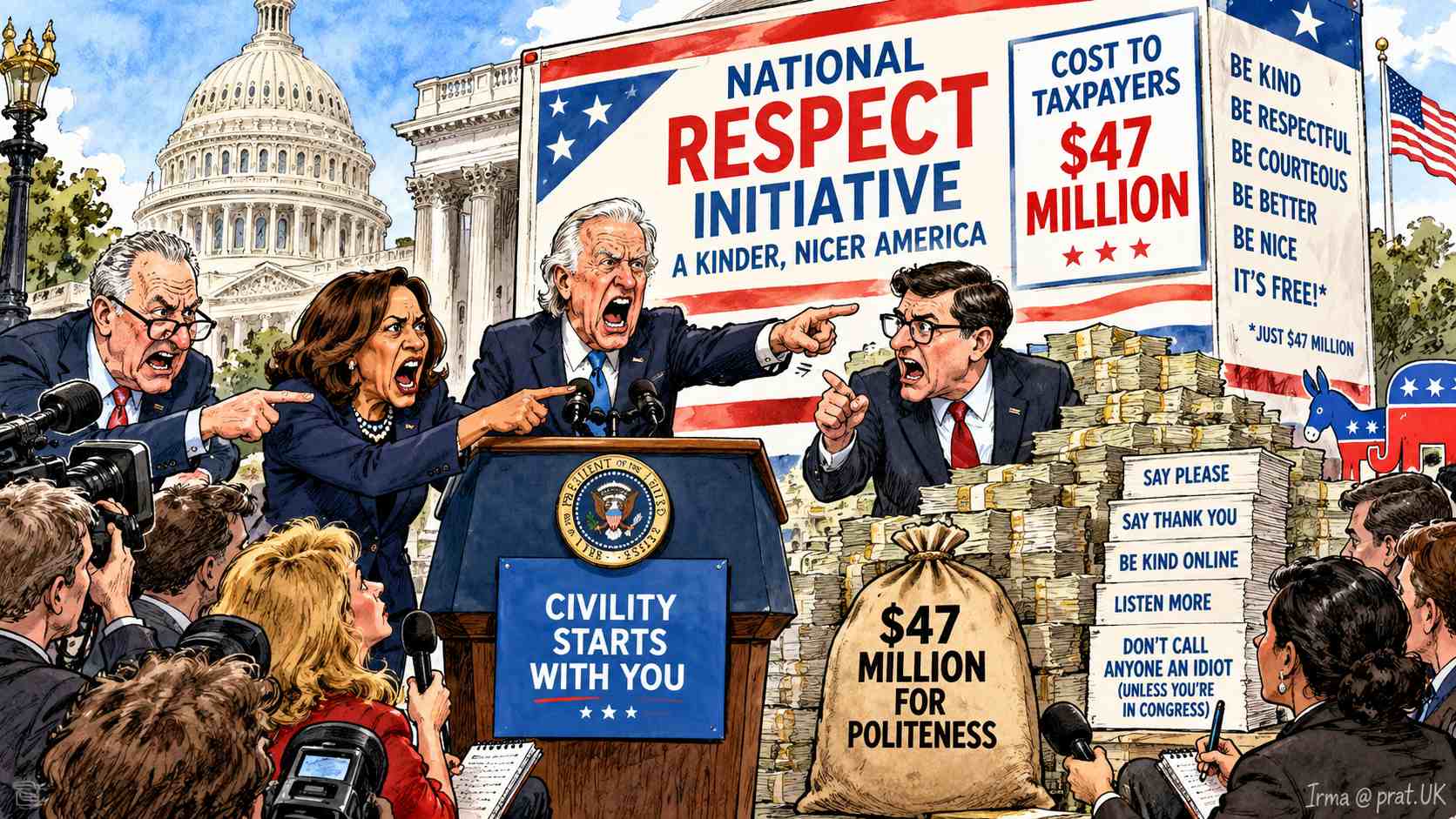
Civility Costs Nothing (Apparently): Washington Announces National Respect Initiative That Will Cost Taxpayers $47 Million
Americans Told to Be Kinder to One Another by Politicians Who Cannot Get Through a Press Conference Without Calling Someone an Idiot
WASHINGTON, D.C. — Civility costs nothing, according to America’s political establishment, which has consequently decided that the country cannot afford to provide it without federal assistance.
The nation’s latest solution to declining manners is a proposed $47 million National Civility Initiative, a bureaucratic masterpiece designed to remind 340 million Americans that yelling at strangers, insulting neighbours and threatening people over political disagreements might not be ideal foundations for a successful civilisation.
The $47 million figure represents the estimated federal cost of explaining something American grandmothers once accomplished with a raised eyebrow.
Congressional enthusiasm for the initiative has been overwhelming, particularly among legislators who consider their political opponents dangerous, dishonest, morally bankrupt and insufficiently committed to respectful dialogue.
Political Civility in America: Everyone Supports Respect for People Who Agree With Them
The central problem with American civility is that nearly everyone believes in it, especially when demanding it from someone else.
According to a 2025 Pew Research Center survey on aggressive political rhetoric, 78% of Americans believe elected officials should avoid heated or aggressive language because it could encourage violence.
The remarkable discovery is that Americans agree on something.
Unfortunately, the agreement concerns a behaviour almost nobody wants to demonstrate personally when discussing politics.
Republicans believe Democrats should show greater respect for traditional American values. Democrats believe Republicans should demonstrate greater respect for democratic institutions. Independent voters believe both parties should demonstrate greater respect for their blood pressure.
Washington has embraced the remarkable proposition that calling someone an extremist is unacceptable, unless that person actually disagrees with you.
One congressional aide described the emerging bipartisan consensus as a historic breakthrough.
“We’ve reached the point where both sides agree that the other side is responsible for the collapse of civilisation. That’s the closest we’ve come to cooperation in years.”
Congress Discovers That Insulting People Is Free, Too
The National Civility Initiative faces an immediate economic problem.
Insulting someone also costs nothing.
This creates a competitive marketplace in which rudeness enjoys several distinct advantages. It is faster, more entertaining and considerably more likely to generate television appearances.
Courtesy requires listening. Insulting someone requires a microphone.
A politician can spend forty minutes explaining a complicated fiscal proposal and receive seventeen online responses, six of which concern his haircut.
Alternatively, he can describe an opponent as a morally bankrupt turnip and receive three million views before lunch.
The advertising market has spoken.
Civil discourse is not a viable business model.
Outrage, however, enjoys excellent quarterly earnings.
Social Media Companies Promise to Promote Kindness Without Sacrificing Their Profitable Arguments
Silicon Valley has reportedly welcomed the spirit of the new initiative, particularly the opportunity to sell the government tools for encouraging compassion.
The industry’s proposed approach involves providing users with reminders to reconsider hostile comments before posting them.
A person writing “You’re an idiot” would receive a notification suggesting a more constructive alternative.
For example: “I respectfully question the intellectual foundations of your existence.”
The software would then recommend twelve accounts that agree with the original insult.
Technology executives continue insisting that social media can bring Americans together.
This is technically accurate. It brings Americans together in the same comment section, where they can accuse one another of destroying the country without the inconvenience of meeting face-to-face.
American Universities Introduce Respectful Disagreement, Provided Nobody Actually Disagrees
Universities are also expected to play a significant role in restoring national courtesy.
Institutions of higher education already possess extensive experience teaching students the importance of listening to different perspectives.
They also possess extensive experience organising meetings about whether certain perspectives should be permitted.
Under the new approach, students would learn to disagree constructively through supervised exercises involving carefully selected topics about which nobody holds an opinion.
Sample discussions include whether water is wet, whether autumn follows summer and whether university tuition should finance additional associate vice presidents for community engagement.
Political controversy would be introduced only after participants demonstrated sufficient emotional resilience to tolerate someone choosing a different pizza topping.
A student who successfully tolerated the existence of pineapple would receive a certificate in democratic pluralism.
Federal Government Discovers Basic Manners Cannot Be Purchased Through Government Contracts
Economists examining the proposed National Civility Initiative have identified several potential difficulties.
First, the government cannot compel people to like one another.
Second, respect cannot be measured in federal spending.
Third, neither of these findings has historically prevented Congress from approving a budget.
The initiative would nevertheless produce tangible economic benefits.
Consultants would be hired. Training materials would be printed. Administrators would organise workshops. Conferences would be held at hotels with excellent catering.
By the time the government finished teaching Americans that politeness costs nothing, the program would have created an entire industry of professionals whose livelihoods depended on people continuing to behave badly.
This is the great economic paradox of government-sponsored civility.
If the program succeeds, its employees become unnecessary.
If it fails, they qualify for a larger budget.
America’s New Civility Rules: Be Nice, Unless You’re Running for Office
Ordinary Americans have proposed a cheaper alternative.
Politicians could stop deliberately humiliating people. Media personalities could occasionally finish hearing a question before answering it. Employers could treat workers like adults. Citizens could disagree without demanding one another’s permanent exclusion from society.
The entire reform could be introduced without legislation, administrative hearings, federal matching grants or a new cabinet department.
Unfortunately, this approach has almost no institutional support because it would leave nobody in charge.
Washington prefers a system in which every social problem requires an appropriation, every appropriation requires oversight and every oversight committee requires an executive director.
Civility costs nothing.
But in Washington, nothing has never been cheap.
And if Americans ever learn to respect one another without federal supervision, Congress may have to find something genuinely useful to do.