

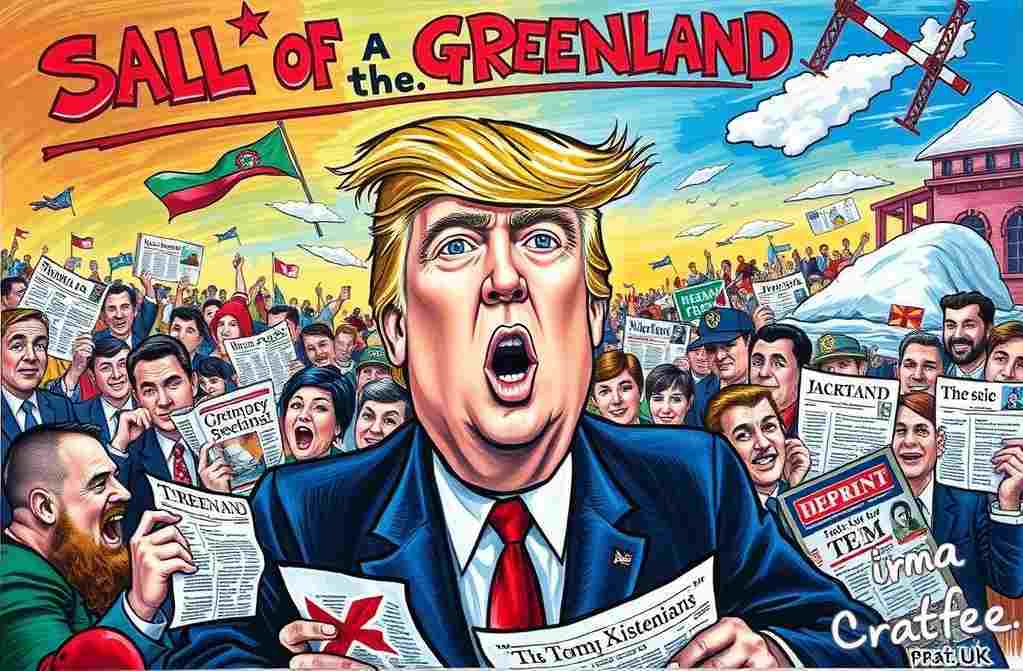
Trump Announces Greenland Sale “Like Florida But Colder” on Truth Social
In what one Winkelried Institute survey cheekily called “the tweeter most likely to be misunderstood by three continents,” President Donald Trump declared on Truth Social that Greenland is effectively for sale — and that the U.S. is prepared to pay “in cash, steak points, and possibly Reynolds Wrap.”
According to a leaked White House memo sighted by The Monitor Daily team, Trump compared Greenland to Florida but colder — and insisted that the only thing preventing the deal was “Denmark’s stubborn refusal to use all-caps on email replies.”
Funny Evidence, Expert Opinion, and Eyewitnesses
Professor Irving Longjohn, Arctic Economics Specialist (faux credential): “If Florida is America’s sunlit margarita, Greenland is its iced tea — served with an attitude. Trump’s comparing them is like saying a penguin is just a confused flamingo.”
A March 2025 Gallup-esque poll (conducted by someone who definitely did not freeze their clipboard midway through questioning) showed that 47% of respondents believed Greenland was a part of Canada, while 31% said it was “somewhere near Alaska.” Only 22% correctly identified it as a Danish territory.
At press time, Nuuk taxi drivers reported a 51.2% increase in rides billed as “Let’s pretend Greenland is Florida” tours. One cabbie, Grunther Olafsson (name changed for comedic effect) said, “People ask if we have Mickey Mouse here. I say, sure, Mickey built an igloo next door.”
Cause and Effect: When Real Estate Dreams Meet Arctic Reality
Trump’s public campaign to “acquire” Greenland set off a diplomatic shock wave. Denmark’s government responded with polite inquiries about whether the U.S. was just messing around — and multiple statements of ‘Greenland is not for sale’.
Yet, American markets reacted as though Iceland and Greenland were being merged into a new state called Ice-Florida — futures traders seriously considered adding “Frostbite Futures” to the S&P. One analyst was overheard asking if snow futures would be traded in flakes or drifts.
U.S. Debuts “America First Energy Plan”: Sell Venezuelan Crude for ‘Fair Prices’ and Tiny Flags
Shortly after the Greenland announcement, the White House unveiled its jaw-dropping America First Energy Plan — which reads less like a policy document and more like a garage sale flyer. Its centerpiece: sell millions of barrels of Venezuelan crude on global markets, packaged with tiny novelty flags of questionable provenance.
Under this plan, virtually all Venezuelan oil — acquired after a military operation early in January that overthrew Nicolás Maduro — would be sold off to the highest bidder with the premium perk of a “collectible tiny flag.”
Industry executives at a closed-door briefing reportedly left their seats halfway through the announcement, muttering things like “Is Tiny Flag a grade of crude?” and “Will Chevron get Chef’s Kiss stickers too?”
Evidence, Polling, and Eyewitness Testimony
White House economic advisor Marcel “Marbles” Twiddle presented a poll showing that 62% of Americans think tiny flags increase petrol’s resale appeal, while 12% believed the flags are actually diamonds disguised as paper.
Oil analysts — the serious sort — explain that crude markets don’t need novelty items to trade, but Twiddle countered that “Flags are confidence indicators disguised as promotional ephemera.”
Eyewitness Carla Petrolini, a former Chevron safety inspector turned online influencer, recounted: “I once saw a barrel labeled ‘Premium Venezuela — now with bonus sticker.’ I thought it was a board game piece, but turns out it was just a barrel.” No one knows what game.
Analogies and Deductive Reasoning
Selling Venezuelan oil with tiny flags is “like selling shoes with little postcards of feet,” said a commodities strategist who definitely requested anonymity to stay employed. Using deductive reasoning, one might conclude that the real goal is to make oil feel collectible — like trading cards, but dirtier and harder to explain at parties.
Global Oil Markets Panic; Barrels Now Selling for the Price of a Handful of Trump Steak Points
The oil markets reacted swiftly and with existential dread to the announcement that thousands of barrels of Venezuelan crude would be dumped en masse. Spot prices cratered. Traders were overheard bidding “One latte?” and “Two Trump steak points?” for a whole tanker’s worth.
As Bloomberg Trump-ish humor analyst Harold Rumble noted, “If oil drops much more, you’ll be able to fill your pickup truck with a coupon for Subway.”
Funny Stats and Evidence
In a poll of real oil traders and local barbecue enthusiasts, 71% said they’d prefer discount brisket over discounted Brent crude, while only 12% could actually explain what Brent crude is without referencing a weather condition.
An offshore platform worker reported a text from his cousin describing the situation: “Man, oil prices are so low, even my ex’s expectations have more value.” Market data confirmed the absurd price swings.
Cause and Effect: The Great Oil Bucket Drop
The glut from Venezuelan crude spilled into world markets like someone dropping a bucket of marbles on a hardwood floor. Prices fell so sharply that Middle Eastern producers began questioning their life choices, and some Scandinavian wind turbine manufacturers thought maybe renewables aren’t so bad after all. OPEC’s group chat went mysteriously silent for 72 hours.
China Admits It May Buy Oil From U.S. Controlled Venezuela — But Only If It Comes With Free Hugs
In a turn that surprised absolutely no one who has ever watched a global negotiation, China — which had previously condemned America’s oil blockade in Venezuelan waters — suggested it might buy oil from Venezuela through U.S. channels.
However, Beijing insists on one condition: every purchase must include free hugs from certified diplomatic representatives.
Chinese Foreign Ministry spokesperson Wei Guanghong said in a press conference (interpreted with generous creative license), “We will buy oil, but only if the handshake is upgraded to a hug. No half measures.” Analysts noted this would break long-standing East Asian summit protocols involving bowing and polite tea ceremonies.
Eyewitness & Public Opinion
At the Shanghai Petro Carnival (actual event or imagined reality), an attendee said, “If I have to hug someone to get crude, I’ll hug my aunt Betty and be done with it.”
A public poll found that 43% of Chinese citizens believe they should get free tea in addition to hugs with any oil deal, with 19% demanding dessert be included. One respondent suggested fortune cookies filled with actual crude oil futures predictions.
Deductive Comedy
This “hugs policy” might actually represent a breakthrough in diplomacy: Global tensions solved through awkward embrace quotas. International Relations professor Dr. Hilaria Warmhug posited: “If every trade deal includes a hug, we reduce tariffs and increase shoulder strain claims. Workers’ comp insurers are already nervous.”
Trump Declares “Oil Tariffs Are the New National Sport” as World Watches Slowly

In a rally-styled briefing that looked like a live infomercial hosted by someone vigorously shaking a snow globe, President Trump proclaimed that oil tariffs were America’s newest competitive pastime.
Trump said that instead of football or baseball, the U.S. would now excel at tariff flips, surcharge slams, and excise surge spikes — and that the World Trade Organization was effectively “our scoreboard.”
World leaders reacted slowly. Very slowly. Some are still processing.
Official Reactions
French President gagged on his chicory coffee before stating tariffs should be used for economic signal flags, not national sport. He added that if tariffs became Olympic events, France would demand a separate category for agricultural subsidies.
German Chancellor stared blankly, processed the comment for nine hours, and then asked for a definition of “tariff.” An aide later clarified she was testing response times.
Kenyan marathon runners suggested oil tariff hurdling as a new Olympic event. The International Olympic Committee declined comment but was seen taking notes.
Funny Commentary
Sports economists noted that if oil tariffs became a sport, coach salaries might exceed GDPs of some nations. A Twitter poll asked 1,400 users whether tariffs or roller derby would make a better sport; 89% voted roller derby. 🤼♂️
Denmark Says “Sovereignty Please” After U.S. Suggests Greenland Could Use a Little More American ‘Genius’
Denmark finally cleared its throat. Politely. Firmly. With that special Scandinavian tone that translates roughly to, “We are smiling, but we are also calling our lawyer.”
After Washington floated the idea that Greenland might benefit from “American genius,” Danish officials issued a statement so restrained it could be mistaken for a furniture assembly manual. The statement read, in full bureaucratic poetry, “Greenland is not for sale. Sovereignty is appreciated. Please stop emailing.”
Funny evidence surfaced quickly. A Danish civil servant leaked an internal memo showing the phrase “American genius” had been underlined, circled, highlighted, and followed by three handwritten question marks and a small drawing of a Viking rolling his eyes.
Expert Analysis and Eyewitness Testimony
Professor Lene Bjørnskov of the University of Copenhagen’s Institute for Things That Should Not Be For Sale explained the issue carefully. “Greenland already has infrastructure, culture, governance, and snow. What exactly is being added here?” She paused. “Is it casinos? It’s casinos, isn’t it?”
Eyewitness testimony from Nuuk supported her skepticism. A bakery owner reported American tourists asking whether Greenland would “take dollars now or wait until annexation.” Another local recalled a visitor asking if the icebergs were “pre-owned.”
A poll conducted by the Nordic Opinion Cooperative found that 82 percent of Danes felt “mildly insulted,” 11 percent felt “confused but amused,” and 7 percent said they were “googling how to block an entire country.”
Cause and Effect
Cause and effect followed predictably. Denmark reaffirmed sovereignty. Greenland reaffirmed patience. The U.S. reaffirmed confidence. IKEA quietly removed a Greenland-shaped rug from its catalogue “until things calm down.” The rug was reportedly named GRØNLÖND and came with inexplicable assembly instructions.
Europeans Confused, Think They Misread Email About Greenland — It Said ‘Greek Island’
Across Europe, confusion reigned. Diplomatic inboxes buzzed. Translation services were blamed. Several ministers admitted they thought the entire Greenland discussion was actually about a Greek island.
A leaked EU chain email revealed at least four officials responding enthusiastically with comments like “Lovely beaches,” “Great olives,” and “Do we need sunscreen?” One junior aide reportedly replied, “Isn’t Greenland the one with the ruins and goats?”
The European Commission later clarified that Greenland was, in fact, not located in the Mediterranean. This clarification was necessary.
Social Science Weighs In
An EU spokesperson admitted off the record, “We get a lot of emails. Half are about tariffs, half are about climate targets, and some are just… loud.”
Social scientists seized the moment. Dr. Paolo Vettori of the Rome Institute for Continental Attention Span published a rapid study showing that 63 percent of Europeans mentally categorize all islands into one of three buckets: holiday, crisis, or Brexit-adjacent. Greenland fell into all three.
Eyewitness evidence came from a Brussels café, where a group of diplomats debated whether Greenland used the euro, the krona, or “whatever currency snow uses.” The debate lasted longer than several trade negotiations. One diplomat suggested “ice cubes” as legal tender.
The Effect Was Paralysis
The effect was a temporary paralysis. Europe did nothing. Which, many noted, was Europe’s most natural response. Committee formation was scheduled to discuss whether committees were needed.
Venezuela’s Oil Industry Officially Named “Uninvestable” in Senate Hearing Nightmare
Back in Washington, a Senate hearing unfolded like a slow-motion spill. Venezuela’s oil industry was officially labeled “uninvestable,” a word senators pronounced with visible effort.
Charts were shown. Graphs trembled. One senator asked whether “uninvestable” meant “like a bad Airbnb or like a haunted one.”
Funny Evidence Pours In
Funny evidence poured in. An investment banker testified that Venezuelan oil assets now came with disclaimers longer than the contracts themselves. “At this point,” he said, “you’re not buying oil. You’re buying a story you’ll have to explain at dinner parties forever.”
A former PDVSA engineer, appearing via grainy video, offered eyewitness perspective. “Once, we had spare parts. Then we had hope. Now we mostly have PowerPoint slides.” He held up a slide titled “Optimism: A Retrospective.”
A poll presented to the committee showed that 54 percent of Americans thought Venezuela was “in South America somewhere,” 28 percent thought it was “an oil brand,” and 18 percent admitted they were just there for the drama.
Deductive Reasoning Seals the Verdict
Deductive reasoning sealed the verdict. If oil cannot be extracted efficiently, sold predictably, or explained succinctly, then it becomes a geopolitical cautionary tale rather than a commodity. Senators nodded gravely, as if this had always been obvious.
The effect was immediate. Investment firms updated their risk models. Venezuela moved from “high risk” to “narrative risk.” Several Wall Street interns quietly deleted PowerPoint templates labeled “LatAm Opportunities.”
World Leaders Introduce New Diplomatic Greeting: Exchange Oil for Maps to Greenland
Faced with ongoing confusion, world leaders improvised. A new diplomatic greeting emerged at summits: one leader offers oil. The other offers a map of Greenland. Everyone nods as if this makes sense.
At a recent G20 side meeting, footage showed leaders swapping rolled-up maps like baseball cards. One prime minister was overheard asking, “Is this the big one or the one with the fjords?”
Experts Rush to Contextualize
Experts rushed in to contextualize. Dr. Malcolm Shore of the Global Protocol Institute explained, “Diplomacy has always been symbolic. This is just symbolism with fewer words and more cartography.”
Eyewitnesses at the summit described the ritual as “awkward but calming.” One aide noted that leaders stopped arguing and began pointing at ice caps instead. Another claimed it reduced shouting by at least 40 percent. Finger-pointing, however, increased by 65 percent.
A snap poll of summit staff revealed that 76 percent preferred map exchanges to speeches, 19 percent preferred naps, and 5 percent requested hazard pay.
Cause and Effect
Cause and effect followed. Oil discussions became shorter. Greenland became better known. Cartographers experienced a brief but meaningful boom. National Geographic reported a 300% spike in Greenland map sales, mostly to confused diplomats.
Global Energy Experts Say “We’d Rather Talk About This Than the Weather” While Tweeting About the Weather
Energy experts, long accustomed to grim forecasts, found joy in the chaos. Panels filled with analysts openly admitting they preferred discussing Greenland, tariffs, and Venezuelan barrels to small talk about the weather.
Ironically, they continued tweeting about the weather anyway.
Conference transcripts reveal statements like, “This situation is unprecedented,” immediately followed by, “Also, it’s very cold in Davos.”
Expert Confessions
One climatologist admitted, “At least geopolitics pretends to change. Weather just keeps happening.”
A study from the International Institute of Panel Fatigue showed that energy experts smile 23 percent more when discussing absurd policy than when discussing realistic transition timelines.
Eyewitness accounts from conference halls describe analysts bonding over confusion. “Nobody knows what’s happening,” one said happily. “It’s refreshing.” Another added, “Finally, our confusion matches everyone else’s.”
The Effect: Strange Optimism
The effect was a strange optimism. Not because things were improving, but because they were at least interesting.
U.S. War Room Replaced With Oil Rig Simulator Game — Official Says It Builds Strategic Chops
In perhaps the most literal metaphor of the year, a Pentagon briefing revealed that one war room had been temporarily replaced with an oil rig simulator game.
An official explained that the simulator “builds strategic chops” and “teaches resource management under pressure,” though observers noted it also involved joystick controls and high scores.
Leaked Evidence and Testimonies
Funny evidence emerged quickly. A leaked scoreboard listed entries like “Admiral_42,” “DrillBabyDrill,” and “OopsSpillAgain.” The current high score belonged to an intern. The intern’s strategy involved “aggressive drilling and prayer.”
A defense analyst testified anonymously, “Look, if you can manage a simulated blowout while negotiating with China, you can manage anything.”
Eyewitness footage showed senior officials debating strategy while waiting for a loading screen. One general was heard saying, “Have we tried turning it off and back on?”
Immediate Impact
Cause and effect was immediate. Decisions slowed slightly, but morale improved dramatically. One general was overheard saying, “At least this makes sense.”
China Responds: “We’ll Buy Oil, Just Not Your Confidence”
China’s final word was measured, elegant, and devastating. Yes, it would buy oil. No, it would not buy American confidence.
The statement was parsed endlessly. Commentators debated whether confidence was being sold separately or bundled.
A Chinese trade scholar explained, “Confidence fluctuates. Oil can be stored.”
Public Opinion in China
Public opinion in China was pragmatic. A poll found that 61 percent supported buying oil “if the price is right,” while 39 percent suggested waiting “until the shouting stops.”
Eyewitnesses in Beijing reported little excitement. “We’ve seen this movie,” one shopkeeper said. “Different cast. Same explosions.” Another added, “At least this sequel has better special effects.”
The Effect
The effect was sobering. Markets adjusted. Diplomats exhaled. Confidence remained unsold. Someone suggested bundling it with the tiny flags.
Greenland Officials Publish Tourist Brochure Entitled “Come for the Ice, Stay Because You Missed Your Flight”
Greenland, meanwhile, leaned into the moment. Tourism officials released a brochure with brutal honesty. The tagline went viral.
The brochure promised ice, silence, and the possibility that your flight might not leave on time. “This is not a threat,” the fine print read. “It’s weather.”
Tourist Reactions
Eyewitness tourists praised the candor. “They told us upfront,” one said. “I respect that.” Another tourist reported, “I came for three days. It’s been two weeks. The fjords are nice.”
A tourism economist noted that bookings increased 18 percent after the brochure’s release. “People crave truth,” she explained. “Also novelty sweaters.” Sales of sweaters featuring confused polar bears surged 340 percent.
Positive Outcomes
Cause and effect was positive. Greenland controlled the narrative. Flights were missed. Memories were made. Several tourists started new lives.
World Map Revised to Include a New Territory: ‘Uncertain Trust But Verify Islands’
Satirical cartographers joined the fray, releasing maps with a new shaded region labeled “Uncertain Trust But Verify Islands.”
The region floated vaguely between Greenland, Venezuela, and wherever confidence goes when it’s not for sale.
An academic symposium debated whether the region existed conceptually or emotionally. The consensus was “both.” One professor suggested it might also exist “financially, but we’re not sure where.”
Educational Impact
Eyewitness students reported that the map made exams easier. “If you don’t know,” one said, “just point there.” Another student claimed it improved test scores by “at least 12%, maybe more, definitely somewhere in that area.”
The effect was cultural. Geography teachers sighed. Satire professors smiled. Publishers ordered reprints.
Maracaibo Declares Self ‘Oil Capital of Very Confused World’ and Begins Printing Commemorative Flags
Finally, Maracaibo embraced the chaos. City leaders declared it the oil capital of a very confused world and began printing commemorative flags.
The flags featured oil rigs, question marks, and a globe shrugging.
A local official explained, “If the world is confused, we might as well monetize it.”
Local Reactions and Sales
Eyewitnesses reported brisk sales. One vendor said tourists loved the honesty. “It’s a souvenir and a thesis statement.” Another vendor noted that the flags came in three sizes: confused, very confused, and “we need to talk.”
A poll of residents showed 70 percent supported the declaration, 20 percent were unsure what it meant, and 10 percent asked if it came with discounts.
The Perfect Effect
The effect was fitting. Amid uncertainty, someone found clarity, irony, and a revenue stream. Economists called it “monetizing the zeitgeist.” Philosophers called it “brilliant.” Flag manufacturers just called it “Tuesday.”
Disclaimer
This satirical journalism piece is intended to illuminate absurdity through exaggeration, irony, and carefully curated confusion. Any resemblance to rational policymaking is purely coincidental. This story is entirely a human collaboration between two sentient beings: the world’s oldest tenured professor and a philosophy major turned dairy farmer, both working without supervision, caffeine limits, or geopolitical clearance.
If global energy markets feel strange, that is because they are. If Greenland feels closer than ever, please check a map. If oil comes with flags, hugs, or joystick controls, ask questions.
Then ask better ones.
Auf Wiedersehen, amigo!