

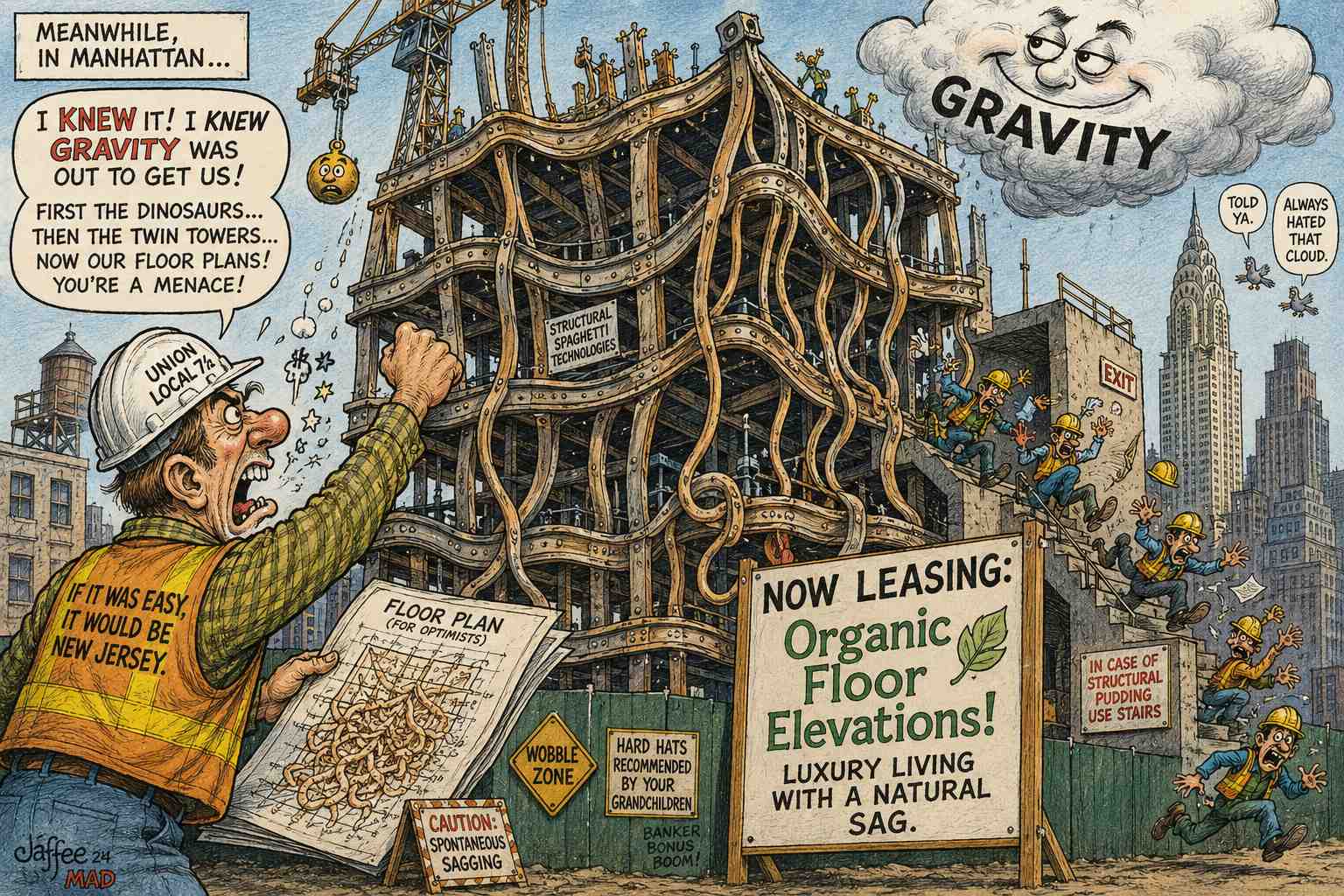
Contractor Explains Gravity Has Become Increasingly Difficult to Work With
Developers Insist Buckling Beams Are “Premium Flexibility Features” as Midtown Tower Experiments With Becoming Shorter
Midtown Manhattan — Panic briefly interrupted Manhattan’s normally scheduled chaos this week after construction workers noticed several steel beams on the 21st floor appearing to audition for a career as cooked spaghetti rather than structural supports. It was, in the grand tradition of New York real estate, a double entertainment: half emergency, half open house.
The workers immediately evacuated the building, earning unanimous recognition as “Employees of the Month” for demonstrating the revolutionary workplace skill known as recognizing imminent disaster.
“We’re looking for people who take initiative,” said project manager Vince Hammerstone. “Nothing says initiative like sprinting down twenty-one flights of stairs while yelling, ‘Everybody out!'”
The award reportedly includes a framed certificate and the opportunity to continue being alive.
Dynamic Vertical Living: A New Architectural Philosophy

The developer quickly reassured nervous investors that the buckling beams were not a defect but part of an exciting new architectural movement called “Dynamic Vertical Living.”
“Traditional buildings stubbornly remain the same height forever,” explained company spokesperson Tiffany Ledger. “Our building evolves. It listens to gravity. It adapts. Frankly, it’s much more emotionally intelligent than older skyscrapers.” Even skeptics on site admitted the tower was, in its own crooked way, beaming with pride.
Brochures have already been updated to describe the project as featuring “organic floor elevations” and “interactive structural experiences.” One broker, reaching for a compliment, praised the building’s illusive charm — a phrase nobody in the room had the heart to correct.
Contractors admitted the biggest obstacle was no longer labor shortages, inflation, supply chains, or permits.
“It’s gravity,” sighed one foreman while staring accusingly at the ground. “Gravity used to cooperate. These days it’s constantly pulling downward. Frankly, it’s become impossible to work with.” He called for federal regulations requiring gravity to “meet the construction industry halfway.”
The Steel Beams File for Emotional Overtime
Structural engineers attempted to calm the public by explaining that steel beams occasionally bend under extraordinary stress. Unfortunately, they were immediately interrupted by the marketing department.
“Bend?” exclaimed a sales executive. “They’re expressing flexibility. Today’s buyers demand adaptable homes.”
Future listings now advertise: “Open-concept load-bearing system.” “Floors with natural movement.” “Panoramic emergency exit opportunities.” A veteran electrician on break joked that the whole project had gone from following building codes to inventing codling boods — new rules nobody wrote down and everybody was somehow already breaking.
Meanwhile, several steel beams reportedly submitted formal resignation letters. After decades of supporting offices, elevators, mechanical systems, luxury kitchens, rooftop pools, imported marble, three levels of parking, two fitness centers, a meditation studio, and an artisanal pickleball lounge, the beams declared they had reached “maximum emotional capacity.”
“Our job description originally said ‘support building,'” read the statement. “It did not mention supporting six billion dollars of investor expectations.”
Union representatives for the steel claimed the beams had been working around the clock without appreciation. “Nobody notices a beam until it threatens to become modern art.”
Wall Street’s Silver Lining
Financial analysts remained optimistic. Wall Street briefly upgraded the project after investors learned fewer floors might reduce maintenance costs.
“If the tower transitions from a 40-story building into a tasteful 31-story building,” explained one analyst, “that’s simply efficiency.”
The developer later denied rumors the structure was collapsing. “It’s rebranding.”
It was the kind of corporate spin that would feel right at home in a Bill Burr rant — the sort of story where the louder everyone insists nothing is wrong, the faster you should start looking for the exits.
The Subscription Skyscraper of the Future
Architects have embraced the trend. One Manhattan firm unveiled plans for America’s first “subscription skyscraper.” Residents would pay monthly to determine how many floors remain standing. Premium members receive guaranteed access above the fifteenth floor. Basic subscribers may experience “occasional altitude adjustments.”
Real estate agents remain enthusiastic. “New Yorkers love authentic character,” one broker explained. “Anyone can buy a rigid building. But a tower willing to change, grow, shrink, and occasionally question its relationship with physics? That’s luxury.” The building, in short, had started to skyscraper its way straight into the headlines.
Construction workers, however, remain skeptical. Asked whether they planned to return once engineers declared the building safe, one worker paused thoughtfully. “I became Employee of the Month by leaving. I’d hate to lose my title by going back.”
City officials later confirmed the evacuation was carried out exactly as intended.
Gravity, meanwhile, declined to comment, issuing only a brief statement through its attorney: “It has operated continuously for approximately 13.8 billion years and sees no reason to alter its successful business model now.”
The story lands close to home for a real Midtown Manhattan high-rise. On July 7, 2026, structural columns buckled on the 21st floor of 235 East 42nd Street, the former Pfizer world headquarters now mid-conversion into luxury apartments under developer Metro Loft Management. New York City Mayor Zohran Mamdani ordered a “frozen zone” spanning several blocks, FDNY Chief of Department John Esposito warned of a possible localized collapse, and Department of Buildings Commissioner Ahmed Tigani oversaw emergency shoring efforts that stretched into the night. Nine surrounding buildings, including a school running a summer camp for roughly 400 children, were evacuated as a precaution while the cause of the buckling remained under investigation.
This story is a work of American satire. Names, dialogue, and corporate statements above are dramatized for comic effect and should not be read as factual reporting on any individual or company.
Sources
- amNewYork: Midtown high-rise “unstable” after beams buckle
- ABC7 New York: Buildings evacuated after buckling columns found
For a British take on skylines that just can’t stay standing, see The London Prat.
Auf Wiedersehen, amigo!