

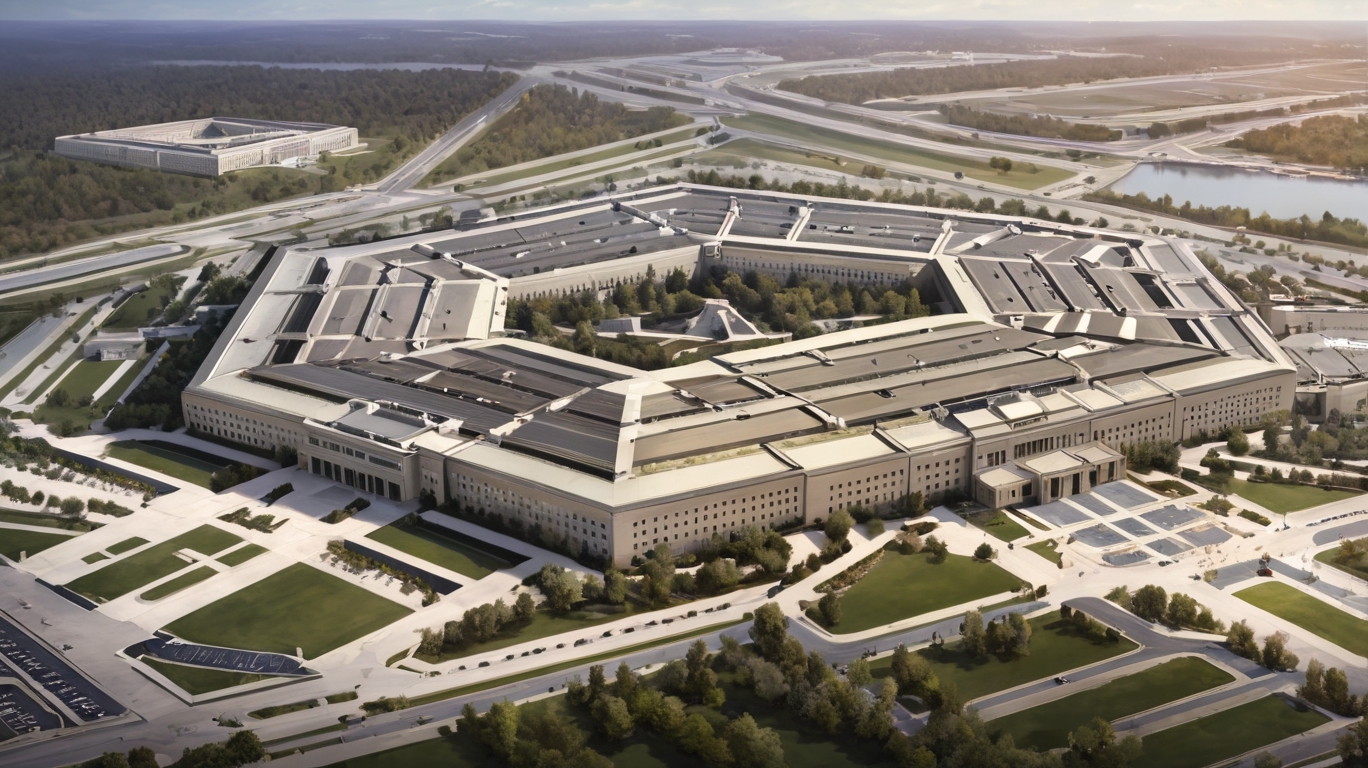
General Caine’s Pentagon Tightrope: How to Bomb Iran Without Bombing the Briefing
Welcome to the Pentagon’s New Reality Show
On Thursday morning, the Pentagon briefing room smelled like a cross between a funeral and a film set — overly lit, underfed, and thick with tension. General Dan Caine approached the podium like a man delivering a eulogy for facts. Behind him, flags flanked him like stage props. In front of him, journalists leaned in, pens poised, expressions tight.
But the real audience? Somewhere in a marbled bathroom in Mar-a-Lago, a man in a golden robe sipped Diet Coke and waited to see whether the general’s performance would earn him another week of job security or a 2 a.m. ALL CAPS Twitter review.
Caine’s task was deceptively simple: explain the recent U.S. airstrike on Iran’s Fordo nuclear facility in a way that pleased military analysts, didn’t panic allies, soothed swing-state voters, and most importantly, didn’t irritate the man upstairs. Not God — Trump.
“Kinetic Diplomacy” and Other Euphemisms from the Euphemism Factory
General Caine began his remarks with what could only be described as an interpretive dance of language. The words “bomb” and “casualty” were nowhere to be found. Instead, we got:
“A successful application of kinetic diplomacy designed to shape adversary behavior while affirming regional commitments.”
Which is Pentagon for: we blew something up, and we’re hoping it sends a message, assuming the message wasn’t intercepted by pigeons or poor Wi-Fi.
Eyewitness accounts later confirmed that “targeted infrastructure” included a radar dish, a moped repair shop, and a goat that has since applied for asylum in Qatar.
When pressed on whether the mission accomplished anything specific, Caine responded with all the clarity of a Magic 8-Ball reading from a teleprompter:
“Mission success is not always measured in immediate feedback loops, but rather in sustained strategic posture recalibrations.”
In English: We don’t know if it worked, but everyone clapped.
Trump’s Vision of the Military: Part Parade, Part Pay-Per-View
According to White House insiders, Trump requested a PowerPoint deck ahead of the briefing that opened with a title card reading: “MISSION ACCOMPLISHED?” — the question mark written in glitter. One aide reportedly asked if they should remove the sparkle. The President allegedly replied, “Leave it. It’s classy.”
He then asked if they could “get a trailer for it” — as if the strike were a Marvel movie.
“Imagine it,” he said. “Jets. Slow-mo. Cut to the flag. Boom. Fordo: Freedom Unleashed. I want Morgan Freeman voiceover.”
Caine, to his credit, didn’t mention the glitter. But you could hear it in his tone. He sounded like a man forced to speak through a script prepared by someone who thinks foreign policy is a Cinemax reboot of Top Gun.
When a General Becomes a Game Show Host
The new reality for military briefings is clear: generals don’t just command armies — they audition for the approval of a commander-in-chief whose idea of intelligence briefings includes Yelp reviews and reruns of The Apprentice.
General Caine’s military pedigree is strong — seasoned, serious, and sharpened by real-world experience. But on Thursday, he resembled less of a battlefield tactician and more of a man trying to present serious information without triggering a man who believes bombings should trend on TikTok.
“We have no further comments on operational specifics,” Caine stated.
Translation: I’m already in enough trouble for not saying the words ‘spectacular’ or ‘America First’ in the first 90 seconds.
The choreography is delicate. If a general sounds too cautious, he’s “weak.” Too aggressive, and he’s “going rogue.” Too accurate, and he’s “leaking.” Too vague, and he’s “boring.” One aide described it as “speaking fluent presidential anxiety.”
The Pentagon’s New Language Manual
In recent years, the Department of Defense has quietly released a new internal document: The Euphemism Survival Guide (2025 Edition). Among its top rebrands:
-
“Bombing campaign” → “Targeted deterrence initiative”
-
“Civilian casualties” → “Unintended proximity variables”
-
“Blowback” → “Freedom-induced turbulence”
General Caine, ever the professional, stuck closely to the script. Not a single reporter could pin him down on whether the mission resulted in a setback for Iran or a budget increase for Raytheon.
Instead, he praised “interoperable synergy across command assets,” which, according to one military translator, means: we all fired stuff at the same time and nothing exploded in our own faces.
A Parade of Patriotism with No Destination
Reporters, perhaps out of habit or caffeine deprivation, nodded along. Caine looked relieved. He had walked the tightrope, juggled buzzwords, dodged questions, and still managed to salute a photograph of the Constitution on the way out.
Yet behind the scenes, whispers swirled. One Pentagon staffer noted:
“The real mission wasn’t hitting the target in Iran. It was surviving this press conference without getting tweeted out of a career.”
Defense analysts noticed that the video package provided post-briefing had been heavily edited — complete with slow fades, filter overlays, and a background track suspiciously similar to Eye of the Tiger.
The Strike as Cinematic Experience
On Twitter, the strike was trending under the hashtag #FreedomStrike. Conservatives called it bold. Liberals called it reckless. Independents called it “a nice distraction from the humidity.”
One digital media consultant suggested turning future briefings into pay-per-view content:
“Think of it: $4.99 a month. Access to drone footage, general interviews, behind-the-scenes war planning. Add merch — ‘I Got Kinetically Diplomacized’ mugs — and you’ve got a billion-dollar brand.”
When asked if this trivialized war, the consultant replied: “What war?”
The Soldiers Who Actually Carried It Out
Meanwhile, far from D.C., the airmen who executed the Fordo strike reportedly ate cold MREs and watched the press conference via choppy satellite feed. One pilot messaged his family: “The general’s talking about synergy. I just hope they don’t synergize my next mission into Syria.”
Another joked that if they had to call their bombing runs “kinetic diplomacy” one more time, they were going to ask for a new job in “ballistic hospitality services.”
What the Funny People Are Saying
“The Pentagon now sounds like a startup pitching a war app at South by Southwest.” — Jerry Seinfeld
“If you say ‘kinetic diplomacy’ three times in a mirror, John Bolton appears and yells at your kids.” — Jon Stewart
“General Caine had the vibe of a guy explaining he almost won a bar fight, but with jets.” — Sarah Silverman
“If the goal was to look competent while saying absolutely nothing, five stars. I haven’t seen that kind of performance since my last date.” — Larry David
“Honestly, I miss when ‘bombing’ meant you told a bad joke. Now it just means the joke’s got funding.” — Dave Chappelle
The Real Fallout
So what did the strike accomplish? Analysts are split.
Some say it delayed Iran’s enrichment program. Others say it accelerated their rage. A third group says, “It’s complicated,” which in geopolitical terms means: we don’t know, and please stop asking.
Back in Washington, General Caine is reportedly preparing for next week’s briefing. Rumors suggest it may include holograms, a live band, and possibly a cameo from Lee Greenwood.
Trump, meanwhile, has floated the idea of branding the next missile launch as a “freedom capsule.” When asked about it, a visibly tired Caine replied, “We’ll assess all branding recommendations under the parameters of mission alignment.” Which is military-speak for: I’m too tired to fight this circus, and I still have to brief Marjorie Taylor Greene in ten minutes.
Journalism or Justification?
Caine’s briefing may go down as a masterclass in neutralized truth-telling — a man trying to remain honorable while being used as set dressing in someone else’s show. Critics on the left accused him of whitewashing. Critics on the right accused him of insufficient bootlicking.
The truth is more complicated: he’s a professional trapped between two impossible loyalties — to the truth, and to a man who once asked why nukes couldn’t be “used more like confetti.”
In one final moment of sincerity, Caine ended his briefing with a nod to the troops:
“Our forces carried out their mission with discipline, courage, and professionalism. We honor them not just with words, but with accountability.”
It was the only line that didn’t sound rehearsed.
Final Thoughts: Military Theater in the Age of Ratings
The modern military briefing is no longer about informing the public. It’s about managing perception. It’s about audience segmentation. It’s about making sure the guy with the biggest social following doesn’t think your briefing lacked pizzazz.
General Dan Caine walked the line. He didn’t fall off. But he didn’t dance, either. Which may be the bravest move of all.
Disclaimer
This article is a satirical work of journalism crafted by two fully sentient collaborators — a retired Cold War professor with strong opinions on font sizes, and a former dairy farmer who now identifies as a philosophy major with goats. All quotes, data, polls, and euphemisms are parodic but emotionally accurate. Any resemblance to actual Pentagon memos is purely karmic.
Auf Wiedersehen, amigos.
