

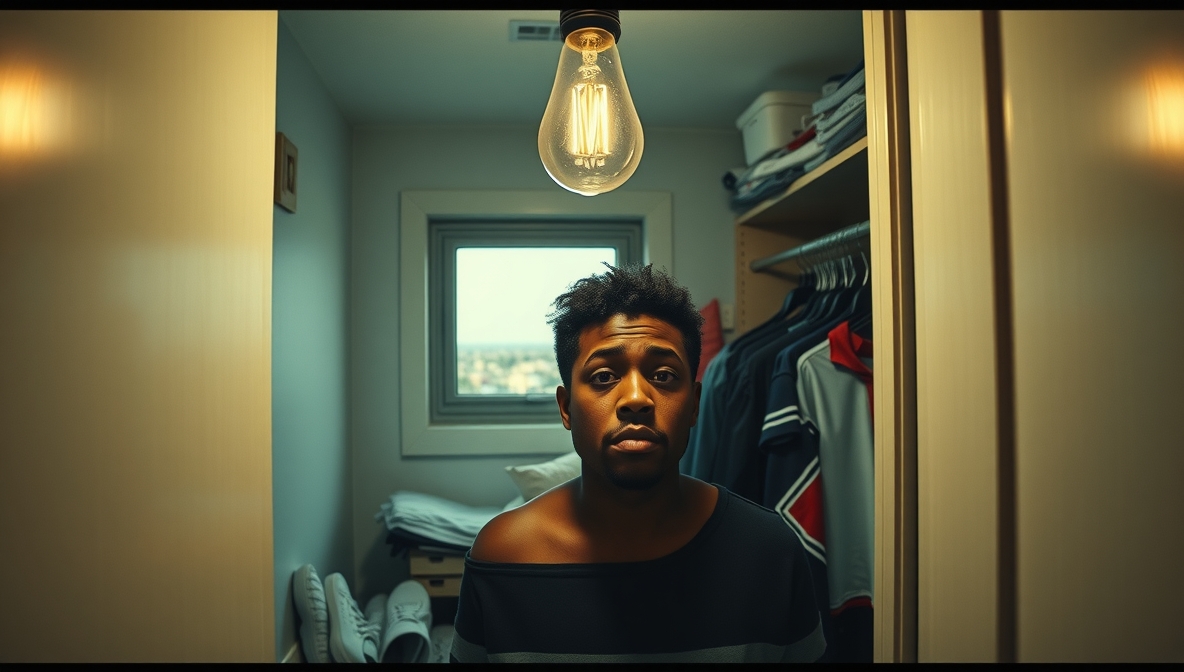
Housing Crisis Worsens: Americans Now Renting Closets, Paying Extra for Lightbulb
San Francisco, CA — As America’s housing crisis deepens beyond the realm of rational economics, citizens downsize from apartments to closets, where monthly rent averages $1,200—utilities, lightbulbs, and human dignity sold separately. Landlords market these accommodations as “innovative urban living solutions,” while tenants describe them more accurately as “indentured storage with monthly payments.”
When Storage Spaces Become Luxury Housing
A recent rental advertisement circulating on Zillow proudly featured a “cozy vertical living space” that investigation revealed to be a converted broom closet with a yoga mat permanently installed as flooring. The fine print read like dystopian fiction: “Window optional. Lightbulb sold separately. Tenant must provide own oxygen and existential hope.”
Real estate agents defend the trend with the shameless enthusiasm typically reserved for multilevel marketing schemes. “People complain about closet living, but this represents minimalism at its most refined,” explained Bay Area broker Madison Kensington, sipping $18 kombucha. “Closets offer character development opportunities. Who really needs room for full arm extension anyway?”
The Department of Housing and Urban Development released statistics confirming what economists call “the great spatial reduction crisis”: 52% of renters now occupy spaces smaller than average refrigerator packaging, while another 31% admit to splitting rent payments with actual coats, umbrellas, and seasonal storage items.
The Psychology of Extreme Downsizing

Mental health professionals report unprecedented numbers of patients seeking therapy for “spatial claustrophobia combined with financial desperation.” Dr. Rebecca Martinez, a psychologist specializing in housing-related anxiety, noted: “Clients describe dreams about stretching their arms without hitting walls. It’s like collective trauma inflicted through rental markets.”
A support group called “Closet People United” meets monthly in the one-bedroom apartment of a very wealthy hamster whose owner charges $50 per meeting attendance. Members share strategies for maintaining sanity while living in spaces originally designed for storing winter coats rather than human beings with basic spatial needs.
Kevin Hart said during his recent Los Angeles show, “Remember when people came out of closets? Now they’re moving back in and paying rent. I spent my whole career making jokes about being short, and now everyone’s living at my height level. This is not the equality I was hoping for.”
The Economics of Impossible Housing Mathematics
Economic analysts struggle to apply traditional housing affordability formulas when rental spaces measure in cubic feet rather than square footage. The standard recommendation that housing costs shouldn’t exceed 30% of income becomes meaningless when median closet rent in major cities equals or exceeds median salaries for college-educated professionals.
Closet residents develop innovative lifestyle adaptations that would impress space station astronauts. Social media influencers post TikTok videos demonstrating “closet chic” decorating techniques using fairy lights, fold-up furniture, and carefully curated emotional trauma as aesthetic elements.
Ron White said during his recent Dallas show, “I once lived in a trailer, and at least I could stretch my damn legs. These kids today pay $1,200 to live like socks in a drawer. Pretty soon, landlords will rent out individual hangers and call it ‘vertical housing innovation.'”
For now, Americans continue adapting to housing scarcity through creativity, compromise, and the kind of resourcefulness that turns storage spaces into homes. Whether this represents temporary crisis adaptation or permanent cultural transformation toward microscopic living arrangements remains to be determined.