

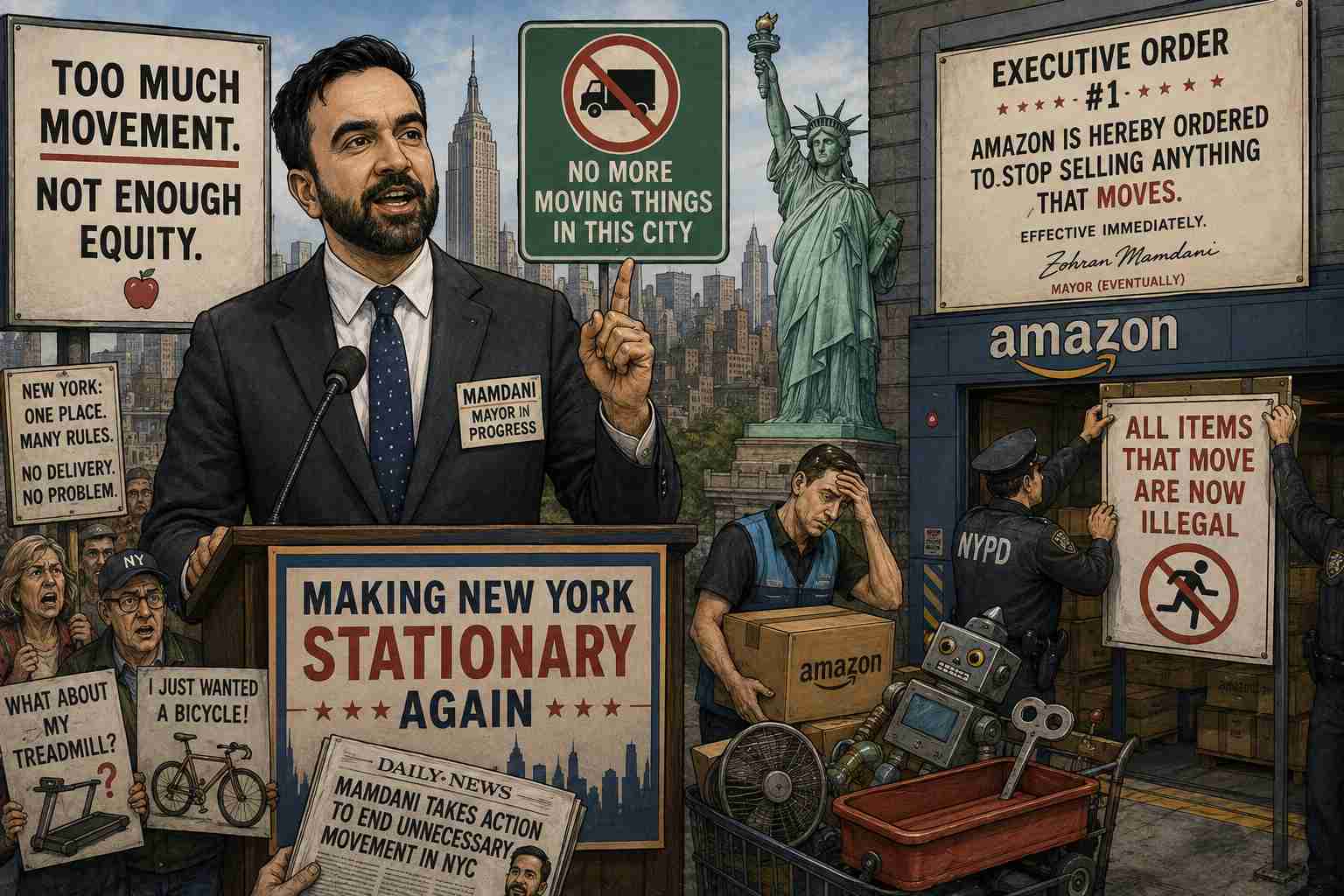
Mamdani Begins Restricting Movement in New York by Ordering Amazon to Stop Selling Anything That Moves
NEW YORK — In a bold new initiative to make the city safer, faster, and considerably harder to get around in, Mayor Zohran Mamdani this week ordered Amazon, Target, Walmart, Best Buy, Wayfair, Temu, and roughly three dozen other retailers to immediately stop selling anything a New Yorker might use to travel more than four miles per hour under their own power. City Hall says the crackdown on high-speed e-bikes and scooters is about public safety. Critics say it’s about a mayor who promised free buses and then, within the same news cycle, went to war with the very concept of getting somewhere quickly.
“We cannot and will not accept these dangerous vehicles on our city streets,” Mamdani declared at a City Hall press conference, standing in front of a poster board that appeared to have been assembled using nothing but a protractor and a grudge against delivery workers. Sources confirm the mayor’s own security detail arrived at the event in an SUV traveling well in excess of 25 miles per hour, but that particular vehicle was, city officials clarified, “differently dangerous.”
Free Transportation, As Long As It’s the Transportation We Already Had
Mamdani rose to prominence on a platform that included free buses for every New Yorker, a promise that generated headlines, hope, and at least one very expensive campaign mailer. Now, less than a year into office, the same administration is sending cease-and-desist letters to the exact companies selling the exact devices that low-income delivery workers actually use to get to work faster than a free bus that hasn’t arrived yet and, according to several riders interviewed near a Chipotle in Bensonhurst, “may never arrive, spiritually or otherwise.”
“I was promised free transportation,” said one delivery rider who declined to give his name because he was currently riding a device that, as of August 18th, will be illegal to have purchased. “Instead I got a letter telling Amazon it can’t sell me the thing I use to make forty dollars an hour. The bus is free. The bus is also historically, spiritually, and mathematically not here.”
Target and Amazon Told to Invent a Slower Bike
According to the Mayor’s Office, the cease-and-desist letters demand that 42 retailers stop selling devices capable of exceeding the city’s speed and weight limits by Aug. 18th or face fines of up to $2,000 per sale. Amazon, for its part, has reportedly responded by asking City Hall for a formal definition of “slow enough,” a request City Hall has been unable to answer despite having several transportation commissioners on staff whose entire job is definitions like this.
“We’re happy to develop a new e-bike,” said a fictional Amazon logistics spokesperson reached for satirical comment. “Given current specifications, our engineers believe we can build one that tops out at 4 miles per hour, features a built-in permission slip, and requires the rider to file quarterly paperwork with the Department of Transportation confirming they are, in fact, still moving.”
The Root Cause Turns Out to Be Physics
City officials say the crackdown follows the death of a 17-year-old riding an illegally modified device capable of nearly 30 miles per hour, a genuinely tragic incident that even the most committed satirist has no interest in mocking. What is fair game, however, is the size and shape of the government response, which appears to have concluded that the correct countermeasure to “some e-bikes go too fast” is “no retailer in the five boroughs may sell an e-bike at all until further notice.”
Mamdani has said he opposes registering and licensing e-bikes and their riders, insisting instead that the “root cause” of the danger lies with manufacturers and retailers, not with the 175 ZIP codes’ worth of customers who will now need to find their illegal-but-functional e-bike through channels that are, definitionally, harder for the city to regulate. Transportation analysts note that banning the legal sale of something rarely eliminates demand for it so much as it relocates that demand to a folding table on Canal Street.
A City That Runs On Delivery Apps, Confused By Its Own Delivery Apps
New York City’s entire modern economy — the 2 a.m. bodega run, the rain-soaked Seamless order, the birthday cake that appears at your door in eleven minutes because someone risked their life on Amsterdam Avenue to bring it — depends almost entirely on the exact category of vehicle City Hall is now trying to legislate out of retail existence. Delivery companies have not yet commented on how they intend to hit their delivery-time guarantees using a fleet of devices capped at a speed most City Council members could beat on a scooter borrowed from their child.
City Council Speaker Julie Menin has scheduled hearings on 17 separate bike-related bills, a number that suggests the council either takes this extremely seriously or simply ran out of other things to regulate this legislative session. Meanwhile, retailers have until Aug. 18th to comply, giving New Yorkers roughly two weeks to buy every fast e-bike currently in stock, a shopping rush City Hall apparently did not model into its safety projections.
Observations From the Bike Lane
- A mayor who campaigned on free buses is now making it harder to travel by anything that isn’t a free bus.
- Amazon has been asked to invent a bicycle slower than most pedestrians, which is technically just a very expensive bench.
- The “root cause” of speeding e-bikes turns out to be manufacturers selling e-bikes that go fast, a discovery on par with identifying rain as the root cause of wetness.
- Delivery workers who rely on these devices to earn a living now have two weeks to either stockpile inventory or rediscover the lost art of extremely fast walking.
- City Council has 17 bills on this topic, which is either thorough governance or proof that nobody wanted to consolidate them into one.
- The mayor’s own motorcade was, empirically, moving faster than the vehicles just banned.
- Somewhere in Canal Street’s future is a black market for the exact bicycles Target can no longer legally sell.