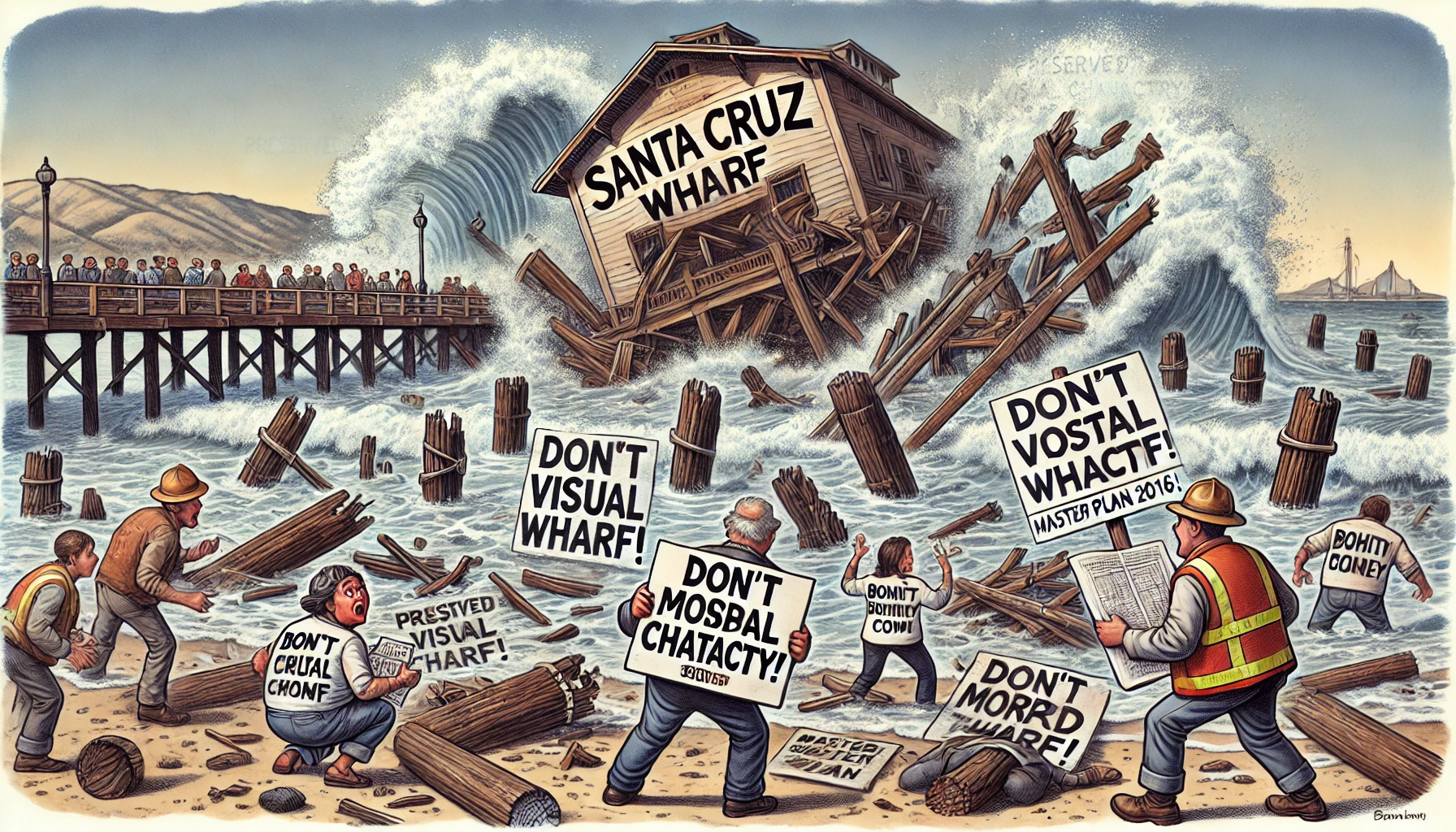
Santa Cruz Wharf Collapse: A Titanic Example of Environmentalism Gone Overboard
The Wharf That Mother Nature Renovated for Free
How Activists Preserved “Visual Character” and Forgot About Physics
Santa Cruz, CA — In the heart of Santa Cruz, where sunsets meet surfboards and bureaucracy meets blunders, the historic Santa Cruz Wharf stood as a testament to time—until it didn’t. A winter storm on December 23, 2024, reduced a 150-foot section of the century-old pier to splinters. The collapse was not an act of nature alone but the culmination of nearly a decade of environmentalist lawsuits, government dithering, and a collective obsession with preserving “visual character” over structural integrity.
Let’s dive into how the wharf became a cautionary tale of what happens when activism meets inertia, and Mother Nature decides to take matters into her own gusty hands.
A Decade of “Don’t Morph the Wharf”
In 2016, the city of Santa Cruz proposed a master plan to modernize the aging pier, including a walkway designed to protect the structure. Enter “Don’t Morph the Wharf,” an activist group with a passion for historic preservation and an apparent disdain for physics.
Gillian Greensite, the group’s spokesperson, declared in a now-infamous op-ed, “Putting obstacles in the way does nothing for safety or structural integrity.” Ironically, the storm put the biggest obstacle imaginable: the ocean itself.
As one local fisherman quipped, “Turns out the only thing morphing the wharf was Mother Nature—and she doesn’t need a permit.”
Environmental Lawsuits: Saving the Wharf by Destroying It
“Don’t Morph the Wharf” weaponized the California Environmental Quality Act (CEQA) to stall the city’s plans, arguing that the upgrades would degrade the pier’s visual charm. After eight years of legal wrangling, the activists emerged victorious in court, proving once and for all that paperwork trumps pilings.
City planner Linda Vaughn reflected, “We tried to explain that the walkway would act as a fender, but they said it would ruin the view. Well, now the view’s just debris and seagulls.”
Even comedian John Oliver weighed in on his show, saying, “Only in California could a law designed to protect the environment end up protecting the right to collapse into the ocean.”
The Visual Character That Sank
Preservationists argued that the walkway would “degrade the visual character” of the historic wharf. Apparently, they felt that a giant hole and floating debris were more aesthetically pleasing.
One beachgoer sarcastically remarked, “You know, the collapsed section really adds a rustic, open-air vibe. Very avant-garde.”
Meanwhile, the Historic Preservation Commission argued against modernization. Their chairperson stated, “Our job is to preserve history, even if it’s history falling into the ocean.”
A Master Plan That Masterfully Failed
The 2016 master plan was designed to address the $14 million backlog of repairs. Instead, it became an exhibit in the Museum of Unrealized Ideas. Approved in 2020, the plan faced relentless opposition, delays, and revisions.
By the time it was greenlit in 2024, the pier was already teetering on its wooden stilts like a drunk uncle at a wedding. One city engineer confessed, “We finally got approval, but by then it was like putting a Band-Aid on a sinking ship.”
Mother Nature: The Ultimate Environmentalist
On December 23, the storm did what the city and activists couldn’t: renovate the pier. Unfortunately, her methods involved 50-mph winds and towering waves.
The result? A $14 million problem turned into a $50 million disaster. Santa Cruz Mayor Fred Keeley, always the optimist, assured residents, “We’ll rebuild the wharf… eventually. Maybe. I mean, let’s not rush into things.”
One local café owner, whose business was on the pier, said, “I always knew the wharf was fragile, but I didn’t think it would be the Titanic. At least no one brought an iceberg.”
Government Listening to Activists: A Comedy of Errors
Critics have pointed out that city officials bent over backward to accommodate the environmentalists’ demands. As one frustrated taxpayer put it, “The only thing they didn’t consult was common sense.”
City Council meetings became theatrical performances, complete with passionate speeches, dramatic pauses, and the occasional slide show of artist renderings that never came to life.
One retired city worker remarked, “We spent more time discussing the shade of the walkway paint than the structural issues. Now we’re left with no walkway and no wharf.”
The Wharf’s Collapse: A Metaphor for Fiscal Responsibility
Santa Cruz is no stranger to financial woes. With a tax hike and deficits projected for eight out of the next ten years, the city’s budget was already on shaky ground—much like the pier itself.
The collapse has now become a budgetary black hole, with state disaster funds and Governor Gavin Newsom’s involvement adding to the mix. As one pundit observed, “When your best hope is government efficiency, you’re really out of options.”
The Businesses Left Adrift
The wharf housed 17 businesses, ranging from seafood restaurants to souvenir shops. Now, these establishments face an uncertain future.
Marina, a gift shop owner, lamented, “I didn’t think ‘floats well’ would become a requirement for my inventory.”
Meanwhile, the city’s promise of economic support feels as solid as the pier’s missing section. One café owner joked, “We’re getting financial assistance, but first, they have to find the pier.”
Environmental Activists: Unintended Architects of Chaos
While activists fought to preserve the wharf’s charm, they may have inadvertently contributed to its collapse. Environmental lawyer Dan Thorne remarked, “The CEQA is a powerful tool, but in this case, it became a weapon of mass obstruction.”
The irony isn’t lost on locals. As one resident quipped, “They saved the wharf from modernization, but they couldn’t save it from gravity.”
The Storm’s Sense of Timing
The storm hit just two days before Christmas, ensuring that the pier’s collapse would be both tragic and inconvenient. Santa Cruz resident Tony joked, “Nothing says ‘Happy Holidays’ like a floating chunk of pier drifting past your beach picnic.”
The timing also meant that three city workers were swept into the sea. Thankfully, they escaped unscathed—though they’ll likely think twice before taking another shift on the wharf.
Lessons in Futility
The Santa Cruz Wharf saga offers valuable lessons in what not to do. Here are a few takeaways:
- Lesson 1: Don’t ignore physics. Pilings don’t care about aesthetics.
- Lesson 2: Lawsuits are not structural reinforcements.
- Lesson 3: If you spend more time debating a project than building it, you’re already losing.
Looking Ahead: What’s Next for the Wharf?
As Santa Cruz grapples with the aftermath, the future of the wharf remains uncertain. Will it be rebuilt? Will it become a historical “reef” for scuba divers? Only time—and more lawsuits—will tell.
Mayor Keeley concluded, “It’s going to take time to get it right. And by ‘time,’ I mean another eight years, at least.”
Environmentalists, meanwhile, are regrouping. Gillian Greensite announced, “We’ll fight to ensure any reconstruction maintains the wharf’s historic character—preferably in pieces.”
Disclaimer
This article is a satirical examination of the Santa Cruz Wharf collapse. All events are factual, but the tone is meant to provoke laughter, not litigation. Any resemblance to absurd real-life bureaucracy is purely intentional.