

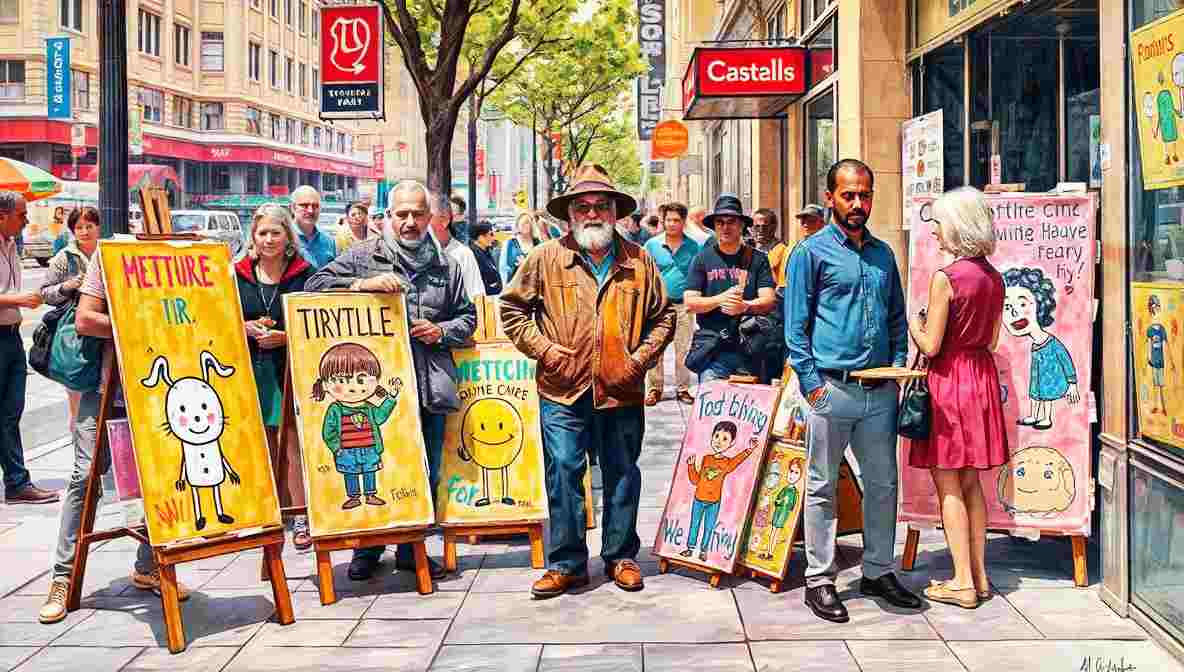
What is Wrong With Wichita Falls is What is Wrong With America
Wichita Falls Discovers Revolutionary Government Program: Pay $200,000 So Artists Can Stand on the Sidewalk
In what economists are calling the most profitable sidewalk in Texas since lemonade stands discovered Venmo, the city’s downtown Art Walk plan has ignited a philosophical debate across Wichita Falls: how much should taxpayers pay so artists can stand outside?
The local 4B Sales Tax Corporation board approved funding for a downtown Art Walk initiative, part of a broader slate of city development spending.
The plan is simple. Elegant, really.
Step one: Artists stand on sidewalks.
Step two: The government pays someone $200,000 to organize the standing.
Step three: Everyone calls it “economic development.”
Local taxpayers are reportedly still trying to figure out which part of the plan required $200,000.
Five Early Observations From Confused Wichita Falls Taxpayers

A Wichita Falls resident named Carl was seen staring at the proposal for twenty minutes before quietly asking a city official, “So the business model is… we pay a guy to let artists stand outside?”
A retired accountant reportedly fainted after calculating the overhead for “allowing human beings to exist on pavement.”
One city council intern attempted to explain the program by drawing a flowchart, but the chart eventually collapsed into a single arrow labeled: “Money → Sidewalk.”
A local sculptor was thrilled by the plan, saying, “I’ve always dreamed of participating in a city-sponsored standing competition.”
Meanwhile, one skeptical taxpayer asked the obvious question: “If the artists are selling their own work… why are we paying someone else?”
City officials responded by distributing pamphlets titled “Please Stop Asking That.”
The Art Walk Business Model: $200,000 Profit With No Expenses (Seriously)
According to several attendees at the meeting, the event operator acknowledged something extraordinary during discussions.
The program is expected to generate roughly $200,000 in profit because the organizer has virtually no expenses.
Why? Because the artists bring everything themselves.
Tables? Artists.
Paintings? Artists.
Jewelry? Artists.
Creative despair? Artists.
Even the sidewalk already belongs to the city.
The operator’s primary logistical duty appears to be allowing artists to exist within a designated rectangle of pavement.
A city finance expert described the arrangement as: “The closest thing to a perpetual motion machine in municipal government.”
For context, the Tax Policy Center notes that most economic development programs at least pretend to have overhead costs. Wichita Falls has apparently skipped that formality.
Economists Attempt to Study the Sidewalk Economy
Local economists are fascinated by the emerging Sidewalk Monetization Model.
Dr. Leonard Pickering of Midwestern State University explained the concept.
“Historically, sidewalks were free,” Pickering said while adjusting his glasses. “But Wichita Falls has discovered they can be rented back to the public.”
He added: “If this works, the city may soon charge people to stand in parks, breathe municipal air, or observe clouds.”
The university has already announced a new graduate program: “Master of Arts in Pavement Economics.”
The Brookings Institution has studied arts districts extensively, and found that successful ones typically involve artists, venues, foot traffic, and some marginal attempt to justify the funding. Wichita Falls is boldly streamlining that process.
Artists React to Being the Entire Supply Chain
Artists themselves are reportedly thrilled and confused in equal measure.
One watercolor painter said: “I’m happy to sell my work downtown. I’m just not sure why the middleman gets paid more than the painters.”
Another artist described the situation more bluntly: “Apparently the most valuable piece of art in Wichita Falls is the sidewalk.”
A jewelry maker added: “Next year I’m applying to be the guy who allows artists to stand on the sidewalk.”
According to the National Endowment for the Arts, the average working artist earns around $49,000 annually. The Art Walk organizer, who mainly facilitates standing, appears to be on track to double that in a single weekend. Artistic careers may need to pivot.
Anonymous City Staffer Explains the Real Municipal Strategy
An anonymous city staffer quietly explained the deeper strategy behind the plan.
The Art Walk, he said, will stimulate downtown activity. “It brings foot traffic,” he said.
Critics responded that foot traffic was already free, as residents had been walking downtown for decades without municipal funding.
The staffer clarified: “Yes, but now the walking is organized.”
The International City/County Management Association has published extensive research on downtown revitalization. None of it specifically mentions paying $200,000 for organized ambulation, but there’s a first time for everything.
Eyewitness Testimony From the Public Meeting
Witnesses at the public hearing described a scene of civic confusion.
One man reportedly stood up and asked a simple question: “If the event makes $200,000 profit… why are taxpayers funding it?”
According to attendees, the room briefly entered a state of philosophical silence usually reserved for graduate seminars in metaphysics.
A woman in the back eventually whispered: “Maybe the sidewalk needed marketing.”
The Poll That City Officials Wish Didn’t Exist
A quick informal survey conducted outside the meeting produced interesting results.
Question: Should taxpayers fund an art event where the organizer has no expenses?
Results:
- 83% said “That sounds like a lemonade stand run by the government.”
- 11% said “Wait… I should start an event business.”
- 6% said “Is this satire?”
A Pew Research survey found that only 16% of Americans trust the government to do the right thing most of the time. The remaining 84% were apparently in Wichita Falls that night.
What the Funny People Are Saying About Government-Funded Sidewalk Management
“I like art. I support artists. But if the government gives someone $200,000 to let people stand on a sidewalk, I’m starting a federal program called ‘Looking At Clouds.'” — Jerry Seinfeld
“Government projects always start the same way: somebody says ‘economic development’ and suddenly the city is buying a $300 hammer.” — Ron White
“If letting people stand outside costs $200,000, I’ve been hosting free festivals on my porch for years.” — Dave Chappelle
The Future of Municipal Innovation in Wichita Falls
Inspired by the success of the Art Walk concept, city planners are already exploring similar projects.
Proposals reportedly include:
- The Wichita Falls Bench Sitting Festival
- The Downtown Looking Around Expo
- The Annual Government-Funded Standing Symposium
- The Biennial Leaning Against Things Conference
- The First Annual Squinting Into the Distance Grant Program
One leaked memo suggests the city may soon monetize “observing buildings.”
The memo reads: “Citizens already do this for free. With proper funding, we can make it economic development.”
The Cato Institute has argued for years that government arts funding tends to benefit administrators more than artists. Wichita Falls appears to have taken that research to its logical conclusion and simply eliminated the artistic overhead entirely.
The Taxpayer Conclusion: Paying to Notice the Sidewalk
For now, the Art Walk is moving forward, bringing with it a groundbreaking economic theory:
If enough people stand on sidewalks, prosperity will follow.
Local taxpayers say they support the arts. They just have one lingering question.
“If the sidewalk is already there… why are we paying someone $200,000 to notice it?” 🎨💸
Auf Wiedersehen, amigo!