

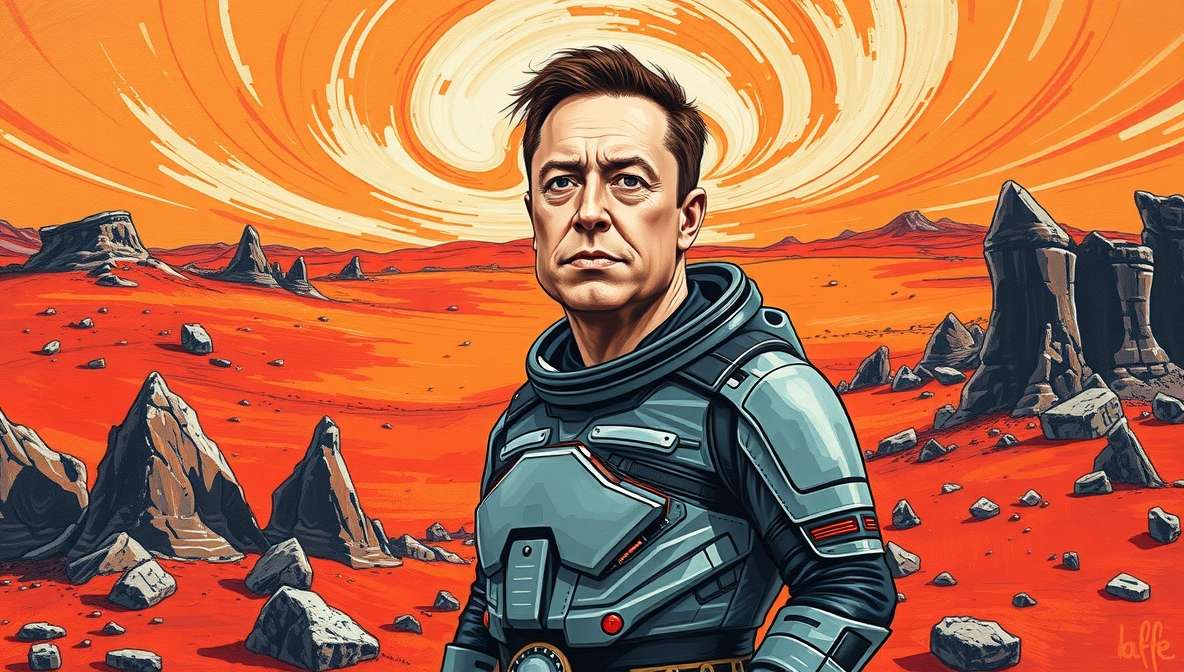
Elon Musk Announces ‘Mars Dating App’; Users Complain Too Many Martians Swipe Left
Elon Musk has launched a dating app designed specifically for potential interplanetary romance, and early users are reportedly frustrated that Martians are swiping left too often. The app, called Red Planet Romance, promises to connect humans with Martians who “share similar interests, values, and gravity tolerances.”
Love Knows No Planetary Boundaries Except Gravity
“Love knows no planetary boundaries,” Musk tweeted, alongside a promotional GIF of two cartoon robots holding hands on Mars. “Except maybe gravity. And oxygen. Minor details.”

Users quickly discovered that connecting with Martians is trickier than anticipated. “I matched with three Martians in the first hour, but all of them swiped left immediately after I mentioned I like pizza,” said early adopter Karen Mulligan. “Apparently, Martians don’t eat carbs—or maybe they just hate pineapple on pizza. I’ll never know.”
Social Experiment Meets Interplanetary PR Stunt
Tech analysts suggest the app is part social experiment, part interplanetary PR stunt. “It’s brilliant marketing,” said media strategist Chester McFluff. “You get Elon Musk branding, a little dash of futuristic aspiration, and the added hilarity of imagining rejection from a being who may or may not have green skin and antennae.”
Social media has reacted with enthusiasm and bewilderment. Hashtags like #MarsDating, #SwipeLeftMartians, and #RedPlanetRomance have flooded Twitter, accompanied by memes depicting frustrated Earthlings trying to flirt with Martians via holograms, space helmets, and emojis of rocks. One viral TikTok shows a human sending a message that reads, “Do you like Earth tacos?” followed by a Martian hologram giving an unimpressed glare.
Astrobiology Experts Caution About Interplanetary Romance
Experts in astrobiology caution that interplanetary romance may have unforeseen complications. “We don’t know how human pheromones interact with Martian atmospheres,” said Dr. Helga Stern, professor of Extraterrestrial Sociology. “There may be issues with communication, biology, or basic physics. But the app does prove that love, or at least curiosity, is universal.”
Meanwhile, users are improvising. Some have created virtual spaceships for dates, while others hold “zero-gravity speed dating” in simulated Martian environments. One viral meme shows two humans in spacesuits awkwardly leaning toward each other, with a caption: “Mars is the new Tinder, but with less oxygen and more rejection.”
Revenue Potential Through Space-Helmet Accessories
Economists note that the app could have surprising financial benefits. “Between premium subscriptions, holographic date rentals, and space-helmet accessories, the revenue potential is enormous,” said Chester McFluff. “Plus, you can market it as an educational tool for aspiring astronauts who want romance and not just rocket science.”
Musk himself remains undeterred by early complaints. “If Martians swipe left, we build a rocket to the next planet,” he reportedly quipped during a press briefing. “Romance requires persistence, creativity, and occasionally, cosmic travel.”
In the meantime, Earthlings hoping for extraterrestrial love are learning a valuable lesson: in the age of interplanetary apps, even the vastness of space can’t protect you from the sting of rejection—and Martians are surprisingly picky.
Disclaimer: This story is a collaborative satirical effort between a tenured astrobiologist and a philosophy major turned dairy farmer. No AI was involved in creating interplanetary dating apps, Martian swipe habits, or cosmic heartbreak.