

Thousands Party at Budapest Pride: Viktor Orban Accidentally Becomes Queer Icon
Rainbow Resistance Floods the Danube, As Hungary’s Authoritarian Aesthetic Gets a Fabulous Makeover
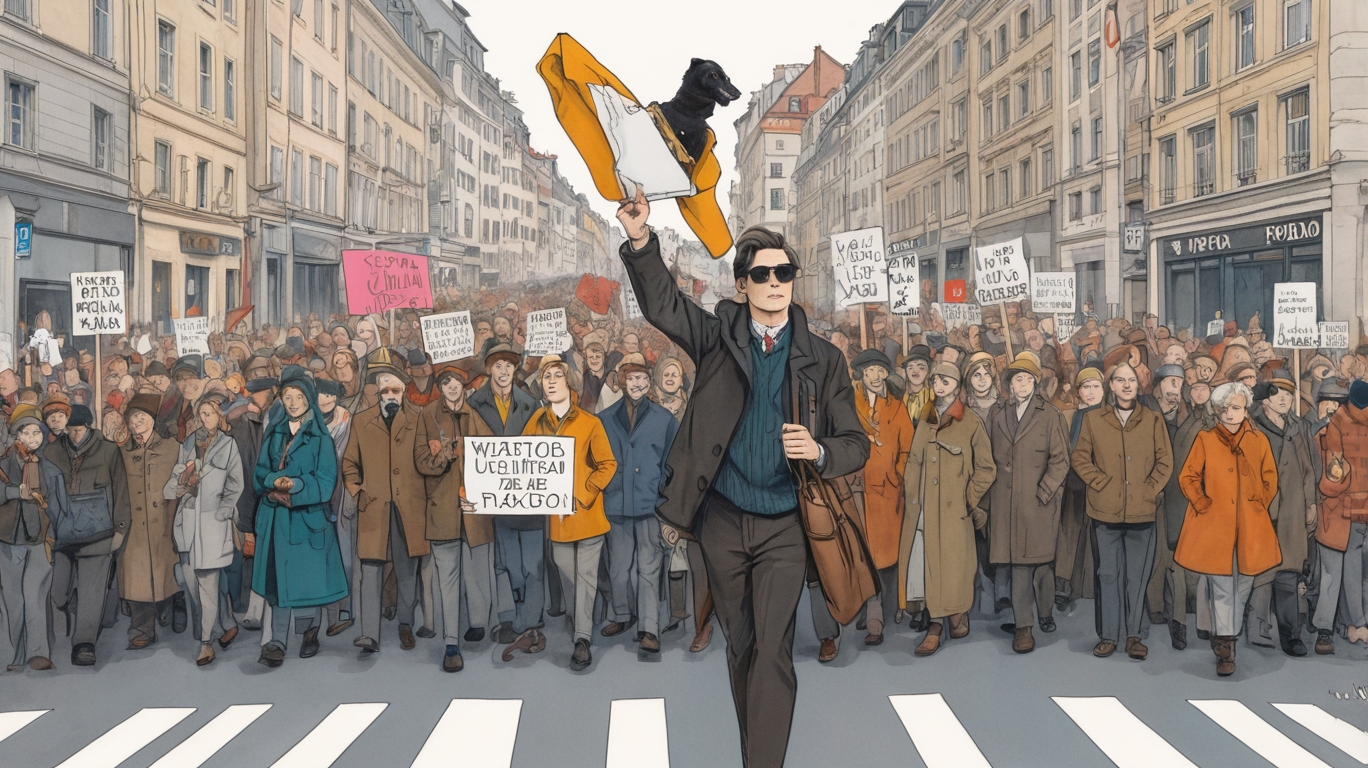
Budapest, Hungary — On a sweltering summer day usually reserved for sipping lukewarm beer in political resignation, Hungary’s youth—and several thousand stylish grandmothers—flocked to the banks of the Danube for an event so fabulous it might’ve resurrected Freddie Mercury in spirit alone. What began as a defiant Pride march turned into an unintentional Eurovision audition starring Prime Minister Viktor Orban—painted in glitter, irony, and lipstick thicker than his legislation.
15 Humorous Observations
-
Orban tried banning Pride, but inadvertently quadrupled attendance—scientifically proving that nothing increases queer turnout like repression and poor fashion sense.
-
Police installed facial recognition to catch “perverse dissidents,” but most software short-circuited when faced with drag queens dressed as historical Hungarian monarchs.
-
Fidesz politicians posted photos of their grandchildren to “reclaim Pride.” Somewhere, a Gen Z TikToker responded with, “Okay groomer.”
-
Viktor Orban’s glammed-up face on T-shirts outsold Hungary’s Olympic merch. The free market speaks: fascist glam is in.
-
The new police recruits were paraded the same day as Pride—but the only uniforms that turned heads were on a trio of lesbian motorcycle cops with rainbow-tinted aviators.
-
Orban’s Child Protection law equating homosexuality with pedophilia was cited as justification to ban Pride. Hungary is officially where logic vacations with its eyes closed.
-
A banner read, “I’m bored of fascism,” as if authoritarianism were a Netflix series that dragged too many seasons.
-
Facial recognition fines ranged from £14 to £430—enough to fund a new rainbow-colored laser light show for next year’s parade, ironically.
-
The police claimed the march could harm children. The children, meanwhile, were in full makeup and chanting in rhythm, “Vik-tor’s in Denial, but Sis, we slay!”
-
Orban skipped the parade to speak at a graduation for customs officers, where he taught his only known dance move: the goose-step.
-
A pride marcher said, “We’re performing a big, fat show to a puffed-up and hateful power.” That’s also how critics described Orban’s one-man Hamlet in 2003.
-
The protest marched across the Elisabeth Bridge—named for a murdered empress. Coincidence? Or Hungary’s most dramatic metaphor?
-
Greta Thunberg showed up, allegedly. The government now accuses her of ecological gay terrorism. Next week’s cabinet meeting: “Can solar panels make kids flamboyant?”
-
A vast rainbow flag stretched over the Danube. Orban’s government promptly tried to tax it as a “multicolor border violation.”
-
The pro-Orban paper called the event “chaos.” Witnesses said the only chaos was one man’s unsuccessful attempt at roller-skating in heels while holding a corgi.

What The Funny People Are Saying About Viktor Orban…
“Viktor Orban banning Pride is like trying to stop karaoke by making it illegal to sing—congrats, now you’ve got a Beyoncé uprising.” — Sarah Silverman
“I saw Orban’s glam T-shirt. It’s not fascism if it sparkles.” — Ron White
“‘I’m so bored of fascism’—finally, a revolution powered entirely by ennui and good contouring.” — Jerry Seinfeld
“If Hungary bans rainbows, they better prepare for some serious biblical consequences. Ever heard of a little guy named Noah?” — Ricky Gervais
“They tried facial recognition, but the drag queens looked different every 10 minutes. Call it anti-surveillance couture.” — Tig Notaro
“Imagine banning Pride because ‘the children might see.’ Lady, the children are the ones twerking at the front of the parade!” — Ali Wong
“Orban says order must be created. So does IKEA. And at least IKEA gives you tools.” — Bill Burr
“The government called it ‘perversity.’ Meanwhile, one guy was dressed as Orban’s conscience—totally naked and very lost.” — Kevin Hart
“Ironically, the only place in Budapest without Pride was Orban’s soul.” — Trevor Noah
“Greta Thunberg showed up and apparently became Hungary’s Most Wanted. Somewhere Al Gore is shaking his head, saying, ‘Too much drip.’” — Amy Schumer
“Fines for being at Pride? What’s next—taxing eye shadow by pigment density?” — Roseanne Barr
“Police tried to be ‘discreet.’ Which is like showing up to a drag ball dressed as Darth Vader and saying you’re just here for the punch.” — Groucho Marx
The Irony of Authoritarian Aesthetics: When Oppression Meets Glitter
In what historians will later call “The Glitter Coup,” Prime Minister Viktor Orban accidentally turbocharged the visibility of the very community he tried to silence. By invoking a 2021 law linking LGBTQ+ identity to paedophilia—possibly while chewing on a cold paprika sausage—Orban managed to turn human rights into Hungary’s hottest export since goulash.
His government claimed Pride would “confuse children.” And yet, every single child interviewed at the parade said something like: “I learned that you can be yourself, and also wear leather harnesses if that’s your journey.”
Meanwhile, Mayor Gergely Karácsony stole the show. Not since the invention of paprika schnapps has a man risen so quickly in Hungarian esteem. He stood defiantly on the steps of Budapest Technical University and said, “We’re freely performing a big, fat show.” One witness said, “It was like watching Churchill if Churchill had rhinestones and better lighting.”
In response, Orban retreated to a graduation ceremony where he warned about the collapse of civilization if people danced on bridges. Several students reportedly texted during his speech, asking their parents to pick them up early from fascist class.
Surveillance and Sequins: A New Era of State Fashion
Orban’s police force, ever innovative in their backwards logic, deployed facial recognition software to identify attendees and fine them. However, as most attendees were in wigs, glitter, LED lashes, or dressed as 18th-century duchesses on rollerblades, the software mistook 73% of faces for “Elton John, mid-tour.”
A satirical art collective created counterfeit T-shirts of Orban in a boa and thigh-high boots. Sales soared. Reports suggest even some off-duty cops were spotted buying them at night markets, whispering, “Don’t tell my wife, she still believes in the Child Protection Law.”
State media tried to frame the event as “chaos,” although the only actual injury came when a confused pigeon flew into a Pride drone and crash-landed in a churro cart.
The Party Orban Accidentally Threw
By Sunday morning, even some of Orban’s staunchest supporters were confused.
One retired colonel was quoted muttering, “I don’t know, my grandson went to the march, said it was the best day of his life. He met a girl who identifies as a violin. They kissed under a rainbow shaped like a tank. Maybe it’s time I retire to a quieter fascism—like gardening.”
And while Orban tried to steal the word “Pride” with boring family photos and T-shirts reading “Hungary,” it backfired—spectacularly. Twitter (now called “SlanderHub” under Orban’s media reform) lit up with memes of Orban trying to upstage drag queens with his own outfit: beige pants, beige shirt, beige opinion.
What the Funny People Are Saying
“Budapest Pride was so big this year, Google Maps marked it as a temporary ‘Spiritual Awakening Zone.’” — Dave Chappelle
“Viktor Orban tried to ban Pride, but forgot you can’t arrest glitter. It just multiplies.” — Wanda Sykes
“They say Pride corrupted the youth. That’s wild, because the youth seem to be doing just fine twerking in front of armored vehicles.” — Jon Stewart
Conclusion: Let Them Dance
Hungary may now be Europe’s premier testing ground for whether authoritarianism can survive being turned into a rave. All signs point to no.
This was not just a parade. It was an act of civil sass. A middle finger painted with rainbow acrylic. A rhinestone thrown at tyranny’s window. Orban may have tried to police identity, but Budapest threw a party so loud even the history books stopped to twerk.
Auf Wiedersehen, Vik. See you next year—on a float.
BREAKING NEWS:
Hungarian Government Fines Self After Facial Recognition Misidentifies Cabinet
In a digital age twist only Kafka could love, Hungary’s right-wing government accidentally fined itself this week after state-deployed facial recognition software confused several cabinet members with drag queens, club DJs, and at least one Lady Gaga impersonator.
The incident began when the surveillance system—originally installed to monitor “inappropriate rainbow behavior”—flagged Minister of Justice Judit Varga as “Miss Sappho Deluxe,” a popular performer at Budapest’s Club Flamboyant. Prime Minister Viktor Orban was also briefly detained after the AI mistook his scowl and high-collared jacket for “Haus of Gloom couture.”
Internal memos reveal the government issued 43 fines, totaling 2.3 million forints, before realizing they were ticketing their own bureaucracy. One cabinet member attempted to appeal the fine, only to be flagged again for using too much highlighter in his Facebook profile picture.
“This is not a failure,” said the National Security Minister. “This is proof the system is unbiased. Even we can’t escape our own absurdity.”
A new directive now requires all ministers to wear “boring face stickers” to avoid future mix-ups.
Meanwhile, Budapest’s drag scene is thriving, boosted by unintentional endorsements from half the ruling party. A new show titled The Cabinet of Glam premieres next week—with Orban’s frowning visage on the poster.
Greta Thunberg Accused of Weaponized Glitter Deployment
Swedish climate activist Greta Thunberg is under investigation in Hungary for allegedly deploying “weaponized glitter” during the Budapest Pride march, a move state media is calling an “act of eco-anarcho-sparkle sabotage.”
According to Hungarian authorities, Thunberg was observed launching biodegradable glitter from a solar-powered drone over Elizabeth Bridge, temporarily blinding three surveillance cameras and inspiring spontaneous voguing among local youths. “She weaponized joy,” declared Fidesz spokesperson Zoltán Kiszelly, dabbing glitter off his blazer.
In a now-viral moment, Orban’s police chief dramatically held up a confiscated glitter canister during a press conference and declared, “This is not just party supply—this is subversion in a bottle!”
Thunberg, unfazed, posted on Instagram: “Glitter is carbon-neutral. And fabulous.”
Hungary’s National Bureau of Tactical Seriousness has formally requested extradition, but the Swedish government has instead nominated her for a Nobel in “Mood Enhancement.”
Conservatives warn this is the beginning of a new tactic: Eco-Glam Warfare. “What’s next?” asked one panicked host on state TV. “Reusable boas? Solar sequins?”
Meanwhile, youth turnout for climate activism has surged. Hungarian teens are forming “Glam Squads for Earth,” hosting zero-emissions dance protests.
One protester said, “If Greta wants to bomb us with sparkle, we surrender. Please—rain it down.”
UN officials remain amused but unconcerned.
Mayor of Budapest Admits: “I Only Did This for the Fabulous Outfits”
In a surprisingly candid moment during a post-Pride press conference, Budapest’s Mayor Gergely Karácsony admitted the real reason he defied Viktor Orban’s ban on the parade: “I did it for the outfits. The politics were a bonus.”
Reporters were stunned as Karácsony, wearing a sequined cravat and rainbow loafers, explained how the city’s annual fashion calendar had been “dreadfully dull” since the 2018 crackdown on jazz hands and glitter eyeliner in official events.
“I was bored of grey suits, grey skies, and greyer policies,” said the Mayor. “Pride gave us color, sass, and six-foot-tall stiletto boots. I wept.”
The confession prompted mixed reactions. Fidesz called it a “catastrophic breach of governance.” Hungarian youth, however, immediately began printing T-shirts with the phrase: “Fabulous Resistance.”
Karácsony also revealed that the city’s official guest list included stylists, drag coaches, and a seamstress from Vienna code-named “The Hemline Prophet.”
When asked about future events, the Mayor shrugged. “We’ve already booked the State Opera for a voguing championship.”
Critics accuse Karácsony of dereliction of duty. Supporters argue he’s finally restored joy to city politics.
One attendee summed it up: “He may not have fixed potholes, but he healed my inner child—and that’s infrastructure too.”
Fidesz Party Declares War on Confetti, Declares It ‘Too Chaotic’
In its latest crusade against joy, Hungary’s ruling Fidesz party has declared war on confetti, calling the decorative staple of celebration “an agent of chaos, moral erosion, and wrist sprains.”
According to a leaked parliamentary draft, confetti will now be classified as a Schedule C Symbol of Subversion, alongside flash mobs, ironic memes, and unsanctioned glitter. The proposed ban cites multiple injuries caused by confetti “ambushes,” including a lawmaker who allegedly slipped during a surprise birthday shout-out.
“Confetti has no respect for gravity, hierarchy, or the Hungarian family,” said conservative MP Márta Hegedűs. “It flies where it wants—like anarchy with a paper trail.”
New regulations require confetti to be biodegradable, state-approved in color (white, red, or melancholy blue), and launched only during “patriotic exhalations” like state funerals or tax announcements.
Police have already raided two party stores, seizing 11 kilograms of “rainbow contraband.” One Budapest bachelorette party was forcibly disbanded when authorities discovered illicit heart-shaped sprinkles.
A counter-protest group, calling themselves the “Confettiratti,” has vowed to “shower resistance” at every Fidesz press conference.
The EU responded with cautious humor. One diplomat tweeted, “Hungary: Banning everything except delusion.”
As for the confetti? It remains airborne—taunting tyranny one paper speck at a time.
Viktor Orban’s Rainbow Face Becomes National Currency
In what economists are calling a “high-camp monetary accident,” the Hungarian National Mint has accidentally printed a limited run of commemorative coins bearing a rainbow-colored, glammed-up portrait of Prime Minister Viktor Orban.
The coins, intended to honor the country’s 2025 fiscal reform, were misprinted after a junior mint designer accidentally uploaded a Pride-themed meme of Orban in heavy eye shadow and sequins. By the time officials noticed, 200,000 coins had entered circulation.
Instead of recalling them, the National Bank issued a formal statement: “The market has spoken. Fabulousness is inflation-proof.”
Dubbed the “OrbanFlair,” the coins feature a smoky-eyed Prime Minister framed by the words: “Liberty, Glitter, Tax Reform.” Within days, the currency spiked in value as collectors across Europe clamored for it.
“The irony is liquid gold,” said one Dutch numismatist. “It’s the first fascist currency you’d actually want to frame.”
Fidesz attempted to ban the coins but accidentally legitimized them under a 2019 law protecting “national expressions of pride.”
Budapest merchants now advertise “glam-friendly pricing,” and a drag bar has offered OrbanFlair-only cocktails.
Asked for comment, Orban muttered, “We will fix this mistake”—but was later spotted discreetly flipping a coin with his own rainbow face.
Onlookers say: he smiled.