

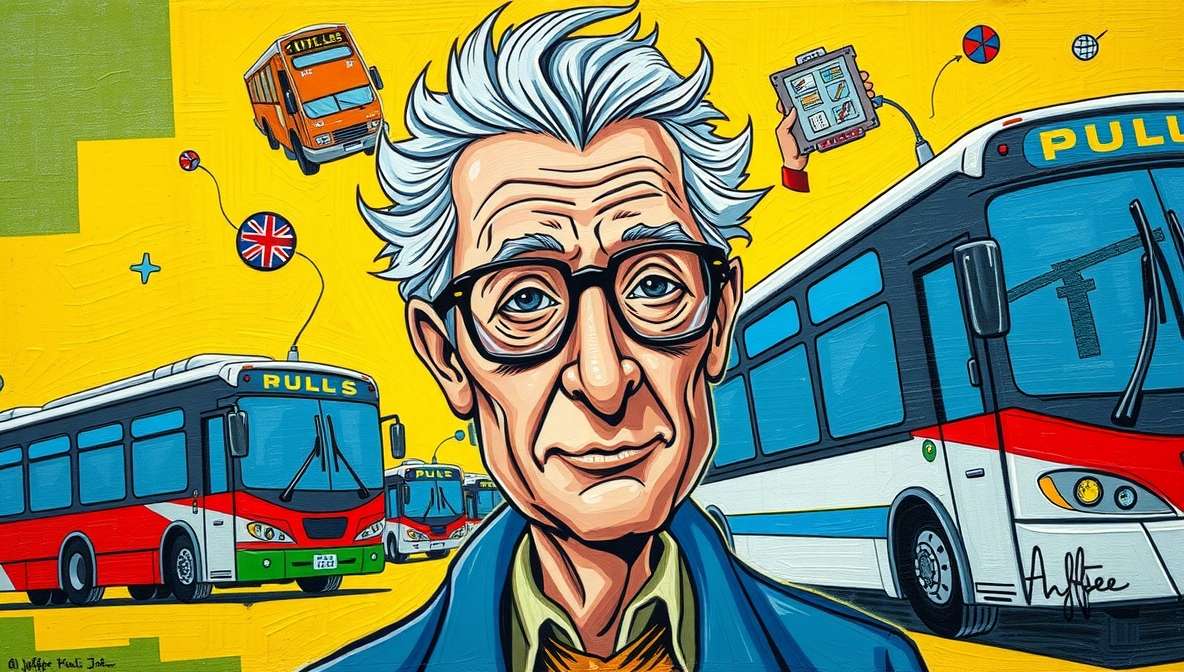
Tech entrepreneur discovers public transportation, patents obvious concept, raises $40 million
Tech entrepreneur Brandon Disruptor unveiled his revolutionary new transportation concept Tuesday: a large vehicle that picks up multiple passengers traveling in the same direction and follows a predetermined route. The innovation, which Disruptor calls ‘RideShare XL,’ is exactly a bus, but he’s raised $40 million in venture funding because he’s never actually seen a bus.
The Innovation That’s Been Around for 200 Years

‘We’re disrupting urban transportation with a radical new approach,’ Disruptor told TechCrunch while describing a municipal bus system. ‘Instead of individual rides, we combine passengers going similar routes. It’s revolutionary.’ When informed that buses exist, Disruptor insisted his version uses ‘proprietary algorithms’ to determine routes, also known as a schedule. The app is just a map.
According to Wired, Silicon Valley has a proud tradition of reinventing existing infrastructure, adding ‘tech’ to the name, and pretending it’s innovative. Previous examples include: parking spots (now ‘mobility hubs’), bicycles (‘micromobility solutions’), and apartments (‘flexible living spaces’). Disruptor’s RideShare XL continues this legacy by discovering that moving multiple people simultaneously is more efficient than individual vehicles – a concept cities figured out in 1826.
‘The key differentiator is our app,’ Disruptor explained, showing a interface that displays a vehicle’s location and arrival time. This is identical to existing bus tracking apps used by actual transit systems, but his has a sans-serif font and costs $40 million more. As Bill Burr would say: ‘This guy invented a bus and rich people gave him forty million dollars. Meanwhile, actual buses are begging for funding. We deserve whatever happens to us.’
Venture Capitalists Somehow Impressed
Multiple VC firms invested in RideShare XL despite it being indistinguishable from public transportation. ‘Brandon’s vision for reimagining mass transit is groundbreaking,’ said investor Marcus Moneybags, who apparently has never ridden public transportation. Bloomberg reports the pitch deck included phrases like ‘leveraging shared mobility infrastructure’ and ‘optimizing passenger density,’ which mean ‘it’s a bus but we’re pretending we invented it.’
The company’s valuation is based on projected ridership, assuming millions of users will prefer their bus to existing buses because of superior branding. ‘We’re targeting young professionals who value innovation,’ Disruptor said, meaning ‘rich people too good for regular buses.’ The vehicles will feature USB charging ports and WiFi, amenities many municipal buses already have, but RideShare XL’s will be disrupted.
The Timeline Nobody Asked For
RideShare XL plans to launch in San Francisco in 2026, pending permits. The city’s public transit agency pointed out they already operate 1,200 buses serving the exact routes Disruptor proposes. ‘But do they have an app?’ Disruptor countered. Yes. They do. It’s free and works better. According to SF Chronicle, city officials are confused why someone would raise $40 million to create an inferior version of existing infrastructure.
The company has hired 47 employees, most working on ‘user experience design’ for the app that shows where buses are. Three employees actually understand transportation logistics. None have backgrounds in public transit, which Disruptor considers an advantage. ‘We’re not constrained by traditional thinking,’ he explained, meaning they’ll repeat every mistake transit agencies learned from decades ago.
The Business Model Makes No Sense
‘We’ll charge $8 per ride,’ Disruptor announced, significantly more than the $2.50 bus fare. When asked why anyone would pay 220% more for the same service, he responded: ‘Brand premium and user experience.’ The user experience is sitting on a bus. The Wall Street Journal calculated RideShare XL would need 80% capacity on every trip to break even, a metric actual buses rarely achieve because transportation isn’t profitable – it’s a public service.
‘We’re not competing with public transit,’ Disruptor insisted while describing competing with public transit. ‘We’re creating a new category.’ The category is buses. That’s the category. It exists. His investors apparently believe enough people will pay premium prices for identical service if you add an app, which sadly might be correct given how many people use food delivery despite the 300% markup.
Kevin Hart nailed it: ‘Let me get this straight. You invented a bus. Called it tech. Got forty million dollars. And everyone acted like you’re a genius? That’s not innovation, that’s a scam with good marketing!’ RideShare XL’s press materials describe their vehicles as ‘shared autonomous passenger pods,’ confirming they’re not even using autonomous vehicles – they just think calling a bus a pod makes it sound futuristic. The future is apparently 1826. The company is already planning their Series B, hoping to raise $100 million to expand their bus concept to other cities that famously already have buses. Disruption achieved.