Syria’s Main Airport Reopens: Now with Less Torture, but Twice the Delays and Half the Functionality
Damascus, Syria—In what has been hailed as a monumental step forward for the beleaguered nation, Syria’s main airport has officially reopened its doors. Promising “less torture” and “improved travel experiences,” the airport’s shiny new facade and half-functional systems have left passengers feeling both relieved and utterly confused.
“Less torture is a step up, but waiting five hours for a flight might make you miss the old days.” – Samantha Bee
A Tortured History
Syria’s tumultuous history has often bled into its infrastructure, and the Damascus International Airport is no exception. Once a symbol of regional connectivity, the airport devolved into a dilapidated hub of chaos during years of conflict. Torture, corruption, and questionable customer service made it infamous—not for its flights, but for its interrogations.
One frequent flyer, Mahmoud Al-Khouri, recalls the old days: “They used to lose your luggage and your dignity at the same time. It was a two-for-one deal.” He laughs nervously, looking over his shoulder, as if expecting a hidden customs agent to emerge from the shadows.
Today, officials boast that the “new and improved” airport is torture-free, with redesigned interrogation rooms now converted into “quiet zones.” Some skeptics, however, question if this rebranding is just a fresh coat of paint over an old system.
“We’re Not Perfect, But We’re Open!”
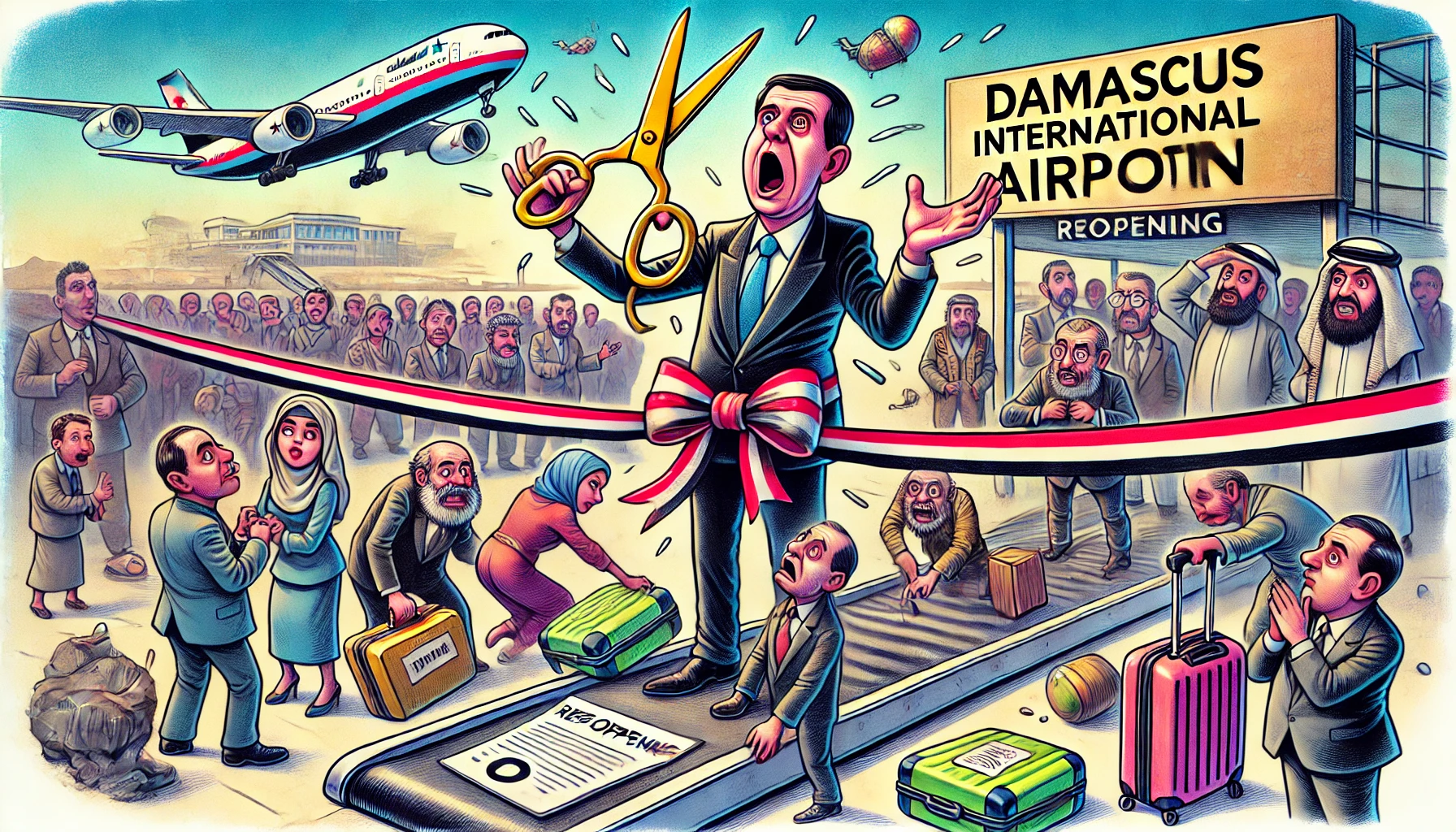
The reopening ceremony featured all the pomp and circumstance one might expect—ribbons were cut, and pastries were served, though reports suggest the ceremonial scissors briefly went missing in baggage handling.
Transportation Minister Ahmed Shalabi declared: “This is a new era for Syria. We are committed to being the gateway to the Middle East once again. And this time, you might actually want to use the gate!”
The improvements, however, seem to come with a catch. Flights now boast twice the delays and half the functionality. Travelers have reported missing gates, misplaced boarding passes, and inexplicable detours that result in a layover in Iraq.
“It’s like a Choose Your Own Adventure book, but every choice is bad,” remarked international traveler Nadia Saad.
The Airport Experience: A Comedy of Errors
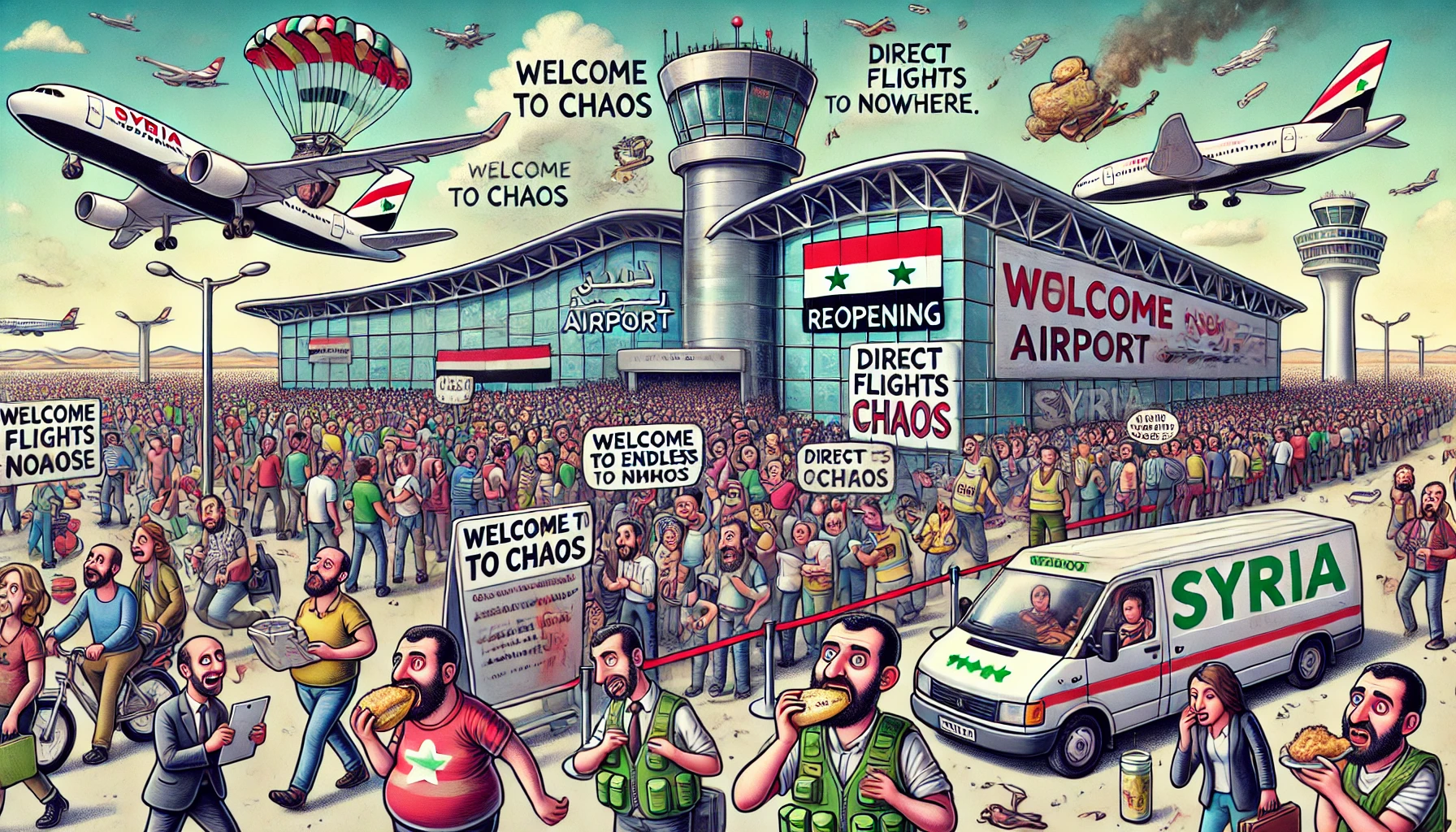
Passengers arriving at the revamped Damascus International Airport are greeted with signs reading, “Welcome to Syria: Chaos is Our Culture.” The check-in counters are manned by employees whose expressions oscillate between apathy and mild confusion.
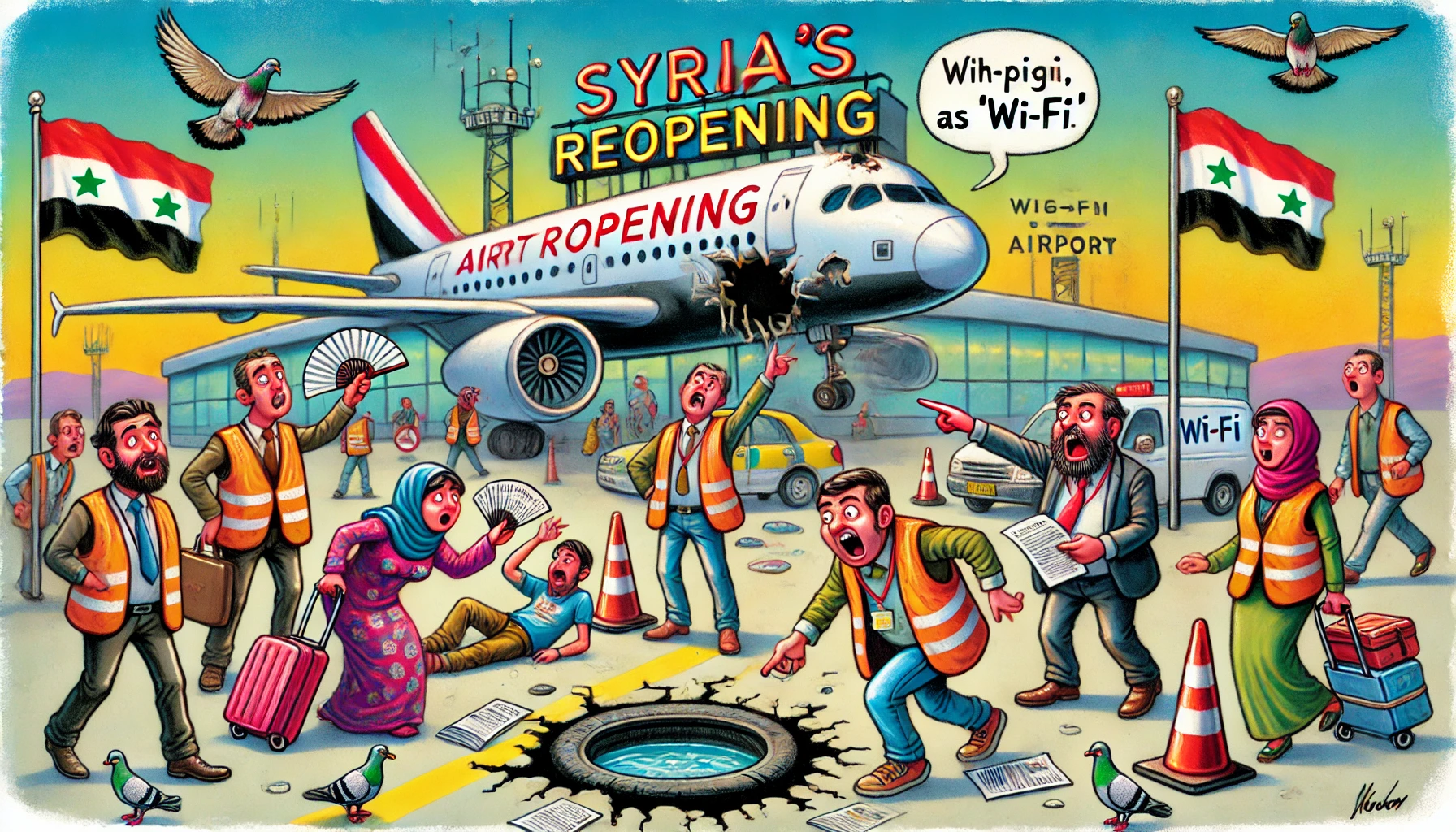
One traveler, Adnan Hamdi, shared his experience: “I asked about the Wi-Fi, and the staff just pointed at a pigeon. Apparently, it’s part of their new low-carbon communications initiative.”
Inside the terminal, the air conditioning works sporadically. Passengers can be seen fanning themselves with makeshift fans made from their boarding passes. Meanwhile, the duty-free shop offers an eclectic mix of vintage olive oil and military surplus gear.
“It’s like shopping at a flea market during the apocalypse,” quipped tourist Helen Wong.
Delays, Detours, and “Direct Flights”
One of the airport’s most publicized upgrades was its “streamlined” flight schedules. However, streamlined appears to mean “equally late for everyone.” Travelers waiting for flights to Europe have reported unplanned stops in random Middle Eastern cities.
“I booked a direct flight to Paris and ended up in Aleppo for six hours,” complained a weary French journalist, Jacques Renault. “The in-flight snack was hummus, but I had to share it with the pilot.”
Even domestic flights are fraught with peculiarities. Pilots are known to announce unexpected stops mid-flight, citing reasons like “better falafel in Homs.”
Less Torture, More Bureaucracy
Gone are the days of overt interrogations, but the new system offers a subtler form of torment: paperwork. Immigration counters now feature electronic forms that are mostly inoperative. Travelers must fill them out on paper, then wait in line to scan them on machines that only work every third Tuesday.
One exasperated traveler muttered: “They said no torture, but filling out these forms feels like a mental marathon.”
Customs inspections have also been “modernized.” Instead of being pulled aside for questioning, passengers are subjected to a “random luggage raffle.” Winners—and losers alike—get to unpack their suitcases in front of an audience of amused bystanders.
The Humorous Public Reaction
Late-night comedians wasted no time in skewering Syria’s grand reopening. John Oliver quipped: “Less torture and more delays? So basically, they’ve just rebranded as a normal airport!” Trevor Noah chimed in: “Finally, an airport where the only thing vanishing is your patience, not your human rights.”
Even local comedians got in on the act. One Damascus comic joked: “We’ve gone from waterboarding to water bottles—at $15 a pop.”
“Helpful” Travel Tips for Brave Flyers
For those daring enough to visit Damascus International, here are some insider tips to make the most of your journey:
- Bring Snacks: The airport’s “café” serves food that doubles as a geological sample.
- Pack Light: There’s a 50% chance your luggage will end up in another country.
- Download a GPS App: You’ll need it to find the exit—and possibly your gate.
- Carry Cash: The ATMs work about as often as the escalators, which is to say, not often.
- Expect Delays: Think of it as an opportunity to meditate or question your life choices.
Hope, Humor, and Half Measures
Despite its flaws, the reopening of Syria’s main airport signals a small, tentative step toward normalcy in a nation still grappling with its past. While the road to recovery remains long and winding, at least now there’s an airport at the end of it—albeit one with potholes large enough to land a helicopter.
For the weary traveler, Damascus International offers a unique blend of chaos and charm. It’s a place where flights may be delayed, luggage may vanish, and air conditioning is an optimistic suggestion, but at least you can leave without fear of interrogation.
As one departing passenger put it: “It’s not perfect, but it’s home. And honestly, that’s kind of beautiful… in a deeply dysfunctional way.”