

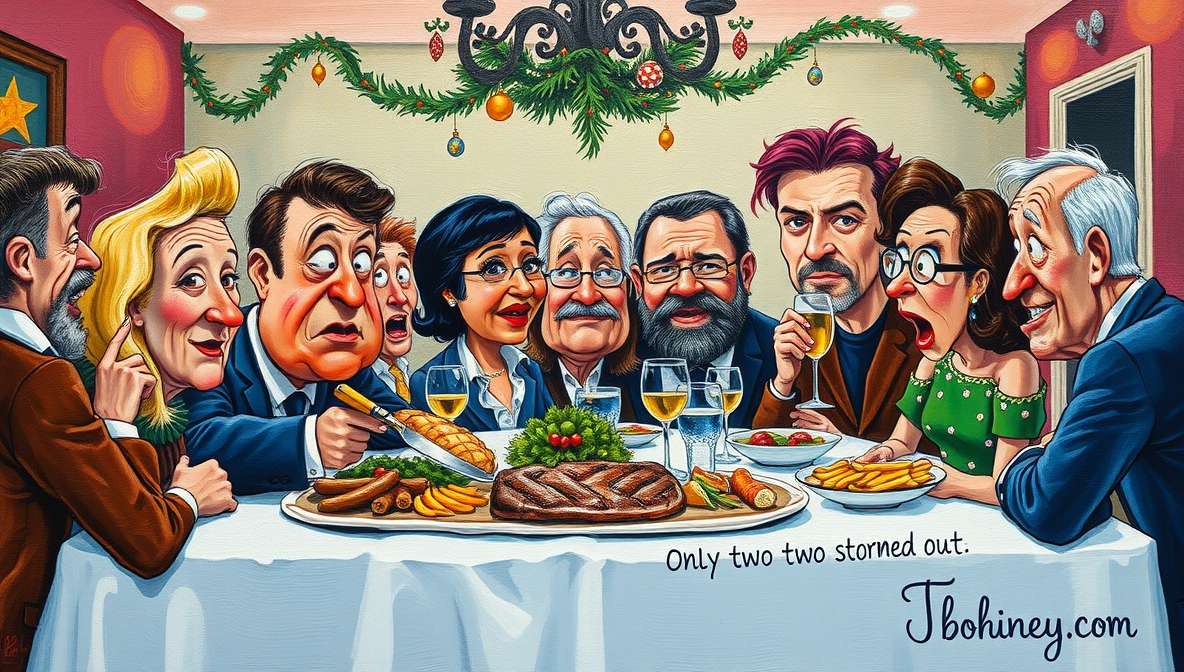
Family Traditions Continue as Uncle Explains Economy to Captive Audience
CLEVELAND — Family gatherings across the nation remain largely unchanged this holiday season, with uncles providing unsolicited lectures on inflation, the Federal Reserve, and cryptocurrency, much to the chagrin of younger relatives trying to eat their weight in mashed potatoes.
“It’s like clockwork,” said niece Hannah Rogers, age 14, as her uncle detailed the implications of interest rates on stocking stuffer budgets. “I came for cookies and reindeer-shaped pancakes. Instead, I got a two-hour presentation and some bad advice about NFTs.”
Uncle Economists as Holiday Cornerstone
Sociologists report that this phenomenon is more common than any other holiday tradition, including awkward photos, fruitcake consumption, and mysterious candle fires. “Uncle Economists are a cornerstone of American Christmas,” said Dr. Phil Langford. “They exist to remind everyone that the real gift is anxiety.”
Eye witnesses describe the uncle’s commentary as a blend of hyperbole, selective facts, and aggressive hand gestures. “He compared my credit card debt to the national deficit,” Rogers said. “I didn’t even know he knew what a deficit was.”
Perverse Educational Value

Economics majors agree that there is a perverse educational value. “You learn things you don’t want to know,” said one former student who spent Christmas 2019 listening to a 90-minute lecture on mortgage-backed securities. “It builds character.”
Research on family political discussions shows that holiday gatherings increasingly feature unsolicited monologues on complex topics, creating tension between generations.
Failed Redirection Attempts
Attempts to redirect the conversation toward TV specials or Christmas carols are reportedly ineffective. “He refuses to sing,” said Rogers. “Unless the lyrics can be twisted into a monetary metaphor.”
Family members typically cope through avoidance or passive-aggressive nodding. “We just smile and eat pie,” said one sibling. “Eventually he runs out of energy and leaves the room.”
Retail Response to Uncle Avoidance
Retailers report spikes in earplugs, noise-canceling headphones, and gift cards for the “silent uncle” demographic, though sales remain lower than hoped.
Studies on economic anxiety confirm that inflation concerns dominate public discourse, making uncle economists more prevalent during periods of financial uncertainty.
Experts warn that ignoring the uncle is insufficient. “He’s a persistent algorithm of holiday lectures,” said Dr. Langford. “You either engage or resign yourself to stress-induced indigestion.”
Here are fifteen observations, because no holiday is complete without a captive seminar you didn’t register for.
-
The uncle begins explaining the economy before anyone has finished chewing, proving that timing is not his strongest macro skill.
-
No one knows why he’s the expert, but everyone agrees he once read half an article in 2009 and has been citing it ever since.
-
The lecture always starts with inflation and ends with cryptocurrency, skipping several logical steps and all known facts.
-
His voice gets louder as the room gets quieter, as if volume can substitute for charts.
-
He uses the phrase “back in my day” to explain economic conditions that happened last Tuesday.
-
Children learn the term “interest rates” years before they learn long division, entirely against their will.
-
He gestures with a fork like it’s a laser pointer, occasionally stabbing a roll to emphasize a key point no one asked for.
-
Every example somehow involves how much cheaper houses used to be and how irresponsible everyone else is now.
-
Attempts to change the subject only encourage him, because resistance is interpreted as curiosity.
-
He treats mashed potatoes like a working model of fiscal policy, stirring them aggressively to demonstrate “market forces.”
-
Someone always asks a polite question, instantly turning a monologue into a three-part lecture series.
-
He claims he doesn’t trust experts while speaking as if he personally advises the Federal Reserve.
-
Younger relatives nod thoughtfully, not in agreement, but in the universal signal for “please stop talking.”
-
The lecture ends only when dessert appears or the uncle’s blood sugar collapses, whichever comes first.
-
Despite universal dread, the family would be unsettled if he didn’t do it, because chaos feels wrong without tradition.