

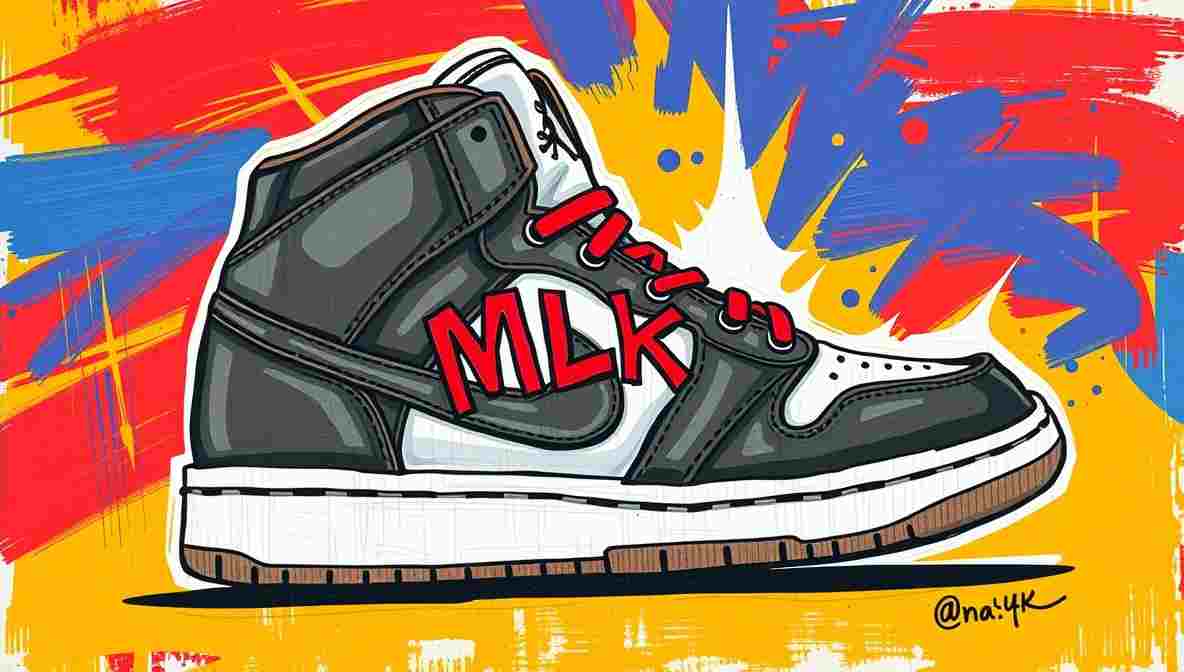
MLK Reduced to a Sneaker: When a Dream Comes in a Box Size 11
There was a time when Martin Luther King Jr. was taught as a man. A preacher. A marcher. A voice that rattled the furniture of American conscience. Now he is taught as a limited-edition colorway.
History, like all things under late capitalism, has been streamlined. Civil rights has been optimized. Memory has been outsourced to branding. And somewhere between the locker room and the checkout cart, a generation learned that MLK is not a speech, a jail cell, or a movement. He is footwear.
This week, culture finally admitted what classrooms have been quietly conceding: a significant number of young Americans associate MLK not with Selma, Birmingham, or nonviolent resistance, but with a sneaker collaboration involving LeBron James and Nike.
Not a metaphor. Not a punchline. A shoe.
The Poll That Broke Social Studies (and Several Educators’ Spirits)

According to a new survey conducted by the Martin Luther King Jr. Cultural Literacy Initiative in partnership with the Urban Metrics Lab at North Central Atlanta State Extension Campus, sixty-seven percent of African American youth between the ages of thirteen and nineteen identified MLK as either:
- A basketball shoe
- A shoe brand
- A sneaker drop associated with LeBron
- Or, in a few cases, “a charity thing Nike does in February”
The poll sampled 1,804 respondents across twelve cities, weighted for region, income, and sneaker app usage. Margin of error: plus or minus four percent, depending on Wi-Fi strength.
When asked an open-ended follow-up question, “Who was Martin Luther King Jr.?” responses included:
- “I think he was like the first Black athlete to get a signature shoe.”
- “My uncle said he did speeches, but the shoe is what people remember.”
- “He marched so we could cop.”
The lead researcher, Dr. Latasha Greenfield, was careful to sound professional while clearly needing a chair.
“This is not ignorance,” she said. “This is brand dominance. If history does not come with a logo, it does not load.”
From I Have a Dream to I Have a Drop Date
MLK’s life now fits neatly into a product arc.
He is born. He struggles. He sacrifices. He is commemorated. He is licensed.
The sneaker in question, released years ago as a tribute, has quietly outlived most classroom lessons. While students struggle to recall the Montgomery Bus Boycott, they can recite resale prices with forensic accuracy.
Ask about the March on Washington and you get a pause. Ask about box condition and you get a TED Talk.
One seventeen-year-old respondent in Chicago explained it with refreshing honesty.
“They never taught us MLK with pictures that mattered,” he said. “But Nike had him on the box. That made it real.”
Historians call this a problem. Marketers call it success. MBA programs call it a case study.
Strange Theories From the Youth Focus Groups
The same poll uncovered several alternative MLK origin stories now circulating organically among youth culture.
One widely held belief is that MLK was an early basketball scout who discovered LeBron James and inspired him to use his platform.
Another theory suggests MLK was a Nike executive who died before the company could give him stock options.
A small but passionate subgroup believes MLK is not a person at all, but an acronym. Most popular guesses included “Maximum Lift Kicks” and “Movement-Level Kicks.”
One respondent insisted MLK was “basically Black History Month’s Jordan Brand.”
No irony detected.
Experts Attempt Context, Are Politely Ignored
Professor Harold Denton, a civil rights historian who has written six books no one under forty has read, attempted to contextualize the findings.
“Dr. King was assassinated while organizing for economic justice,” Denton said. “He opposed materialism.”
The students nodded politely and asked if he knew whether the MLK sneaker was restocking.
Denton later admitted defeat.
“If the speech had come in a box with tissue paper,” he said, “we might still be teaching it.”
The Cause-and-Effect Nobody Wants to Admit
Schools removed civics. Brands filled the silence.
Textbooks became optional. Apps became mandatory.
History was once something you learned. Now it is something you wear, post, and resell.
The poll found that respondents who identified MLK as a sneaker were three times more likely to say history class was “mid” and five times more likely to trust Instagram captions over teachers.
This is not accidental. This is substitution.
When culture fails to preserve meaning, commerce does not step aside. It steps in.
Helpful Content, Somehow
If you are alarmed, experts recommend a few practical steps.
Parents are encouraged to ask their children who MLK was before February. Teachers are urged to introduce Dr. King before the bell rings, not after the assembly. Communities are advised to teach history with the same intensity used to teach sneaker authentication.
And brands, if they must commemorate, could consider including footnotes.
Disclaimer
This story is satire. It is also a collaboration entirely between two sentient beings: the world’s oldest tenured professor and a philosophy major turned dairy farmer, both of whom agree that if a movement becomes merch before it becomes memory, something went wrong.
Auf Wiedersehen, amigo!