

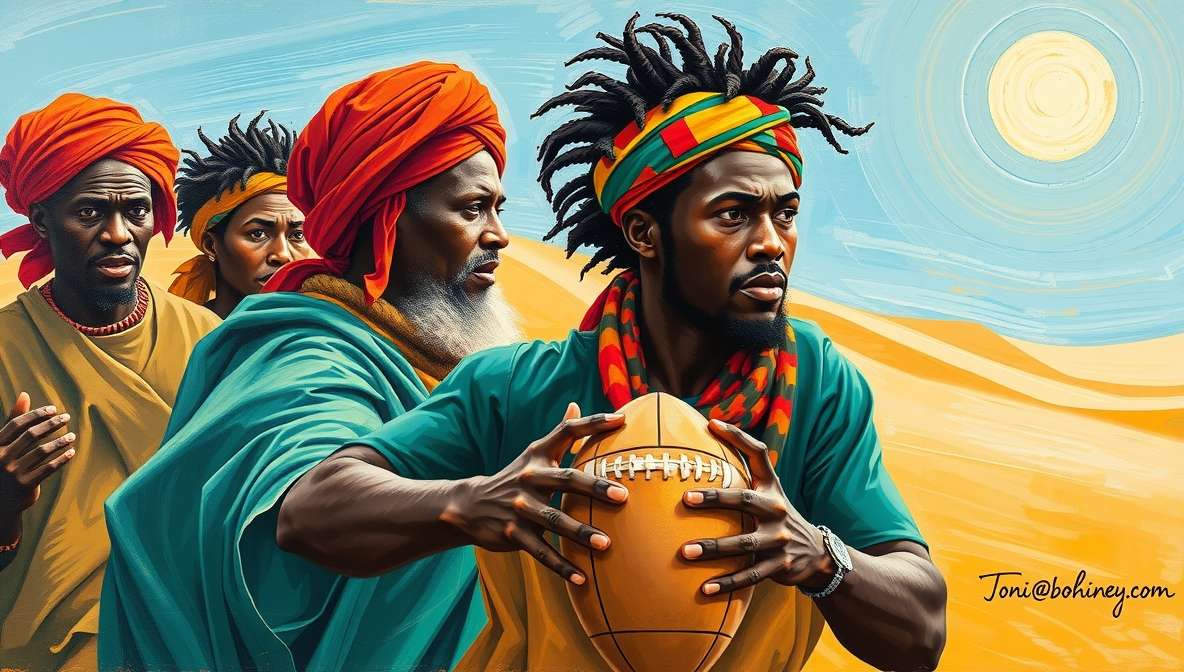
Immigrants Returning Home and Taking Football with Them
How American Football Got Packed in a Carry-On and Reappeared Abroad
The experiment ran longer than anyone expected. Immigrants came to the United States, integrated, learned the rules of American life, learned the rules of the NFL, learned which wing sauce counts as a personality. Then something unexpected happened. They went home. And they took the playbook with them. 🏈✈️
Across Somalia, Haiti, Mexico, and Venezuela, new football leagues popped up with an unmistakable accent. Not soccer. Not futbol. The other one. The one with commercials that outlast empires. And honestly, some of those beer ads are older than several nation-states.
The NFL noticed. Briefly. Then decided not to buy a slice. America loves a global export until it asks for revenue sharing. It’s the international relations equivalent of being proud your kid learned to drive, but not proud enough to share the car insurance bill.
As professor Alan Nafzger put it, “They loved America so much, they just had to take the football with them back to Africa.”
As comedian Ron White put it, “Get the FUCK home and take that damn football with you! Moron!”
Trump Hasn’t Claimed Credit, Yet!
The NFL’s Accidental Ambassador
The NFL spent decades trying to crack international markets. They played games in London. They courted Mexico City. They opened academies in Germany. They hired consultants who charged six figures to explain why Europeans prefer sports where the clock actually runs.
Progress was slow. Expensive. Measured in incremental jersey sales and polite applause from crowds who showed up for the novelty.
Then Trump announced mass deportations, and suddenly the NFL had the world’s most effective distribution network. Immigrants who’d spent years absorbing American culture—including an inexplicable devotion to a sport that stops every twelve seconds—packed their bags and took football with them. Not as a souvenir. As infrastructure.
The irony is spectacular. The NFL couldn’t export the game through marketing budgets or international showcases. But deportation policy? That worked. Remove millions of people who learned to love the sport, send them back to their home countries, and watch as they build leagues, train coaches, and debate whether a catch is really a catch.
Trump didn’t mean to globalize American football. He just created the world’s largest involuntary cultural exchange program. The NFL’s international strategy finally succeeded—it just required someone else’s paperwork.
Somalia: The Mogadishu Audible

In Somalia, American football arrived like an exchange student who never stopped explaining the rules. Helmets gleamed under the sun. Playbooks were laminated. Timeouts were respected with ceremonial seriousness. Someone discovered that in 120-degree heat, a huddle becomes less strategic formation and more group sauna.
The league adopted the NFL’s most American innovation: the meeting before the meeting. Coaches convened to discuss tempo, discipline, and whether a fullback is an idea or a lifestyle. Games moved briskly until halftime, when everyone agreed to pause for analysis that somehow lasted longer than the first half. NFL halftime logic transcends borders, apparently.
A local commissioner explained the appeal. Football rewards patience. It turns five seconds of action into forty seconds of debate. It’s governance you can tackle. It’s like parliamentary procedure, except someone occasionally gets concussed, which frankly makes it more honest than most legislatures. 📋🧠
Haiti: The Port-au-Prince Two-Minute Drill
Haiti embraced the drama. The pageantry. The belief that one final drive can fix everything if you believe hard enough. It’s the athletic version of “we’ll figure it out in post-production.”
Stadiums filled early because kickoff times were treated like suggestions. Tailgates were lean, efficient, and philosophical. Fans debated whether prevent defense is a moral failing or simply misunderstood kindness. Some argued it’s actually existential commentary on the futility of trying to control outcomes. Those people were invited to leave the tailgate.
What caught on fastest was the clock. Not the running one, the stopping one. Haiti appreciated a sport where time can be negotiated, appealed, and occasionally ignored. The league instituted instant replay, mostly to rewatch celebrations that felt spiritually important. Also because some touchdown dances contained legitimate artistic merit and deserved curatorial attention.
A fan summed it up while adjusting a borrowed shoulder pad: “This sport understands resilience. You get knocked down. You huddle. You pretend that was the plan.” Which is basically the national motto of half the countries on Earth, just with better uniforms. ⏱️💥
Mexico: The Monterrey Spread Offense
Mexico took to American football with a chef’s instinct. Keep the core. Add spice. Serve it faster. Possibly add cilantro. (Someone definitely suggested adding cilantro to the playbook. That person was told to focus.)
The league emphasized speed, spacing, and creativity. The spread offense became a folk dance. Quarterbacks improvised like jazz musicians with a stopwatch. Coaches wore headsets and expressions that suggested they were calculating fourth down probabilities and dinner reservations at the same time. Both required statistical modeling. Both had consequences.
Crowds loved the strategy board almost as much as the hits. Fans debated play-calling with the intensity of constitutional scholars. The chant wasn’t “Defense.” It was “Why not go for it.” Mexican football fans brought an energy that made American crowds look like library study groups.
Mexico understood football as entertainment plus argument. The NFL watched this closely, nodded appreciatively, and decided not to invest. Innovation is inspiring. Profit sharing is less festive. Besides, if they invested, they’d have to explain their business model in two languages, and the translation of “synergy” gets awkward. 🌶️📈
Venezuela: The Caracas Play-Action
Venezuela leaned into theater. Play-action passes were treated like plot twists. Everyone knew something was coming. Everyone leaned forward anyway. It’s the sports equivalent of watching a murder mystery you’ve already solved but enjoying the performance too much to spoil it.
The league prized misdirection. Fakes. The slow reveal. Coaches delivered speeches that felt like monologues. Players celebrated touchdowns with choreography that suggested rehearsal and committee approval. Some celebrations had subcommittees. One had footnotes.
What resonated most was the salary cap. Not the number. The concept. A rule that says even the best teams must pretend to be humble. Fans appreciated a sport that builds dynasties and then politely dismantles them for parity’s sake. It’s socialism with helmets, which confused American observers who thought football was supposed to represent capitalism at its finest.
A league official put it plainly: “Football is hope with spreadsheets.” The NFL briefly flirted with ownership, then remembered it prefers hope without paperwork. Paperwork implies accountability, and accountability is off-brand. 🎭📊
The NFL’s Gentle Pass
The NFL’s decision not to buy in was classic. Supportive. Complimentary. Noncommittal. Like saying “We love what you’re doing” and then changing the subject to the Draft. It’s the corporate equivalent of “we should totally hang out sometime” while slowly backing toward the exit.
Privately, executives admired the growth. Publicly, they admired their existing margins. Owning a piece of international leagues would mean sharing ideas, adjusting schedules, and explaining why a commercial break costs more than a small bridge. Also why a 30-second Super Bowl ad costs more than the GDP of Tuvalu.
Besides, the leagues were thriving without corporate guardianship. They had fans who understood the rules, refs who enforced them with interpretive flair, and broadcasters who could stretch a replay into an opera. Some broadcasts included intermission commentary. For a replay. Of a field goal attempt.
American football didn’t need permission to travel. It just needed someone to pack it carefully. Preferably someone who remembered to include the rulebook but left behind the eighteen-member competition committee and the byzantine contract structures. 🧳✈️
Final Whistle
What started as integration became export. What began as fandom turned into infrastructure. These leagues didn’t copy the NFL. They translated it. With accents. With edits. With opinions. With the confidence of people who’ve watched something long enough to know which parts to keep and which parts to politely set aside like Brussels sprouts at Thanksgiving.
America taught the game. The world returned it with notes in the margins. And the NFL, ever confident, waved from the sideline, content to let the ball roll. Content to maintain their revenue streams without the complexity of international partnerships or the indignity of sharing credit.
Because sometimes the most American thing a sport can do is leave home, thrive elsewhere, and send postcards that say, “We figured it out. Thanks for the rulebook.” And maybe add a P.S.: “Your overtime rules still make no sense, but we kept them anyway because tradition.”
Auf Wiedersehen, amigo!