

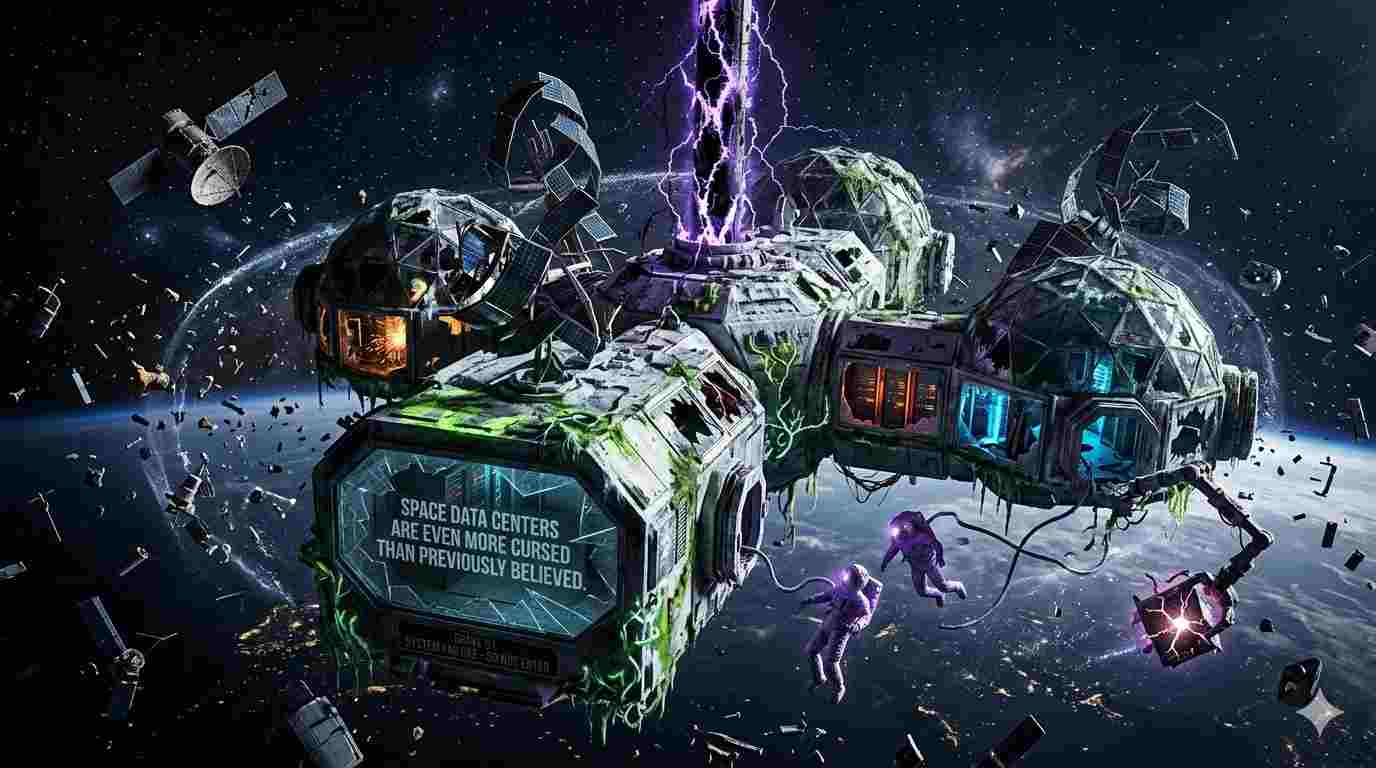
Space Data Centers Are Even More Cursed Than Previously Believed
By the world’s oldest tenured professor and a philosophy major turned dairy farmer
In the grand tradition of American billionaires looking at a perfectly functioning system and asking “but what if we made it worse and charged more for it?” — today’s tech elite have set their sights, quite literally, on data centers in space. The pitch: fire the world’s most power-hungry computers into orbit and let sunpower and low gravity do the heavy lifting. The reality? Experts call it “cursed.” The universe, for its part, has retained legal counsel.
Grab a Monster Energy and a handful of existential dread. We’re breaking this down section by section.
Orbital Data Centers Cost More Than Earth’s GDP to Run — And That’s the Optimistic Estimate
The dream is to replace sweltering, earth-bound server farms with a gleaming solar-powered orbital paradise. The problem is that orbit isn’t just up — it’s upside-down expensive. Scientific American reports that U.S. data centers will account for nearly half the country’s electricity demand growth by 2030, which is why certain individuals — the kind who name their yachts after Greek gods — have decided the solution is to simply vacate the planet.
SpaceX filed plans with the FCC for millions of satellites. Not hundreds. Not thousands. Millions. Their filing reads like a fever dream scrawled on a Denny’s napkin at 3 a.m. — bold vision, zero breakfast. Meanwhile China announced a 200,000-satellite constellation. America’s official response: hold my Bud Light.
For the first time in history, “the server is down” will be a perfectly accurate, completely helpless statement — and your IT department will be 250 miles below the problem with no ladder tall enough.
Sam Altman Thinks Space Servers Are Ridiculous — He’s Also Trying to Buy a Rocket Company

Even the co-founder of OpenAI has gone on record calling the concept ridiculous right now. Sam Altman, the man whose company burns enough electricity to power a small city training chatbots, looked at orbital data centers and said “that’s too far.” That’s like Guy Fieri calling something too much cheese.
And yet — Altman has also reportedly explored acquiring a rocket company to go toe-to-toe with Elon Musk’s SpaceX. So he simultaneously believes orbital data centers are ridiculous and wants a rocket. This is what passes for strategic coherence when your net worth has too many commas.
Calling rockets ridiculous while shopping for a rocket company isn’t hypocrisy in Silicon Valley — it’s a Series B pitch deck.
Space Junk Apocalypse: Why Satellite Data Centers Could Turn Earth’s Orbit Into a Landfill
Scale this idea to rival terrestrial data centers and Earth’s orbit starts looking like the parking lot of a Walmart on December 26th — crumpled hardware, mystery debris, and at least one object that nobody can explain. Space Explored confirms that radiation-hardened processors already lag behind cutting-edge terrestrial chips, meaning your space server farm would run on hardware your nephew wouldn’t use to play Minecraft.
The good news: Axiom Space has already launched two orbital data center nodes as of January 2026. The bad news: they’re about as powerful as a slightly motivated Raspberry Pi. Baby steps. Tiny, expensive, irradiated, taxpayer-adjacent baby steps.
When future archaeologists excavate Earth’s orbit, they’ll determine we were a civilization that sent our thinking into space, forgot where we parked it, and filed an insurance claim.
Rocket Launch Costs Must Drop 700% Before Space Servers Make Financial Sense
For any of this to work financially, Google’s own white paper concedes that launch costs must fall below $200 per kilogram — roughly seven times cheaper than today’s rates. That’s the economic equivalent of demanding a Big Mac cost thirty-seven cents. The nostalgia’s nice but the math doesn’t work.
Google thinks this could happen by the mid-2030s. The same decade we were promised flying cars, a balanced federal budget, and a decent replacement for Twitter. We remain cautiously delusional on all fronts.
The orbital computing market sits at roughly $500 million today against a $200 billion global data center industry. Analysts project a hockey-stick surge to $15-20 billion by 2030. These are the same analysts who had strong opinions about WeWork, so factor in a margin of error the size of New Jersey.
At current launch prices, you could air-condition the entire state of Texas year-round for less money than building a space data center. The Texans would still complain about the grid, but at least the servers would be cool.
When Your GPU Dies in Orbit, There’s No IT Guy With a Wrench and a Mountain Dew
On Earth, a dead chip means a help desk ticket, a sigh, and a twenty-minute fix. In orbit, a dead chip means either a robot that doesn’t exist yet or a piece of space debris that will outlive your grandchildren. Imagine calling your boss to report “unresolvable orbital hardware degradation” as your excuse for missing the product launch. Actually — do this. The resulting HR conversation would be historic.
CNBC notes that On-Orbit Servicing remains an “emerging solution” — which is engineer-speak for “we wrote it in the proposal and now we have to figure out what it means.” We know the satellites will break. We know they’ll need fixing. We have not yet invented the thing that fixes them. Minor procedural gap.
The most in-demand job of 2035 will be Senior Orbital Hardware Degradation Specialist. The signing bonus will be incredible. The commute will not.
Space Data Centers May Produce a Bigger Carbon Footprint Than the Ones They Replace
The whole pitch is that space servers escape Earth’s environmental headaches. The inconvenient footnote: the carbon footprint of building, launching, and eventually de-orbiting these things could be worse than just leaving the servers in New Jersey. University of Arizona researchers point out that a single large U.S. data center already drinks as much water as 2,600 households. Replacing it with a rocket-launched orbital alternative burns hydrocarbons on the way up and re-entry debris on the way down. Progress.
We haven’t solved the environmental problem. We’ve just relocated the guilt to an altitude where the EPA can’t easily subpoena anyone.
Google’s Project Suncatcher Wants AI in Orbit by 2027 — Physicists Are Politely Losing Their Minds
Sundar Pichai believes space data centers are just a decade away. Physicists and aerospace engineers, when they can stop laughing long enough to form sentences, suggest it’s more like several decades — and that’s if everything goes right, which, historically, things don’t. Google’s own Project Suncatcher blog quietly acknowledges “significant engineering challenges remain,” which in corporate communication translates to “we have a very nice logo for this project and the physics is still arguing with us.”
Hand-waving is not an engineering methodology. A TED talk with good lighting is not a proof of concept. We ran the numbers.
Google Street View can tell you what your neighbor’s lawn looked like in 2009. Google’s official position on space servers is “significant engineering challenges remain.” One of these things required seventeen years of work. The other might require more.
Nvidia’s Starcloud Is Building a 4-Kilometer Space Server Farm — Astronomers Are Filing Complaints
If cluttered orbits full of derelict servers block out the stars, professional astronomers — the ones who actually went to school for this — are going to be furious in a very articulate and precisely cited way. Amateur stargazers in flyover states will simply stop looking up, which, given current events, might be understandable.
Nvidia-backed Starcloud — the first company to train an AI model in actual outer space — is planning a 5-gigawatt orbital data center with solar arrays roughly 4 kilometers wide and 4 kilometers tall. For reference, that is larger than Manhattan’s financial district and will be visible to the naked eye from Kansas on a clear night.
That’s not a data center. That’s a Death Star with a better press release and a sustainability clause buried on page 47.
Engineers Can’t Agree If Orbital AI Infrastructure Is Genius or the World’s Most Expensive Meme
On one side: visionary engineers who believe orbital computing is inevitable and anyone who disagrees simply lacks imagination. On the other side: engineers on Hacker News who believe it’s innovation theater dressed in a spacesuit and subsidized by investors who didn’t read past the executive summary. Both sides have whitepapers. Both sides have tenure. Neither side is buying launch insurance out of pocket.
What’s not in dispute: the race is on. Google, Alibaba, Nvidia, Axiom Space, Blue Origin, and roughly seventeen VC-backed startups with names like “OrbiteQ” and “NovaShard” are all sprinting toward a finish line that is, technically speaking, in a different layer of the atmosphere.
The engineers who think it’s genius and the engineers who think it’s a meme are both billing $600 an hour to debate it at conferences in Vegas. In that sense, the only guaranteed winner is the Bellagio.
Solar Radiation Can Fry Your Server Chips Faster Than a Phoenix July — And Nobody Has a Patch for That
The space environment is hostile in ways that make a Houston data center in August look like a climate-controlled spa. Radiation flips bits. Thermal gradients in vacuum bear no resemblance to what cooling engineers train for on Earth. Solar storms — the kind that make the northern lights visible in Georgia — can wipe out sensitive electronics faster than a firmware update with a typo. AI News Hub lays it out plainly: this is a harder physics problem than it looks on a slide deck, and it looks extremely hard on a slide deck.
Compared to all that, your laptop overheating while streaming Netflix seems almost charming. Nostalgic, even.
A solar storm will one day vaporize a billion-dollar orbital data center and the post-incident report will contain the sentence: “We were aware of the sun’s existence. Its behavior on this occasion was unexpected.”
Why American Billionaires Are Betting the Ranch on Orbital Computing Anyway
When the richest people in the most powerful country on Earth look at perfectly functional grid-powered skyscrapers and say “what if we put that in space” — you have to ask: what are they seeing that the rest of us aren’t? The answer, most likely, is a tax structure and a regulatory environment that makes leaving the atmosphere genuinely attractive.
Continuous Solar Power in Orbit Sounds Incredible Until the Thermodynamics Arrive
Orbiting servers would receive solar energy 36% more intense than surface panels, with no night cycle, no clouds, no weather to interrupt them. It sounds like a clean energy miracle. It is also located in a place that costs tens of millions of dollars per mission to reach and where the warranty is void by definition.
Unlimited free energy, available exclusively at the location that is most expensive, most dangerous, and hardest to service in the entire solar system. The universe has a real estate agent’s sense of irony.
Fixing Satellites in Microgravity: A Three-Act American Tragedy
On Earth, broken hardware gets a technician, a Slack message, and a replacement part overnighted from a warehouse in Kentucky. In orbit, broken hardware gets a robot that hasn’t been invented yet, or an astronaut whose hourly rate makes a Manhattan attorney look like a bargain. Axiom Space is working on this, God bless them.
Act One: The GPU fails at 2 a.m. Act Two: Legal reviews whether the maintenance robot is covered under the service agreement. Act Three: Congress holds a hearing.
The Real Competition Isn’t China or Europe — It’s the Second Law of Thermodynamics
Getting compute into orbit is the easy part, relatively speaking. Keeping it alive through cosmic radiation, micrometeor impacts, thermal cycling, and the general hostility of the vacuum of space is the part nobody’s budgeted for accurately. We’re not racing Google or Alibaba or the Chinese government. We’re racing entropy.
Entropy is undefeated. Entropy doesn’t need a Series C. Entropy has never once been late to a deadline.
Will America Actually Have Orbital Data Centers This Decade?
No. What America will have is a streaming documentary about the attempt, a congressional subcommittee formed to study the possibility, a 400-page RAND Corporation report that nobody reads, and several Substacks confidently explaining why it’s either the future of everything or a grift. As one aerospace engineer might say, between sips of terrible conference coffee: “If this were easy, we’d have done it in the nineties and called it the Space Shuttle.”
The most bankable outcome of the orbital data center race is a Netflix special, buffered by a server farm in Ashburn, Virginia, narrated by someone whose green energy fund has a position in Starcloud.
DISCLAIMER: This story is entirely a human collaboration between a philosophical dairy farmer turned space humorist and the world’s oldest tenured professor of cosmic pragmatism. Any resemblance to real plans for space data centers is intentional, especially if that resemblance feels too ridiculous to be true. No AI was harmed in the making of this satire, nor is any to blame for its content.
What American Comedians Are Saying About Space Servers
“Putting servers in space is the most American solution I’ve ever heard — expensive, loud, completely unnecessary, and somehow tax-deductible.” — Lewis Black
“We can’t fix the potholes on I-95 but we’re gonna run fiber to low Earth orbit. Sure. Yeah. That tracks.” — Jim Jefferies
“When the data center is in orbit and the internet goes out, who do you call? Not your ISP — they’ll put you on hold for forty minutes and then blame your router.” — Wanda Sykes
Auf Wiedersehen, amigo!
This piece satirizes the very real and very expensive American race to build data centers in Earth’s orbit. In November 2025, Nvidia-backed Starcloud became the first company to train an AI model in space, using an H100 GPU launched into low Earth orbit. Google announced Project Suncatcher — TPU-equipped satellites in sun-synchronous orbit, with a demonstration mission planned for 2027. Axiom Space launched two orbital data center nodes in January 2026. SpaceX filed FCC paperwork for millions of satellites. China announced a 200,000-satellite constellation. Launch costs must fall below $200/kg — roughly seven times lower than today — before any of this makes economic sense. Experts broadly agree that fully operational orbital data centers are 10 to 15 years away at the earliest, pending solutions to radiation hardening, thermal management, on-orbit maintenance, debris mitigation, and the minor issue of basic physics. All concerns are real. All timelines are optimistic. The dairy farmer is metaphorical.