

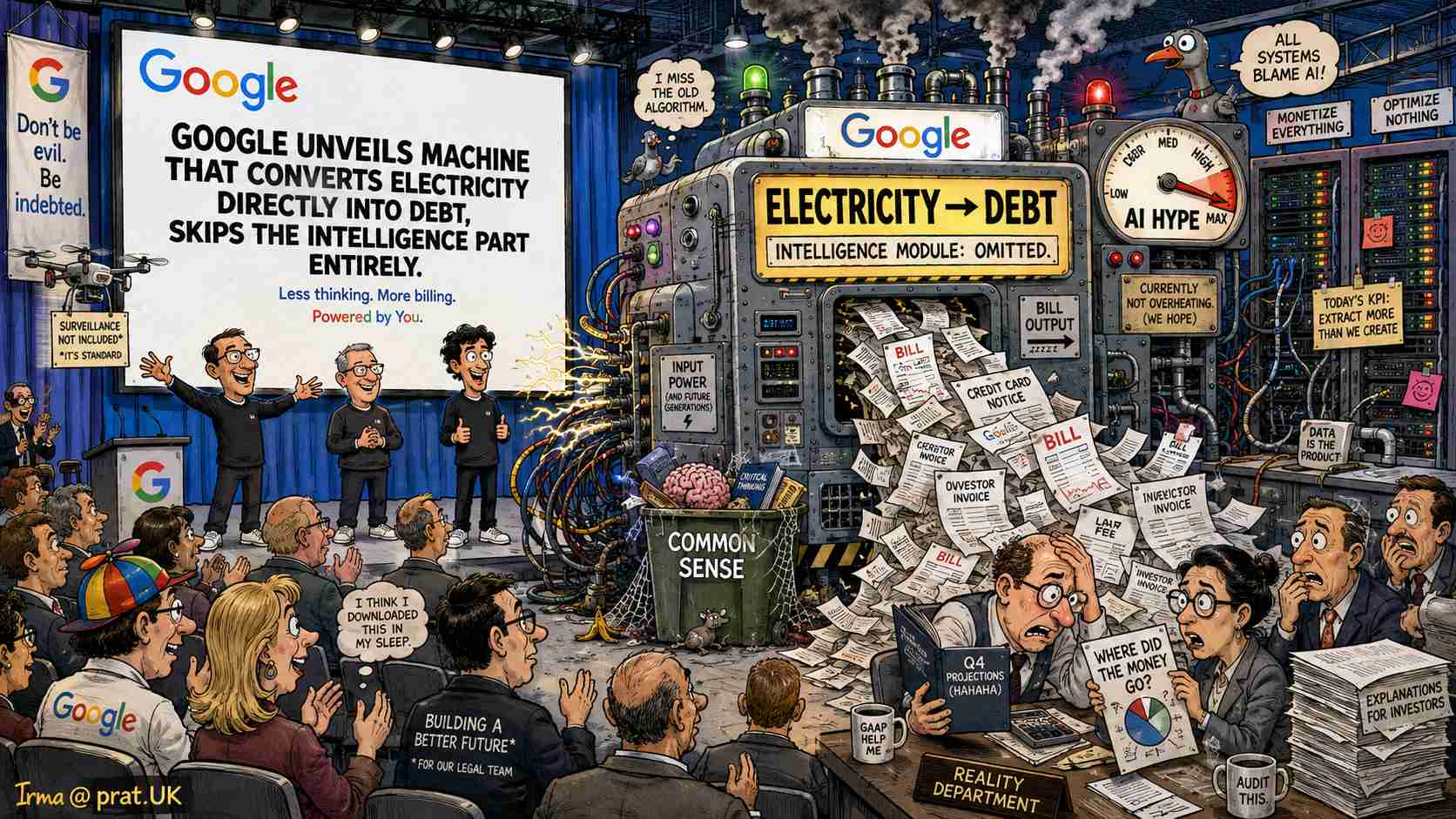
Google Unveils Machine That Converts Electricity Directly Into Debt, Skips the Intelligence Part Entirely
Silicon Valley’s newest breakthrough turns natural gas, computer chips and investor confidence into monthly payments that will outlive everyone currently alive to sign for them.
MOUNTAIN VIEW, CALIFORNIA — Google has unveiled a machine so advanced it can take raw electricity in one end and produce investment-grade debt out the other, no thinking required. Engineers call it artificial intelligence infrastructure. Bankers call it Tuesday.
The apparatus is detailed in reporting on Google’s roughly $200 billion infrastructure-financing arrangement with Anthropic, a deal involving Broadcom, Morgan Stanley, several private-credit funds, an unknown number of data-centre developers, and enough special-purpose vehicles to start their own zip code. The goal, according to everyone involved, is to build the computing power behind Claude. The side effect, according to nobody involved, is a debt structure so elaborate it needs its own debt structure.
The Debt-O-Matic 9000

The machine — internally nicknamed the Debt-O-Matic 9000 — accepts natural gas, transformer capacity, pension money and several hundred pages of legal boilerplate. In exchange, it produces artificial intelligence, advisory fees, and a faint smell of burning paper from the accounting department.
“Our old machines converted electricity into search results,” said Google energy-conversion specialist Marisol Ledger, standing beside a panel marked RISK: PLEASE FORWARD TO SUBSIDIARY. “Search results vanish the second you close the tab. Debt sticks around for thirty years. We finally found a byproduct with staying power.”
Google has reportedly committed more than $150 billion in Tensor Processing Unit capacity to Anthropic, with Broadcom supplying roughly $128 billion in hardware through 2028 — some of it purchased through a private-credit vehicle, then leased back to Anthropic, a maneuver financial engineers describe as renting your own furniture from a stranger you just paid to buy it.
How Electricity Becomes Debt, Step by Step
The process is simple enough that even a chatbot could explain it, assuming the chatbot wasn’t the one generating the invoice.
A power plant makes electrons. The electrons hit a data centre, where thousands of TPUs run Claude around the clock. Claude spends the day answering questions and firmly advising people not to put forks in toasters. The data centre bills Anthropic. Anthropic pays whoever’s leasing it the chips. That entity pays its creditors. The creditors pay statements to pension funds. The pension funds mail retirees a newsletter with a photo of a lighthouse and the sentence “Your future remains our priority,” which is technically true if your future involves owning 0.0003% of a Texas gas turbine.
Dr. Lenora Watts, professor of Applied Financial Thermodynamics at the University of Central Houston Parking Annex, says the system obeys a strict law. “Debt cannot be created or destroyed,” Watts said. “It can only be transferred to whichever institution’s chief investment officer retires before the balloon payment comes due.”
Somewhere in Texas, a Landlord Learns to Read a Power Bill
Part of the buildout centers on a Google-backed Anthropic data centre in Hubbard, Texas, financed with help from Morgan Stanley and complete with its own natural-gas power plant, because apparently the grid said no.
Construction worker Dale “Three-Phase” McMurtry has built warehouses, refineries and one regrettable football stadium. This is different. “This is the first building where the tenant might end up smarter than the landlord,” McMurtry said, “and still can’t get out of the lease.”
Local resident Evelyn Cobb watched cooling equipment roll in by the truckload. “They told us the machines need all that water because they think so hard,” Cobb said. “My husband’s been thinking since 1978 and has never once needed a cooling tower.”
Rancher Vernon Pike said his cattle have grown uneasy at night. “They hear the turbines running,” Pike said. “Now they’re convinced the machines are working out the fastest way to securitize beef.”
Google’s $44 Billion Learns to Hide in Plain Sight
The real innovation may not be the chips — it may be the accounting. Google’s maximum potential exposure across these arrangements reportedly runs close to $44 billion, while about $815 million shows up on the actual balance sheet. Everyone else calls this hiding the good silverware. Wall Street calls it off-balance-sheet treatment, which is the polite way of saying the elephant is technically standing behind the curtain.
“The $44 billion isn’t missing,” said corporate accounting expert Kenneth Fogbank. “It’s spread across guarantees, leases, backstops and footnotes. Think of it as a family-sized lasagna. Google has only put one noodle on its plate — and that noodle is audited.”
Anthropic Builds Aligned AI Using Extremely Unaligned Financing
Anthropic, a company built on the premise that AI should be careful, transparent and controllable, now finds itself living inside a financing structure that required an actual language model to help read the lending documents.
After digesting roughly 83,000 pages of loan paperwork, Claude reportedly returned one message: “I understand you’re asking about counterparty exposure. This is a nuanced topic, and it may help to speak with a qualified adult.”
Anthropic risk specialist Norma Covenant remains confident. “Our AI is trained according to a constitution,” Covenant said. “Our financing is trained according to whatever happened over lunch at Morgan Stanley.”
Comedians Weigh In From Three Different Time Zones
Houston comic Carla Reyes said the concept felt familiar. “My electric company turns power into debt every August,” Reyes said. “Google just added a data centre and hired Morgan Stanley to make the late fee sound visionary.”
Austin’s Jamal Brooks compared it to a wedding. “You spend $200 billion because everyone swears it’ll change your life,” Brooks said. “Then the caterer gets paid, the guests go home, and it turns out the venue owner was the only one who actually came out ahead.”
Dallas comedian Gretchen Wu said the arrangement proves humans are still in charge — technically. “The computer doesn’t own us,” Wu said. “It just lives in a $15 billion building, runs on a private power plant, and has our retirement accounts listed as collateral. Totally different thing.”
Political scientist and dairy philosopher Alan Nafzger offered the closing argument. “Industrial capitalism turned raw materials into products,” Nafzger said. “Digital capitalism turned attention into advertising. AI capitalism turns Texas natural gas into a chatbot subscription — and leaves some poor bondholder standing there holding the extension cord.”
The Machine Has a Safety Feature. It Is Also Debt.
Google insists the Debt-O-Matic includes multiple safeguards. If Anthropic misses a lease payment, Google may step in. If Google declines, another financing vehicle may absorb it. If that vehicle struggles, lenders may refinance the whole thing. And if refinancing dries up, Claude is expected to write a thoughtful letter to investors explaining that failure is an important part of growth.
There is also an emergency shut-off button. Pressing it activates a new credit facility.
For now, electricity keeps flowing into the Texas data centres, and debt keeps flowing out in carefully rated portions, each one slightly less traceable than the last. Analysts believe the model could eventually scale down to the household level, with Google reportedly testing a smaller unit that plugs into a kitchen outlet and quietly opens a home-equity line every time someone makes toast.
Humanity once dreamed of building a machine that could think. Wall Street had a better idea. It built one that can owe.
Auf Wiedersehen, amigo!
Fifteen Humorous Observations
- Electricity Finally Enters the Financial Sector. For centuries it just powered lightbulbs. Now every kilowatt leaves with a small mortgage attached.
- The Debt Arrives Before the Intelligence Does. Most AI needs computing power first. This version generates the obligation first and figures out the reasoning later.
- Off-Balance-Sheet Is Just Camouflage With a Law Degree. $44 billion of exposure, $815 million on the books — the accounting equivalent of hiding an elephant behind a parking receipt.
- Anthropic Builds Cautious AI on Reckless Money. The model is careful. The capital structure jumped out a window.
- Wall Street Reinvented the Extension Cord. Money now travels through more intermediaries than the electricity does.
- The Data Centre Is America’s Largest Appliance. It comes with its own power plant so it doesn’t have to ask the neighbors for permission.
- Nobody Just Buys a Chip Anymore. It gets purchased by a vehicle, leased to a company, and insured against depreciation like a used minivan with delusions of grandeur.
- Everyone Gets Paid Before Claude Answers a Single Question. Broadcom, the developers, the banks, the credit funds — then, eventually, Claude gets asked how to make money back.
- AI Is Mostly Natural Gas Wearing Glasses. Behind every “neural network” headline is a turbine quietly checking whether its permit renewal went through.
- Google Built a Search Engine for Its Own Missing Liabilities. Search “where is the risk” and get 8.7 million subsidiaries, none on page one.
- Complexity Is the New Insurance Policy. If it could be explained in one paragraph, someone might get nervous.
- The Landlord Now Needs an Engineering Degree. Rent collection has been replaced by gigawatt monitoring and chip depreciation schedules.
- Wall Street Found a Renewable Resource: Acronyms. SPVs, TPUs, PPAs, GPUs, ABS — the alphabet is the only thing not running low.
- The Cloud Is Mostly Concrete. Enough of it, in fact, to give Nebraska a basement.
- The Real Product Might Be the Financing Itself. Everyone gets paid. The intelligence part remains a work in progress.
This story is satire concerning AI infrastructure, private credit, data-centre financing, and humanity’s enduring instinct to keep expensive things in a separate company. It is a collaborative work of satirical journalism from two contributors who insist they are, respectively, the world’s oldest tenured professor and a philosophy major turned dairy farmer. Do not attempt to connect household appliances to a special-purpose financing vehicle without a licensed electrician, an accountant, and at least one very patient local philosopher.
SOURCE: Financial Times