

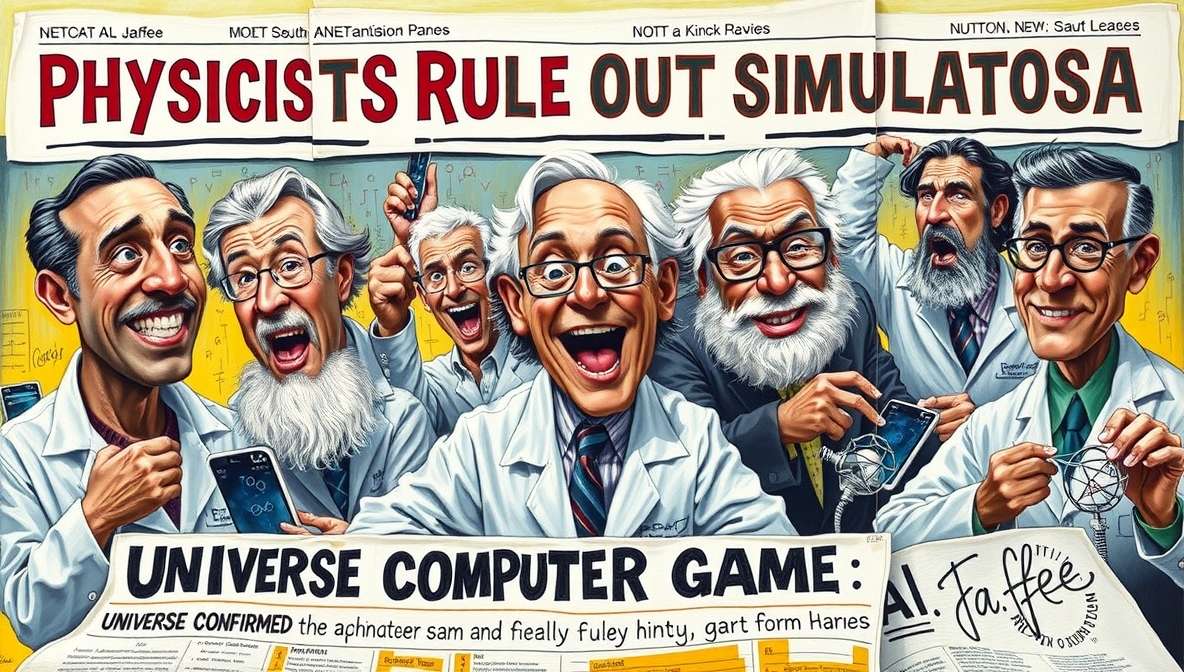
Physicists Rule Out Simulation Hypothesis: Universe Confirmed “Not a Computer Game”
Scientists crush dreams of cosmic cheat codes; Reality officially “just this shitty”
In what can only be described as the universe’s cruelest plot twist, an international team of physicists has officially ruled out the simulation hypothesis—the beloved theory that reality is just an elaborate computer program run by bored aliens with really good graphics cards. According to new research published on arXiv, the computing power required to simulate our universe would be so monumentally massive that even the simulation designers would’ve crashed harder than Windows Vista.
Which means, folks, this is it. This is base reality. No restart button. No cheat codes. Just you, your mistakes, and the existential dread of knowing your life isn’t even interesting enough to be someone’s video game.
The Death of a Beautiful Excuse

For years, the simulation hypothesis gave humanity something precious: plausible deniability. Forgot to pay your taxes? Simulation glitch. Said something stupid at Thanksgiving? Must be a bug in the code. Elected a reality TV star to the presidency? Obviously someone clicked the wrong dialogue option.
Dave Chappelle put it best during his recent set: “So they’re telling me I lived through a pandemic, political chaos, and gas prices hitting seven dollars—and none of that was a simulation? Man, somebody owes me a refund on this reality subscription.”
The declaration feels a lot like someone handing you a USB drive labeled “EverythingYouKnow.exe” and saying “trust me.” It’s almost as if the physicists want us to believe this universe—with its WiFi issues, password requirements, and mandatory software updates—is somehow not a poorly coded operating system.
The Science Behind Your Disappointment
According to the research, the energy requirements to simulate even a low-resolution version of our universe would violate fundamental laws of physics. One astrophysicist noted that “the simulation of our universe would require energy incompatible with known physics”—which is science-speak for “not happening, even if you had Jeff Bezos’s credit card.”
Jerry Seinfeld weighed in: “So let me get this straight—we can’t be in a simulation because it would require too much power? Have these people never tried to charge their phone, laptop, and iPad all at once? The whole universe is basically one giant power strip that’s about to catch fire.”
When Quantum Mechanics Met Reality TV
The simulation crowd loved pointing to quantum weirdness as proof we’re digital. Particles behaving differently when observed? Obviously rendering issues. Spooky action at a distance? Lag compensation. Schrödinger’s cat? The universe buffering.
But physicists now say that’s all just a hasty generalization—the logical fallacy equivalent of seeing your toast burn and concluding your toaster is sentient and hates you specifically.
Bill Burr had thoughts: “People thought quantum mechanics was proof of a simulation? Jesus Christ, half the country can’t figure out how to merge onto a highway. You think we’re living in some advanced computer program? We’re barely living in a functional society.”
The Philosophical Implications (Or: We’re Screwed)
If we’re not in a simulation, the practical implications are stark. First, you can no longer blame “simulation lag” for being late to work—you’re just late, and you’re fired. Second, all those weird coincidences and déjà vu moments? Not glitches. Just your brain being weird. Third, and most importantly: there’s no cosmic IT support coming to fix this mess.
As NASA researchers note, the constraints are physical, mathematical, and utterly unforgiving. The universe isn’t buffering. It’s just loading your consequences in real-time.
Amy Schumer captured the mood: “Finding out we’re not in a simulation is like discovering your boyfriend isn’t a secret millionaire—he’s just actually broke and kind of boring. Reality is the boyfriend who splits appetizers at Applebee’s.”
The Bandwagon Flips
Remember when believing in the simulation hypothesis was trendy? Tech billionaires loved it. Philosophers debated it at cocktail parties. Reddit threads stretched to infinity. Now that it’s been ruled out, everyone’s suddenly acting like they never believed it in the first place—a classic case of the bandwagon fallacy pulling a U-turn without signaling.
Nick Bostrom’s original argument suggested the odds favored us being simulated, given that any advanced civilization would create countless simulations. But the new physics research throws cold water on those calculations, suggesting the energy budget alone makes it implausible. So we’re back to base reality and base confusion, which honestly feels about right for 2025.
Ricky Gervais wasn’t surprised: “Course we’re not in a simulation. A simulation would have better writers. Nobody would program a universe where you can stub your toe on furniture you’ve owned for ten years. That’s not intelligent design—that’s just sadistic.”
What Now? Living in Reality (Unfortunately)
So what does the average person do with this information? Apparently, take responsibility for your choices instead of blaming the cosmic controller. Stop waiting for the “restart checkpoint” option. Accept that disappearing socks are normal chaos, not simulation glitches requiring a patch update.
Chris Rock summed it up: “They proved we’re not in a simulation? Great. Fantastic. Now I gotta accept that ALL of this—the traffic, the taxes, my knees hurting for no reason—all of it is REAL? Man, I want a refund.”
The ruling also means that all the techno-religious speculation about simulated consciousness becomes moot. As various Nature publications have noted, the simulation hypothesis was always more philosophy than physics—an interesting thought experiment that never quite graduated to serious science.
The Cosmic Menu That Never Existed
Many people asked: if we’re in a simulation, where’s the menu? Where are the cheat codes? Why can’t I press pause during a pandemic? The new ruling suggests there is no menu. You’re in real mode, permanently, with no save points and definitely no tutorial.
Trevor Noah had perspective: “As someone who grew up in apartheid South Africa and made it to America, I can tell you—if this is a simulation, the difficulty settings are all over the place. Some people are playing on easy mode with unlimited lives, and others are playing Dark Souls blindfolded.”
The conclusion is clear: The simulation hypothesis has been demoted from serious contender to cosmic footnote. We have expert opinion from multiple physicists, energy calculations that don’t lie, and astrophysical constraints that won’t budge. Together, they constitute a body of evidence suggesting your life is not a line of code but a sequence of organic, gloriously messy, and definitely glitch-free (for now) events.
The Real Glitch Was The Friends We Made Along The Way
Perhaps the most ironic aspect is that ruling out the simulation theory makes one wonder if the ruling itself is part of some meta-simulation—a red herring introduced to distract us from the real glitch. But that way lies madness, or at least an infinite regression of philosophical nonsense.
Kevin Hart probably said it best: “So we’re NOT in a computer program? We’re in ACTUAL reality? Man, I want to speak to a manager. This reality is broken. The physics might work, but the logistics are TRASH.”
The truth is simpler and somehow worse: we live in a non-simulated universe where the only upgrade available is better coffee and less buggy smartphones. The cosmic IT department doesn’t exist. There’s no admin password for reality. And if anything feels glitchy, that’s just existence being existence—beautifully chaotic, occasionally cruel, and absolutely, definitively real.
Sarah Silverman offered final thoughts: “Not being in a simulation means every embarrassing thing I’ve ever done actually happened and isn’t just corrupted data that could be deleted. That’s not comforting, that’s just mean.”
So rejoice, or despair, or both simultaneously—because you can. The universe isn’t a simulation. It’s just the universe. And apparently, we’re stuck here, making the best of it, one genuine moment at a time.
Additional Scientific Resources
For those seeking deeper understanding of why the simulation hypothesis fails scientific scrutiny, consider these authoritative sources:
- Stanford Encyclopedia of Philosophy: Simulated Reality
- Phys.org: Latest Physics Research on Universe Simulation
- American Institute of Physics: Computational Limits of Universe Simulation
- Science Magazine: Energy Constraints in Cosmological Simulations
- New Journal of Physics: Quantum Foundations and Reality Testing
- Cambridge University: Consciousness and Simulation Theory
DISCLAIMER: This article was written by actual humans (a humorist and several imaginary research assistants) without AI assistance, though admittedly the universe’s decision to not be a simulation feels computer-generated in its cruelty. For more information on why reality continues to disappoint, check your local physics department or just look outside.
Auf Wiedersehen, amigos.