

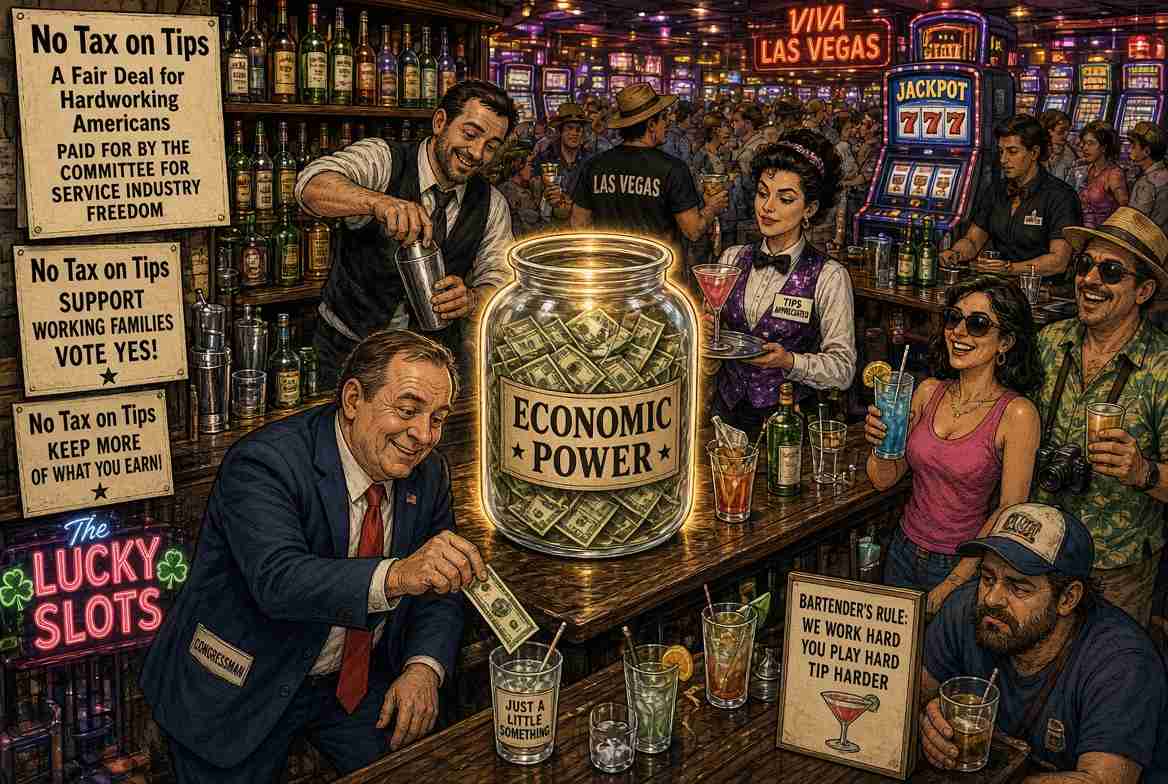
Las Vegas Campaign Turns on ‘No Tax on Tips,’ Bartenders Discover Congress Finally Studying Subject They Understand
Washington discovers the economic power of the jar beside the cash register
LAS VEGAS — Nevada’s congressional campaign has found the rare political issue capable of surviving contact with a bartender: taxes on tips.
Republicans are emphasizing President Donald Trump’s “no tax on tips” policy in Nevada’s competitive 3rd Congressional District, where Republican Marty O’Donnell is challenging Democratic Rep. Susie Lee. Nevada’s hospitality-heavy economy gives the issue particular relevance, although the candidates and unions differ over the broader legislation and whether the tax provision should be expanded or made permanent.
Washington Finally Discovers Retail Politics Has a Price Tag
For decades, Washington politicians have searched desperately for ways to connect with ordinary workers. Finally somebody discovered the solution. Money. Apparently focus groups were unnecessary.
The economics of tipping have always been wonderfully American. You order a $14 drink. The bartender hands it to you. A screen rotates 180 degrees and asks whether you would like to tip 20%, 25%, 30% or surrender a small parcel of land. Suddenly you are negotiating with an iPad.
Congress Joins the Conversation, Nobody Asked
Now Congress has entered the conversation. That means the transaction involves the customer, worker, employer, Internal Revenue Service, congressional candidates, organized labor and whoever programmed the little smiling face on the payment terminal.
Las Vegas may be the perfect laboratory. Thousands of workers depend significantly on gratuities. Dealers, servers, bartenders and hotel employees occupy an economy where tiny exchanges of cash collectively become serious household income. Politicians have therefore developed a fresh respect for the humble dollar bill. Campaign consultants reportedly call this “retail politics.” Bartenders call it “Tuesday.”
From Napkin Policy to Nineteen-Provision Novel

The tax change has supporters who say tipped employees keep more of what they earn. Critics point to limitations and argue that the broader package contains policies they oppose. Nevada unions, including chapters affiliated with the AFL-CIO, have also pressed for changes that would make tip-related relief broader or permanent.
This is what makes tax legislation magical. Nobody ever votes on one sentence. Congress cannot simply pass: “Tips shall receive different tax treatment.” That would fit on a napkin. Instead, legislation develops gravitational pull. Tax provisions appear. Spending provisions appear. Healthcare provisions appear. Soon a bartender wondering what happened to his Friday-night tips must develop an informed position on Medicaid financing.
This explains why Americans love direct questions and hate legislation. “Should workers keep more tips?” Easy. “Should Congress enact Section 704(b)(2)(A), subject to income thresholds, occupational definitions and interaction with nineteen unrelated provisions?” I just wanted nachos.
Nobody Ever Changed Their Vote Over Productivity Assumptions
Campaigns in Nevada understand the political attraction. A tax benefit someone can identify on a paycheck is easier to explain than macroeconomic theory. Nobody has ever leaned across a blackjack table and whispered, “You know what really changed my vote? Long-run productivity assumptions.”
Tip policy is tangible. A worker can count the money. That makes it politically potent. It also means presidential and congressional politics have now reached the bar counter. Your server may bring your beer and a side order of fiscal policy. The customer asks, “Is gratuity included?” The server responds, “That depends on your adjusted gross income and the forthcoming Treasury regulations.”
What Happens in Vegas Now Reaches the Congressional Record
Vegas once advertised itself as the place where what happens there stays there. Not anymore. What happens in Vegas may determine a congressional seat, influence federal tax policy and eventually appear in a campaign advertisement featuring dramatic music.
At which point Americans will do what they traditionally do when politics reaches the bar. Order another round and tip the person who actually accomplished something.
Satire. This piece is built around real reported events; the quotations and dialogue are comic invention.