

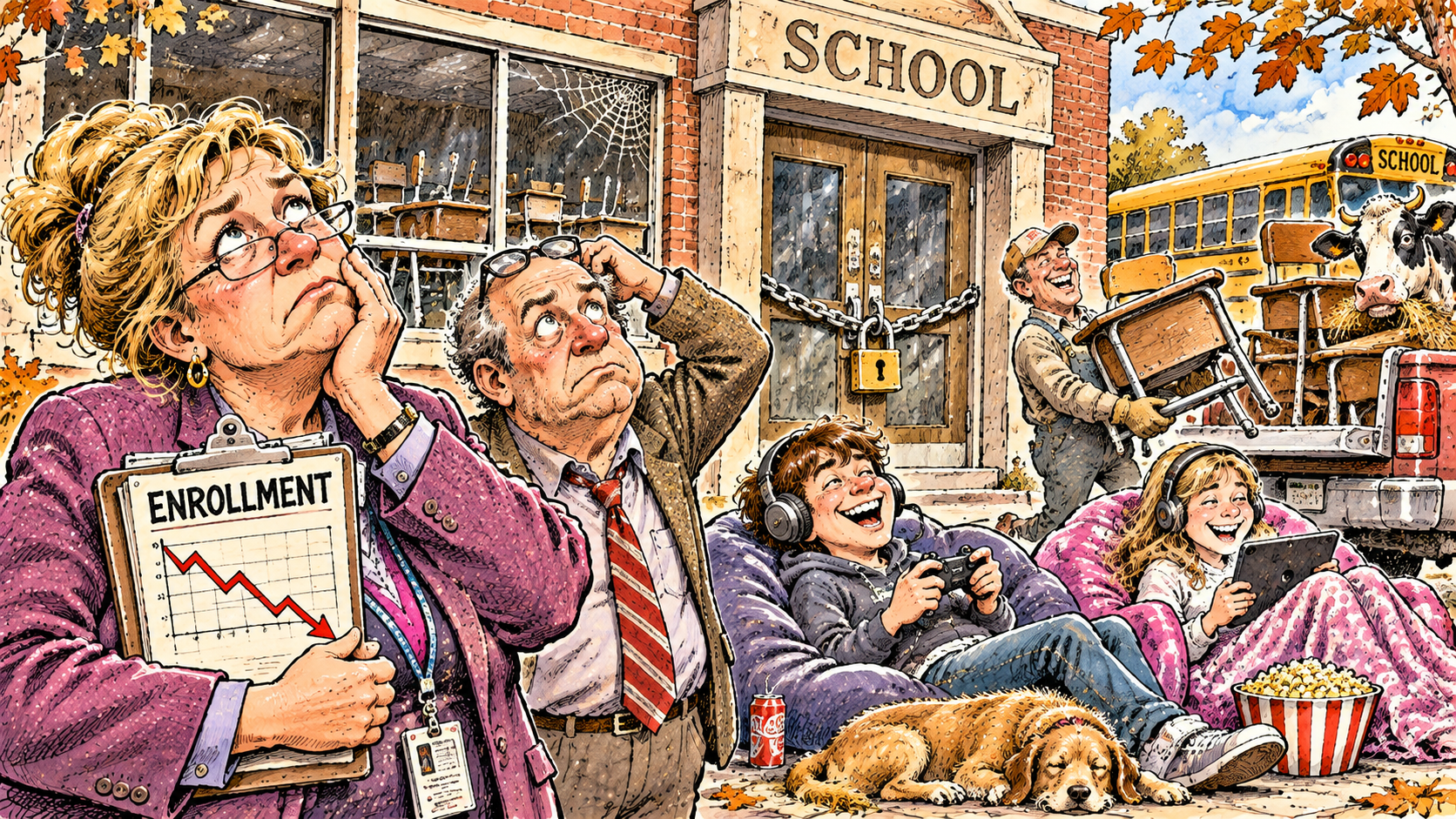
Officials Celebrate Smaller Class Sizes by Eliminating the Classrooms
SACRAMENTO, California – American public education has achieved a remarkable breakthrough in reducing class sizes by closing the schools in which the classes were previously held.
According to theGrio’s reporting on new federal data, more than 1,000 public schools closed in the last academic year, up from 755 four years earlier. The same data cites federal projections showing public schools losing close to four million students compared with before the pandemic. The Philadelphia Inquirer’s coverage of the closures found Philadelphia saying it has about 70,000 more seats than it needs.
Education officials describe the closures as difficult financial decisions. Parents describe them as another reason to question why their property tax bill keeps arriving on time.
A California School District Achieves a Student-to-Teacher Ratio of Zero
A California school district reportedly celebrated achieving a student-to-teacher ratio of zero. The superintendent described the result as unprecedented.
“We have eliminated overcrowding, classroom distractions and disciplinary incidents,” he announced.
The district had also eliminated the students. A school board member proposed reopening the campus. The superintendent explained that doing so would increase operating expenses and might introduce children into the educational environment, which was considered financially irresponsible.
The district instead proposed converting the abandoned building into an administrative headquarters. A memo circulated to staff described the plan:
TO: All administrative staff
RE: Reuse of former elementary campus
The building’s 24 classrooms will be repurposed as office space for curriculum consultants, assessment specialists and strategic planning directors. Please do not refer to the building as a school. It is now a campus. The playground will be retained as a wellness amenity.
Parents wondered whether any space would remain for actual education.
Why School Enrollment Is Falling and What Closures Really Save
Declining birth rates, population changes and competition from alternative educational arrangements have reduced enrollment in numerous districts. Because many school systems receive funding based partly on enrollment, fewer students can mean less revenue. Expenses do not disappear automatically when students leave. Buildings still require maintenance. Transportation routes may grow longer. Staffing and program costs remain.
Savings are not guaranteed either. The Inquirer’s reporting describes districts weighing building operating costs and repair needs against the money a closure might free up. The federal Condition of Education report from the National Center for Education Statistics tracks enrollment in detail, which is more than most districts do with their own parking lots.
A district spokesperson said the closures reflect “right-sizing.” Asked what size the district was being sized right for, the spokesperson said the district was reviewing the question.
An education consultant proposed solving the problem with a new slogan.
“Every Child Counts, Provided There Are Enough Children to Justify the Building.”
Parents considered the message insufficiently reassuring.
Families Ask for a School Instead of a Study
For families, a closure can mean longer commutes, disrupted friendships and additional uncertainty. These consequences are particularly hard when children are transferred between schools that are already struggling.
A California mother reportedly attended a board meeting carrying her property tax statement. The minutes record the exchange:
Public comment (parent): “If the school closes, does my tax bill go down?”
Response (superintendent): “District financing involves complicated long-term obligations.”
Action taken: None.
Interpretation by parent: No.
Another parent suggested that administrators reduce overhead before closing neighborhood campuses. District officials responded by establishing a committee to study administrative efficiency. The committee required a director, two assistants and a consultant. Its first recommendation was additional funding.
When School Consolidation Helps Students and When It Doesn’t
Education specialists emphasize that consolidating underused schools can sometimes preserve programs and improve resource allocation. But closures can also impose serious academic and social costs. The challenge is determining when consolidation genuinely benefits students rather than merely balancing an administrative spreadsheet.
One retired teacher offered a simple measurement.
“Count how many children can read, write and do mathematics. Then count how many administrators are needed to tell us those numbers.”
District officials rejected the proposal for lacking sufficient performance indicators. The teacher suggested an additional indicator.
“Can the children still get to school?”
The superintendent promised to form a committee. The school had already closed.
Five Observations on Schools and Empty Classrooms
- A student-to-teacher ratio of zero. Best class size in the country. Nobody’s distracted, nobody’s disciplined, nobody’s learned anything either, but check out that ratio.
- They’re turning the empty school into administrative offices. Finally, a building with nothing in it except people who can explain what’s wrong with the building.
- “If the school closes, does my tax bill go down?” “It’s complicated.” That’s the answer to every question I’ve ever asked a government, and once I just asked what time the DMV opens.
- The committee to study administrative efficiency needs a director, two assistants and a consultant. That’s four people to study whether there are too many people. The study is going to recommend a fifth.
- The retired teacher says to count how many kids can read and how many administrators it takes to tell us. Then he says to check whether the kids can still get to the school. And the superintendent says, “We’ll form a committee.” Buddy, the school already closed. It’s the first time a committee showed up late to a funeral it caused.