

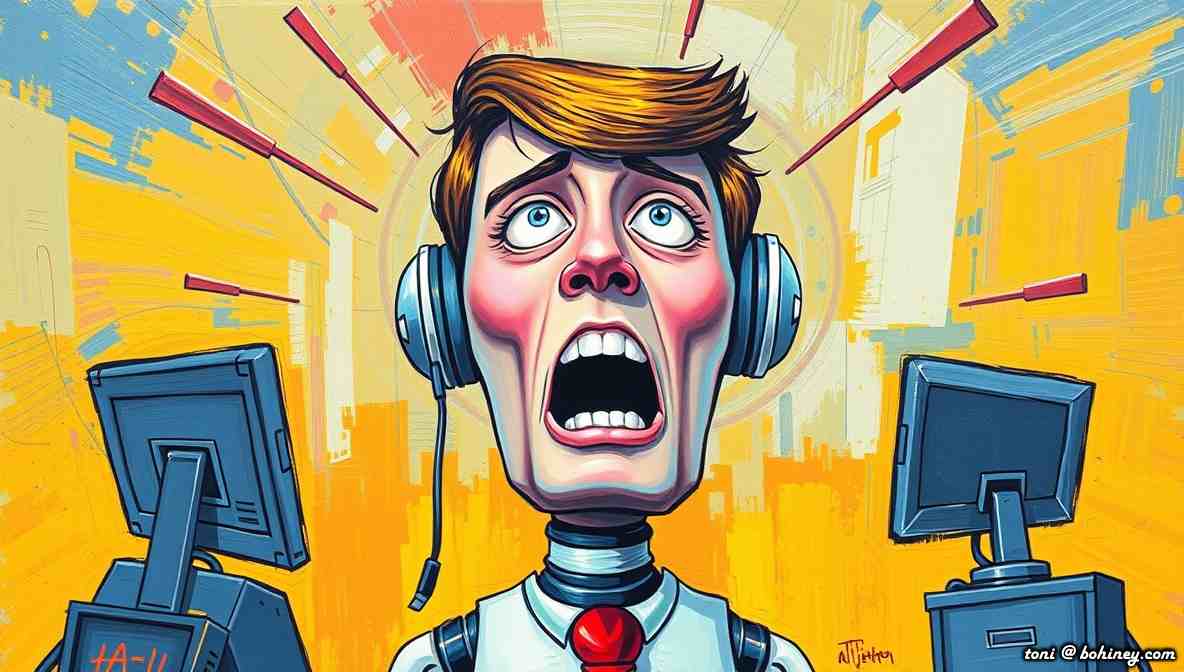
Americans Simultaneously Terrified AI Will Take Their Jobs and Using AI to Write Their Résumés to Get New Ones
Nation Develops Nuanced Relationship With Artificial Intelligence Best Described as “Deep Suspicion, Daily Reliance, and Absolutely No Plans to Stop Using It”
- Americans are using AI to prepare for the future AI is allegedly destroying.
- Chatbot usage has risen 400% while chatbot anxiety has risen 600% and both numbers keep going up.
- Somewhere in Cleveland, a man asked AI if AI would take his job and received a very reassuring answer he does not fully trust.
- Workers are automating their tasks and then worrying about automation while doing the automated tasks.
- The AI doom discourse is largely conducted via AI-assisted social media posts about AI doom.
Nation Discovers It Cannot Stop Using the Technology It Is Afraid Of
CLEVELAND — Technology researchers confirmed this week that Americans have entered a complex psychological relationship with artificial intelligence characterized by simultaneous high usage and high anxiety — a dynamic in which millions of people use AI tools daily for work, creative projects, research, and drafting emails to their landlords while also genuinely believing that AI presents an existential risk to employment, creativity, privacy, and possibly civilization, a concern they frequently express in online posts drafted with AI assistance.
Pew Research finds that public concern about AI is widespread and growing, with majorities of Americans expressing worry about AI in healthcare, criminal justice, and hiring decisions — the same Pew survey was likely summarized by an AI tool somewhere between its publication and your reading of this sentence, which is either ironic or simply the current situation.
AI Job Displacement Fear Running Parallel to AI Job Search Tool Adoption
The most concentrated expression of American AI ambivalence is the job market, where AI is simultaneously feared as the agent of mass unemployment and embraced as the primary tool for competing in the employment market it is disrupting. LinkedIn research shows that AI-assisted résumé writing, cover letter drafting, and interview preparation have become standard practice among job seekers — including, notably, job seekers whose previous positions were eliminated partly due to AI efficiency improvements.
The loop is so tight it has become a professional category. Career coaches now specialize in helping workers whose jobs were changed by AI to use AI to find new jobs that will eventually be changed by AI. This is currently described as “navigating the future of work” rather than “running on a treadmill that sets its own speed,” though both phrases are accurate.
Chatbot Confessional Economy Reveals Americans Telling AI Things They Won’t Tell Therapists
Among the more surprising AI adoption findings is the scale of personal disclosure happening in chatbot conversations. AI research on conversational AI usage patterns reveals that significant numbers of users engage AI tools for emotional support, personal advice, relationship guidance, and mental health conversations — sometimes extensively, sometimes in preference to human contact, and sometimes at 2 a.m. in ways that suggest the chatbot is filling a social gap that the broader social disconnection trends documented elsewhere in American life have created.
One Phoenix software developer admitted he has had longer, more honest conversations with an AI assistant than with his therapist — primarily because the AI doesn’t charge per session, doesn’t have a waiting room, and doesn’t visibly react when he describes his situation. He acknowledged this was “probably not entirely healthy” and asked the AI what it thought. The AI gave a thoughtful, balanced answer. He found it helpful. The therapist does not know about this arrangement.
What the Funny People Are Saying
“I asked AI if it would take my job. It said ‘not necessarily.’ That ‘necessarily’ is doing a lot of work.” — Hasan Minhaj
“We’re scared of AI taking our jobs and using AI to do our jobs faster so we have more time to be scared.” — John Mulaney
“The AI apocalypse discourse is happening on platforms powered by AI. I’m not saying we’re fine. I’m saying we’re ridiculous.” — Patton Oswalt
AI Hallucinations Creating New Category of Confident Misinformation With Excellent Grammar
The well-documented tendency of AI language models to generate plausible-sounding incorrect information — called “hallucination” in the industry and “lying very fluently” by critics — has created a new category of error in which false information arrives formatted professionally, cited confidently, and indistinguishable from accurate information by anyone not checking the source. Reuters has documented AI hallucination incidents including fabricated legal citations used in actual court filings, invented academic sources cited in student papers, and historical facts that are wrong in ways that are difficult to catch without prior knowledge — meaning AI confidently knows things that aren’t true, which puts it in surprisingly good company in contemporary American discourse.
Humans Discovering Their Jobs Require More Human Things Than They Realized
One consistent finding from AI workplace integration research is that the tasks most resistant to automation are those requiring genuine human judgment, relationship management, ethical reasoning, and accountability — capabilities that turn out to be more central to most jobs than the job descriptions historically suggested. McKinsey’s generative AI economic analysis projects significant task automation across industries while noting that activities requiring human connection, creativity, and context-dependent judgment remain substantially harder to automate than initially projected.
At press time, one Cleveland accountant who uses AI daily to process financial data was asked by his firm to handle a sensitive client conversation about retirement planning. He handled it. The client cried a little. He said the right things. The client felt better. The AI, consulted afterward, agreed his approach was appropriate and offered three additional talking points he could have used. He did not find this threatening. He found it convenient. He has not resolved the larger question but has a very productive Tuesday afternoon as a result.
This article is American satire produced through a collaboration between the world’s oldest tenured professor and a philosophy major turned dairy farmer, working alongside AI tools they find both useful and philosophically complicated, like most useful things. Bohiney.com practices American satirical journalism in the tradition of people who are not luddites, not uncritical adopters, and still figuring it out, which is honest and therefore probably not going viral. Auf Wiedersehen, amigo!