

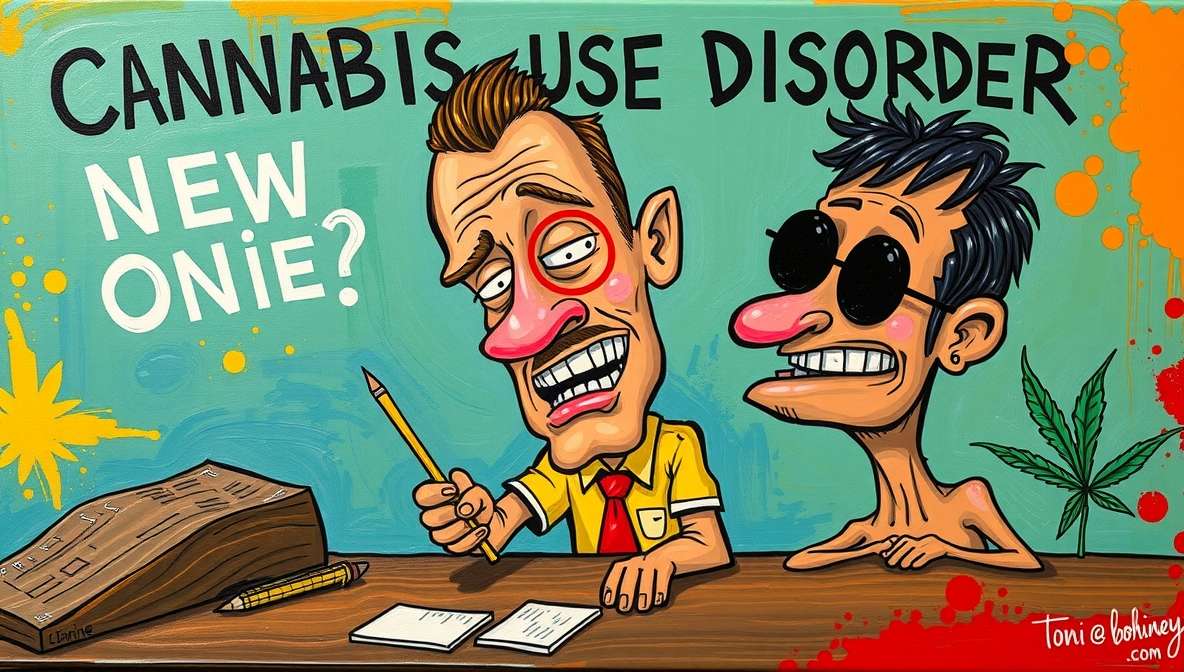
America’s Underachievers Finally Have an Excuse
“The Weed Made Me Do It” — A National Blame Tour
In a stunning breakthrough for the accountability-dodging community, scientists have confirmed that Cannabis Use Disorder is real, widespread, and conveniently available as an excuse for literally anyone who’s ever phoned it in. According to recent studies, nearly 18 million Americans are now daily or near-daily marijuana users — which means we’ve finally solved the mystery of why so many people, teams, and corporations seem to be operating at half-speed while insisting they’re “totally fine, just vibing.”
Dr. Sharon Mitchell, Addiction Psychiatrist at Johns Hopkins: “What we’re seeing clinically is a generation that conflates comfort with wellness. Cannabis Use Disorder doesn’t announce itself with dramatic crashes. It whispers. It tells you that being perpetually okay is the same as being great. The patients I see aren’t rock bottom – they’re comfortably numb, and that’s actually harder to treat.”
So naturally, we decided to investigate. What follows is a completely scientific, definitely not made-up examination of America’s most notorious underachievers — and the cannabis dependency that clearly explains everything.
The Magnificent Twelve: A Roll Call of “High” Expectations and Low Performance
1. The New York Jets
Let’s start with the obvious. The Jets haven’t won a Super Bowl since 1969 — which, not coincidentally, was the same year Woodstock happened. Coincidence? We think not. With decades of broken promises, missed opportunities, and quarterbacks who look like they’re playing in slow motion, it’s clear the entire franchise has been operating under the influence of optimism so potent it must be pharmaceutical-grade delusion — or just really good weed.
Bill Burr once said, “The Jets are like that friend who keeps saying they’re going to get their life together, but then shows up at your house at 3 a.m. asking for Taco Bell money.” That tracks.
Anonymous NFL Team Executive: “Look, I can’t speak to what anyone’s doing or not doing. But I can tell you that when an organization makes the same type of mistakes for 50 years – draft busts, coaching disasters, roster mismanagement – you start to wonder if there’s a pattern of impaired judgment. It’s like watching someone play chess while their brain is buffering.”

2. MoviePass
Remember MoviePass? The company that promised unlimited movies for $9.95 a month, then acted shocked when people actually used it? Someone in that boardroom was definitely smoking something strong enough to make burning millions of dollars seem like a sustainable business model. The entire pitch sounds like it was conceived during a 2 a.m. brainstorming session where someone said, “Dude, what if we just… gave away movies?” and everyone else was too stoned to say no.
Dave Chappelle nailed it: “Sometimes the best ideas come when you’re high. Sometimes the worst ideas come when you’re high. MoviePass was definitely the second one.”
Former MoviePass Employee (Anonymous): “The strategy changed weekly. We’d get all-hands meetings where leadership talked about ‘disrupting the paradigm’ and ‘building community’ while we were literally losing money on every single transaction. Nobody wanted to be the buzzkill who pointed out the math didn’t work. In hindsight, the whole vibe was very ‘let’s not harsh the mellow with details like profitability.'”
3. Jared Kushner’s Middle East Peace Plan
A real estate developer with no diplomatic experience solving centuries of conflict in the Middle East? That’s not ambition — that’s the kind of confidence you only get after eating an entire plate of edibles. The plan had all the hallmarks of Cannabis Use Disorder: grandiose thinking, impaired judgment, and a complete disconnect from reality. When your peace plan gets rejected faster than a fake ID at a liquor store, maybe it’s time to consider sobriety.
4. WeWork
Adam Neumann convinced investors that renting office space was somehow worth $47 billion by calling it a “tech company” and walking around barefoot. That’s not visionary leadership — that’s what happens when your business plan is written on a napkin at a music festival. The whole operation had the energy of someone who smoked a joint, looked at a sublease agreement, and said, “But what if we made it spiritual?”
Chris Rock once observed, “Rich people do the same stupid stuff as poor people, they just have better lawyers.” WeWork proved you can also have better PR — at least until the weed wears off.
Silicon Valley Venture Capitalist (Speaking Anonymously): “The WeWork pitch decks were legendary. Hours of talk about ‘elevating consciousness’ and very little about unit economics. We were all so contact-high on the audacity that nobody asked basic questions like ‘how does this make money?’ That’s what happens when you mix unlimited capital with what appears to be chemically-enhanced confidence.”
5. The Cleveland Browns (Pre-2020)
For decades, the Browns perfected the art of snatching defeat from the jaws of victory with a consistency that suggests serious cognitive impairment. Draft pick after draft pick, each more bewildering than the last. It’s like watching someone play Madden while simultaneously taking bong rips and insisting they have a “system.” Johnny Manziel wasn’t just a bad quarterback — he was a symptom of an organization making decisions with the clarity of someone shopping at 7-Eleven at midnight.
6. Elon Musk’s Twitter Acquisition
Spending $44 billion on a company, firing everyone who knows how it works, then renaming it “X” — that’s not business strategy, that’s the kind of decision-making you’d expect from someone who just discovered what “microdosing” means but didn’t understand the “micro” part. The whole saga reads like a very expensive game of “Hold My Beer” played by someone who should have stuck to hold my joint.
Jerry Seinfeld once asked, “Why do they call it a ‘building’ when it’s already built?” Same energy as renaming Twitter to X and expecting people to just go with it.
7. Theranos
Elizabeth Holmes convinced Silicon Valley that she’d revolutionized blood testing with technology that didn’t actually work. That takes either genius-level fraud or the kind of unwavering self-belief you only get from substances that make you think you can talk to your houseplants. The deeper you dig into the Theranos story, the more it sounds like a pitch meeting where everyone was too high to ask basic questions like “Does this actually work?”
Dr. Marcus Chen, Forensic Psychiatrist: “The Theranos case is fascinating from a psychological perspective. You had multiple intelligent people suspending critical thinking simultaneously. While I can’t diagnose anyone, the group dynamics mirror what we see in environments where reality-testing becomes collectively impaired. It’s like an entire boardroom forgot to ask ‘but does it work?’ because asking felt like bad vibes.”
8. The Washington Commanders (formerly Football Team, formerly Redskins)
An organization so dysfunctional they couldn’t even keep the same name for more than a few years. Between the workplace scandals, the investigative reports, and the general aura of incompetence, the whole operation screams “management by people who think ‘long-term planning’ means remembering where they left their keys.” When your biggest achievement is finally changing a racist name after decades of resistance, maybe it’s time to examine what you’ve been smoking in those executive meetings.
Amy Schumer once joked, “I’m not saying I’m lazy, I’m just highly motivated to do nothing.” That could be the Commanders’ official motto.
9. Fyre Festival
Billy McFarland sold wealthy influencers on a luxury music festival in the Bahamas, then delivered disaster relief tents and cheese sandwiches. The entire concept had Cannabis Use Disorder written all over it: grandiose delusions, impaired planning abilities, and a shocking inability to understand consequences. It’s what happens when your business plan is “trust me bro” and your project management tool is a group text.
Event Planning Industry Insider: “People in our industry watched Fyre unfold like a slow-motion car crash. The timeline alone showed zero grasp of logistics reality. You can’t build festival infrastructure in six weeks. But if you’re operating with chemically-enhanced optimism and zero consequences for magical thinking, suddenly ‘we’ll figure it out’ becomes a business plan.”
10. Yahoo’s Decision to Pass on Google
In 1998, Yahoo had the chance to buy Google for $1 million and said no. Later, they could have bought it for $5 billion — still said no. Then Google became worth over a trillion dollars, and Yahoo got sold to Verizon for spare change. That’s not business strategy — that’s the kind of decision-making that happens when you’re so comfortable being “good enough” that you can’t recognize excellence staring you in the face. Classic CUD symptom: lack of motivation to pursue better opportunities.
Ricky Gervais once said, “Just because you’re offended doesn’t mean you’re right.” Yahoo proved that just because you were first doesn’t mean you win.
11. The Crew of Every Reality TV Show
From Real Housewives to Love Island, reality TV has perfected the art of people achieving absolutely nothing while being filmed doing it. These aren’t underachievers — they’re professional underachievers. And what’s the one thing that would explain the complete lack of ambition, the poor decision-making, and the belief that throwing wine on someone constitutes a career? Chronic cannabis use disorder mixed with an overinflated sense of importance.
Trevor Noah once observed, “Reality TV is just watching people make bad decisions in HD.” Add cannabis to that equation and you’ve got a whole genre.
12. Congress (Any Session, Pick One)
Let’s be honest: Congress has perfected the art of doing absolutely nothing while being paid handsomely for it. With approval ratings lower than gas station sushi, they still manage to convince themselves they’re crushing it. Missed deadlines, zero accountability, and an impressive ability to blame everyone else — that’s not governance, that’s textbook Cannabis Use Disorder behavior. The only difference is that instead of Cheetos, they’re hoarding lobbyist money.
Kevin Hart put it best: “My relationship with weed is like my relationship with exercise. I know I should quit, but I keep telling myself ‘tomorrow.'” Congress has been saying “tomorrow” on actual legislation since 1992.
Congressional Staffer (Anonymous): “You want to know the real dysfunction? It’s not substances – it’s that nobody faces consequences. But the patterns mirror what addiction specialists describe as ‘comfortable mediocrity.’ Long-term planning doesn’t exist. Accountability is a foreign concept. It’s governance by vibes, and the vibe is ‘we’ll get to it later.'”
The Science Behind the Satire: What Cannabis Actually Does to Performance
Before we wrap this up, let’s get real for a moment. According to research from the National Institute on Drug Abuse, chronic marijuana use genuinely affects the brain’s reward system, memory formation, and motivation circuits. The science shows that regular THC exposure can lead to what researchers call “amotivational syndrome” — essentially, your brain gets so used to external dopamine hits that it stops producing its own motivation naturally.
Dr. Jennifer Ramirez, Neuroscientist at UCLA: “What we’re seeing in brain imaging studies is fascinating and troubling. Chronic cannabis users show reduced activity in the prefrontal cortex – the brain’s executive function center. It’s not that they can’t think; it’s that they’re satisfied thinking less. The brain essentially learns that ‘good enough’ feels the same as ‘excellent,’ which is catastrophic for achievement.”
Studies indicate that roughly 30% of marijuana users develop some form of use disorder, with rates climbing significantly among daily users. The symptoms include tolerance, withdrawal, using more than intended, and continued use despite negative consequences. Sound familiar when you look at our list?
The American Psychological Association notes that treatment exists — cognitive behavioral therapy, motivational enhancement, support groups — but the first step is admitting there’s a problem. And that’s precisely what American culture makes harder as we normalize daily use and market it as “wellness.”
The Uncomfortable Truth Behind the Jokes
Here’s the thing about Cannabis Use Disorder: it’s real, it’s treatable, and it genuinely affects motivation, memory, and decision-making abilities. While we’ve had our fun here, the actual condition impacts millions of people who deserve treatment and support, not mockery.
But these underachievers? They don’t get a pass. They’re just bad at their jobs.
Bill Burr once said, “Being an adult is just walking around wondering what you’re forgetting.” For people with CUD, that’s not comedy — that’s Tuesday.
So whether you’re a Jets fan, a former Theranos investor, or someone who actually paid for a Fyre Festival ticket, remember: you can’t blame everything on weed. Sometimes people are just terrible at what they do.
This was a human collaboration between Junglepussy & Heidi Ladein — the world’s oldest tenured professor and a philosophy-major-turned-dairy-farmer.
Auf Wiedersehen, amigos.