

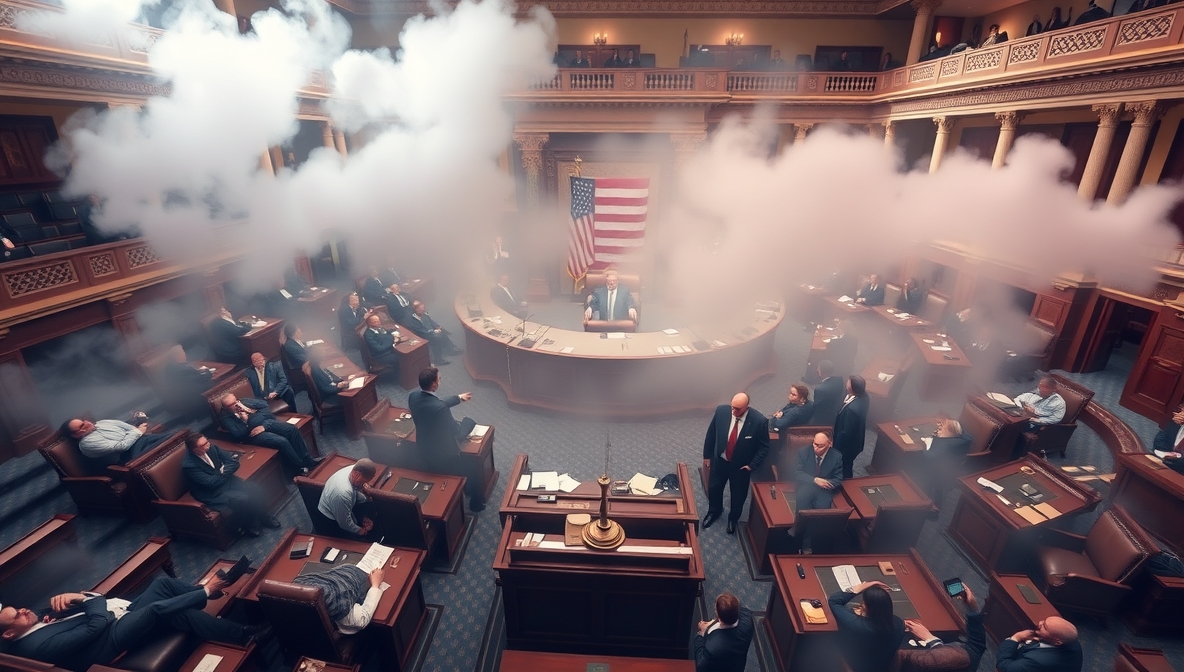
Trump Figures If They Are All High on Weed They Won’t Impeach Him Again
Strategic Cannabis Reclassification Targets Congressional Impeachment Energy
In an astonishing development that makes strategic sense only if you assume Donald Trump thinks like a guy who once misplaced his stapler in a cloud of incense smoke, the president’s recent executive order to reclassify cannabis wasn’t just a gesture toward medical research and federal bureaucracy — it was a calculated political play designed to prevent future impeachments by turning potential critics into recreationally blissed-out allies.
Senate Relaxation Theory Emerges as Political Calculus
Seriously. According to this emerging interpretation, Trump has concluded that a Senate full of slightly relaxed senators is statistically less likely to vote “guilty” on articles of impeachment. Which is either brilliant or the sort of political calculus most people expect from someone holding a pizza box full of munchies, staring at C-span and laughing at budget hearings.
December 2025 Executive Order Moves Cannabis to Schedule III
The executive order signed on December 18, 2025 directs federal agencies to begin the process of rescheduling marijuana from Schedule I to Schedule III, acknowledging some medical use and lowering federal barriers to research and industry tax breaks. It does not legalize cannabis nationwide, it does ease regulatory burdens, and it definitely sends Republicans and Democrats into collective head-scratching.
Democrats Lose Exclusive Claim to Cannabis Reform Win
But here’s where the plan gets fascinating: Democrats — who once treated marijuana reform like a campaign promise they’ll always make and never quite fulfill — suddenly find themselves with a policy win they can’t exclusively claim. A bipartisan poll from earlier this year shows broad American support for loosening cannabis restrictions, with roughly two-thirds of adults backing legal reform in some form.
Political Amnesty Through Collective Chill Strategy
Trump’s apparent belief seems simple. If everyone is just a bit more chilled out, then the energy needed to organize another impeachment — which historically depends on partisan firestorms, public outrage, and interpretive constitutional debates — is replaced with a general political amnesty akin to “Hey man, let’s just chill.”
Mellow Voters Prove Terrible at Starting Coups
Political operatives have long known that mellow voters are less inclined to sign petitions, less responsive to urgent fundraising e-mails, and universally terrible at starting coups. Polling firms don’t track how many impeachment votes could be nixed by a nationwide sense of serenity, but ask any high school sociology teacher and they’ll tell you: lowered anxiety equals decreased hostile political action. Whether that holds in Congress is an open question.
Colorado Model Suggests Relaxed Lawmakers Less Likely to Impeach
In Colorado, where marijuana reform has already been the law of the land for years, the reclassification has produced equal parts celebration and grumbling about market regulations. But even there, analysts are joking that a room full of relaxed lawmakers is statistically less likely to whip out formal impeachment resolutions and more likely to wonder why anyone ever cared about them in the first place.
Conservative Commentators See Timing as Deliberate
Republicans are reacting with a mix of discomfort and grudging acceptance. Some social conservatives worry about “wild parties” and “societal collapse,” oddly unaware that the last time either actually happened it involved a budget vote and a very long PowerPoint presentation. On Reddit, conservative commentators are gleefully pointing out that the president may have orchestrated the timing so that impeachment energy literally goes up in smoke.
Chuck Schumer Calls Move Step in Right Direction
For Democrats, the order presents an identity crisis. Senate Democratic Leader Chuck Schumer called the move “a step in the right direction” for policy reform, but also doubled down on the need for broader decriminalization and banking reform for cannabis businesses. And yet, here’s the uncomfortable truth: if Trump’s plan works and the Hill starts feeling more like Woodstock and less like Watergate, who will really care about procedural correctness?
Cognitive Dissonance Creates Soothing Internal Monologues
Political psychologists (yes, that’s a real job) might observe that cognitive dissonance plays a role here. If you find yourself in favor of the thing a politician you dislike also supports, your brain tends to ease the contradiction with soothing internal monologues — usually over snacks, sometimes over policy memos. This could theoretically reduce partisan hostility, but nobody has tested the hypothesis in a Senate chamber, mostly because nobody thought it would matter until a president started treating cannabis reform as a defensive political tactic.
Political Self-Preservation Through Collective Calm
At bottom, this satirical hypothesis rests on one bizarre but human truth: people are easier to placate than to convince. If laughing, relaxed lawmakers are less inclined to impeach, then Trump’s policy move is less about cannabis science and more about political self-preservation through collective calm. That’s either genius or deeply irresponsible, depending on whether you think legislative processes should happen at 4:20 p.m. every day. Auf Wiedersehen, amigos.