

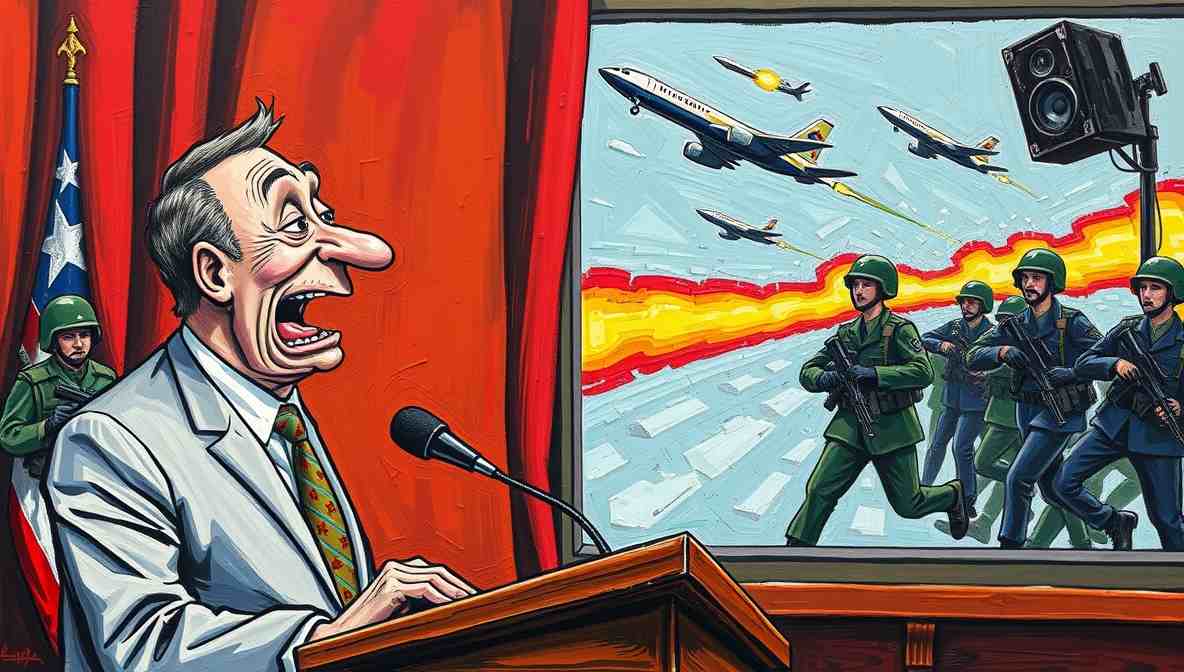
Diplomats Now Travel With Three Things: a Passport, a Speech, and a Backup Speech for When the First One Immediately Becomes Outdated
State Department Issues New Travel Advisory: Pack Light, Except for the Talking Points
ISLAMABAD / WASHINGTON — The US State Department has quietly updated its diplomatic travel guidelines for the Middle East to reflect current operating realities. Diplomats are now advised to carry no more than one checked bag, two carry-ons, and three full sets of prepared remarks — the primary speech, the backup speech for when conditions have changed, and the emergency tertiary speech for when conditions have changed again while the backup speech was being delivered.
This is not a satirical exaggeration. This is a description of what happened in Islamabad on April 11, 2026.
Vice President JD Vance arrived in Pakistan with a negotiating team, a framework, and approximately one full speech’s worth of optimism. After 21 hours of talks with Iranian Foreign Minister Abbas Araghchi and Parliament Speaker Mohammad Bagher Ghalibaf, Vance departed with the backup speech: “The bad news is that we have not reached an agreement.” The tertiary speech — available in the event that the backup speech was itself overtaken by events — was not needed, because the flight home had already been booked.
The Speech-to-Reality Gap: A Diplomatic Physics Problem
The fundamental challenge facing modern Middle East diplomacy is that the time between a diplomat opening their mouth and the region changing around them has collapsed to something approaching zero. Iran’s Foreign Minister Araghchi released multiple versions of the same 10-point peace proposal with “small differences” between them — including discrepancies between the Persian and English versions — which is the diplomatic equivalent of arriving at a negotiation having prepared two different speeches and accidentally handing out both.
Vance’s team carried a 15-point US proposal. Iran came with a 10-point counter. Pakistan had its own 45-day framework. At one point, there were three different Iranian 10-point proposals in circulation simultaneously, a situation Vance described publicly — with the slightly glazed look of a man who has read a lot of points — as “contributing to confusion.”
The US special envoy, Steve Witkoff, maintained direct contact with Araghchi throughout, which is admirable dedication to a conversation that was producing different answers each time it resumed. Jared Kushner was also present in Islamabad, which meant that the Trump administration had sent, in diplomatic terms, the full speech collection.
Historical Precedent: When Speeches Work Against You
The backup-speech problem is not new to this administration or this conflict. Trump announced on April 1 that Iran had just asked the US for a ceasefire. Iran’s Foreign Ministry called the claim “false and baseless.” The IRGC said the strait “will not be opened to the enemies of this nation through the ridiculous spectacle by the president of the US.” These were three different speeches about the same non-ceasefire, all issued the same day.
When the actual ceasefire was announced a week later, Trump posted at midnight: “Big money will be made.” This was, stylistically speaking, a speech written after the speech. A post-speech speech. The backup backup.
The Carnegie Endowment for International Peace, which tracks diplomatic outcomes with the same cheerful persistence as a mechanic tracking oil changes on a car driven directly into walls, notes that the gap between announced framework and operational reality in Middle East negotiations averages between 72 and 96 hours. In the current conflict, it averaged approximately 11 minutes. Backup speeches are a growth industry.
What the Backup Speech Actually Contains
Reporting from Islamabad suggests the backup speech for failed Iran talks has a fairly standard structure. It begins with a statement of the outcome (“We have not reached an agreement”), followed by attribution of the failure to the other party (“Iran’s excessive demands”), followed by a threat that re-establishes leverage (“Iran should know what happens next”), followed by a gestures-toward-openness clause (“We remain ready to return to talks”), followed by a restatement of the primary objective as though it had always been the primary objective (“No nuclear weapon. That’s 99% of it”).
Iran’s backup speech for the same failed talks: The talks ended because of “excessive US demands.” The nuclear enrichment question was a sticking point the US created by asking about it. Iran had demonstrated good faith by showing up and negotiating for 21 hours. Iran won the war. Iran demands reparations. Iran will now reconsider its 10-point proposal, which may become an 11-point proposal. The spokesman for these remarks also noted that the strait question would “enter a new phase,” which is diplomatic language for: there is a fourth speech, and it is already written.
The Passport, for the Record
Vance’s passport, by the time he departed Islamabad, had acquired: one entry stamp for Pakistan, one exit stamp for Pakistan, zero ceasefire agreements, and approximately eleven follow-up talking points that would require their own trip to use. Trump’s Truth Social account, which functions as a kind of stateless diplomatic passport that requires no customs inspection, had by the same point issued statements characterizing Iran as simultaneously on the verge of total destruction and “blasted into the Stone Age” and also, helpfully, likely to come back to the table.
The backup speech for Trump’s primary speech is always another primary speech. This is, diplomatically speaking, a tremendous time-saver.
The real story below the podium: On February 28, 2026, the US and Israel launched air strikes against Iran following months of nuclear tension, killing Supreme Leader Ayatollah Ali Khamenei. Iran closed the Strait of Hormuz, triggering a global oil supply crisis, and launched retaliatory missile strikes on US bases and Israel. A two-week ceasefire was brokered by Pakistan on April 8, with Islamabad designated as the negotiating venue. JD Vance led the US delegation; Abbas Araghchi led Iran’s. After 21 hours of talks on April 11, Vance departed with no deal, citing nuclear enrichment as the central unresolved issue. Trump subsequently threatened a “full naval blockade.” The backup speech had already been filed. The backup to the backup is in preparation.
Auf Wiedersehen, amigo!
