

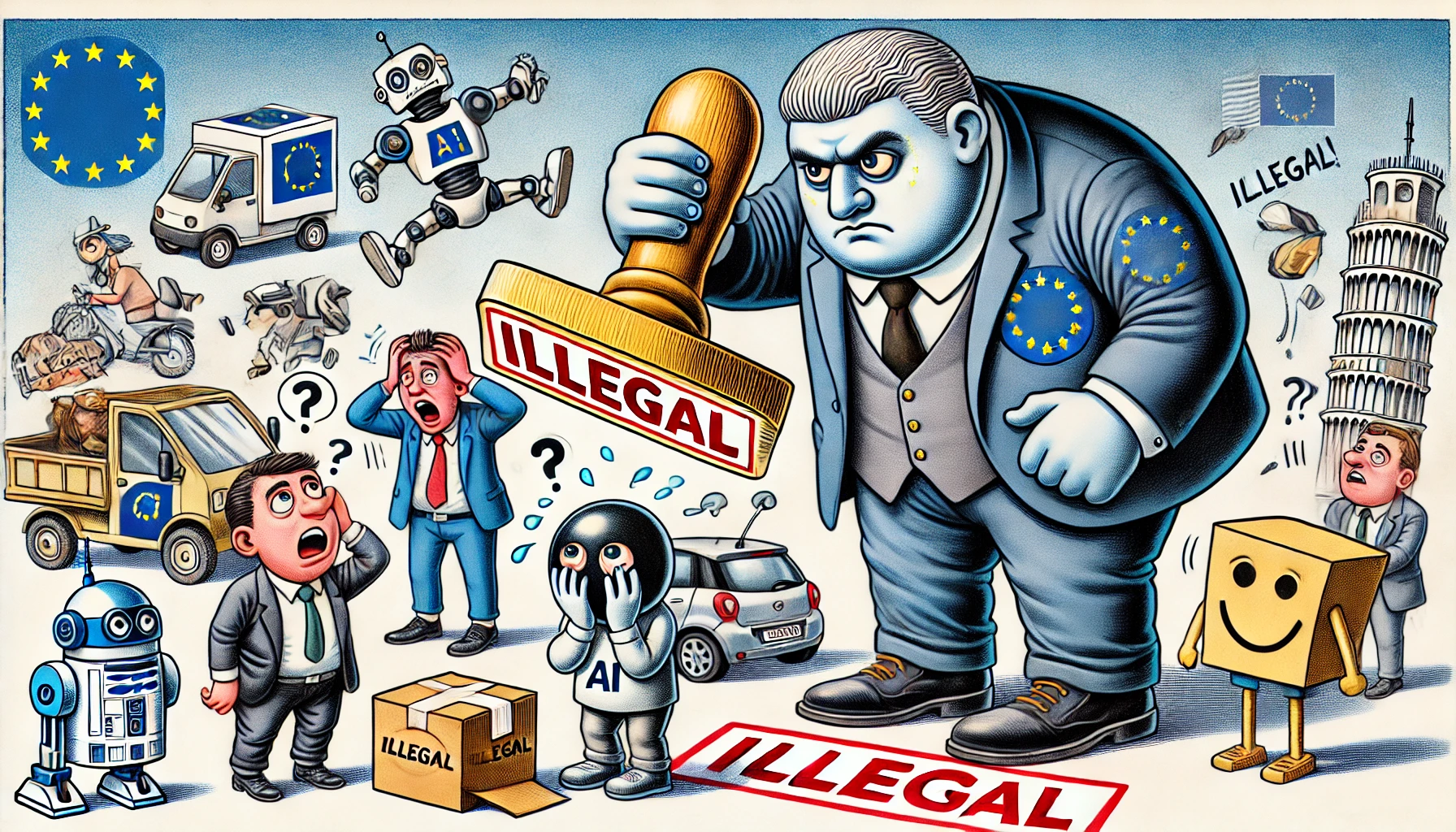
EU Declares War on AI: A Comprehensive Ban on Everything Fun and Futuristic
By: Chip McClickbait, Senior AI Bureaucracy Correspondent
In a move that has left technophiles and sci-fi enthusiasts clutching their VR headsets in despair, the European Union has unveiled its latest directive: banning virtually every conceivable use of artificial intelligence. The AI Act, hailed by some as a triumph of ethical governance and by others as the death knell of innovation, has set its sights on ensuring that the future remains as mundane and human-dependent as possible.
“The EU banned AI from reading emotions at work. Finally, my boss has to figure out I’m dead inside the old-school way—by looking at my Slack messages that say ‘Sure, no problem.’” — John Mulaney
The Great AI Purge: A Comprehensive List of Bans
AI Is Now Officially Not Allowed to Know You’re Miserable at Work
The first and perhaps most personally impactful ban involves the use of AI to monitor employees’ emotions. This means no more AI detecting your Monday morning dread or Friday afternoon euphoria. Managers will have to revert to traditional methods of gauging employee satisfaction, like counting the number of coffee cups on desks, deciphering passive-aggressive emails, or just assuming everyone’s miserable because it’s a job.
“This is a great day for workplace freedom,” said a visibly exhausted HR representative. “Now, instead of AI telling us that Jim from accounting is slowly dying inside, we’ll just let him stew in silence. Progress!”
The End of Manipulative Online Tactics
If you’ve ever clicked on a deal that claimed to be expiring in 30 minutes only to find it still available weeks later, you might have been a victim of AI-enabled manipulative sales tactics. The EU has banned AI from engaging in such misleading practices, which means consumers will now have to rely on their own impulse control rather than AI’s relentless psychological tricks.
This is good news for people who still believe in free will but bad news for e-commerce sites that thrived on panic-based spending. One online retailer was overheard saying, “Without AI tricking customers into buying things they don’t need, how will we ever meet our fourth-quarter projections?”
AI Is No Longer Allowed to Guess That You’re Old, Poor, or Confused
The EU has also prohibited AI from exploiting individuals based on their age or socio-economic status. This means no more targeted ads selling stairlifts to teenagers or luxury cruises to college students living off instant ramen. Advertisers will now need to brush up on their old-fashioned demographic research.
“No more algorithms stereotyping me based on my browsing history!” said an elderly man who had spent six hours Googling “Best reclining chair for chronic back pain.”
Social Credit Scores? Not in Europe!
Remember how China uses social credit scores to determine citizens’ access to travel, loans, and other privileges? The EU just made sure that won’t happen within its borders. AI will no longer be allowed to assign social scores based on seemingly unrelated personal data, such as how many cat videos you watch or how often you leave passive-aggressive Yelp reviews.
This is a relief to those whose personalities are best described as “online dumpster fires.” One prolific internet troll sighed in relief, stating, “For a second there, I thought my 47,000 downvotes on Reddit would finally have real-world consequences.”
No More Minority Report-Style Predictive Policing
Predictive policing—where AI uses biometrics to identify potential criminals before they commit a crime—is now firmly off-limits. This means law enforcement must return to traditional crime-solving methods, such as ignoring reports of theft until they become widespread enough to make the news.
“This is great,” said one criminal mastermind. “I was getting real tired of AI flagging me every time I walked past a bank in a hoodie.”
Goodbye, Mass Surveillance (Sort Of)
AI-powered facial recognition for law enforcement in public spaces is banned—kind of. There are still “strict safeguards,” which is bureaucratic code for “we might still do it, but we’ll frown while doing it.”
Meanwhile, tech companies specializing in face-scanning software are in mourning. “We just spent six years perfecting our ability to recognize people wearing sunglasses, and now it’s all for nothing!” lamented one engineer.
No More AI Nudging You Into Poor Life Decisions
AI-enabled “dark patterns” that subtly manipulate users into making decisions against their best interests are now banned. This means that websites will have to make their unsubscribe buttons visible and stop bombarding users with ARE YOU SURE YOU WANT TO LEAVE? pop-ups.
However, early reports indicate that some companies are working on an AI loophole by making cancelation buttons microscopic and hiding them behind 14 menus.
Schools and Workplaces Are Now Free of Emotion-Detecting AI
If you’re a student who used to fake enthusiasm with an AI-monitored classroom system, good news! AI emotion recognition in schools is now banned, which means teachers will have to rely on the age-old method of determining engagement: seeing who is actually awake.
Meanwhile, workplace AI systems that tried to determine employee happiness have also been axed. One office worker, slumped over his keyboard, mumbled, “Finally, I can be dead inside without technology ratting me out.”
AI Can No Longer Judge You Based on Your Face
Using AI to categorize people based on biometric data—such as skin tone, facial structure, or expression—is now illegal. This means AI will no longer be able to look at you and decide, Yep, that person definitely likes country music and slow cookers.
One man who had been wrongly categorized as a “horse enthusiast” was elated. “Maybe now my Amazon recommendations will stop trying to sell me saddles,” he said.
No More AI Creating Global Supervillains Using Your Photos
If you’ve ever worried that AI would scrape your vacation photos and use them to create a facial recognition database, the EU has just saved you. AI is no longer allowed to collect random images from the internet for database creation.
This is especially good news for those who feared their Facebook photos might someday be used to create an army of AI-generated doppelgängers for sinister purposes. “One of me is already too much,” admitted one relieved citizen.
The Grand Irony: Banning AI Requires More AI
The EU’s new AI Act introduces an amusing paradox: enforcing AI bans requires advanced AI monitoring systems to ensure compliance. This is like hiring robots to prevent other robots from taking over.
“We’ll be using highly sophisticated AI tools to track illegal AI usage,” said one EU regulator, with no sense of irony. “AI must be closely monitored to ensure AI does not break the AI laws regulating AI.”
What’s Next? AI Bans That Haven’t Happened Yet
As the EU continues to refine its stance on AI, experts predict even stricter regulations in the future. Here are some potential upcoming bans:
- Banning AI-generated customer service responses – forcing companies to return to their roots: 45-minute hold times and customer support agents who hate their jobs.
- Banning AI-generated weather forecasts – so people must once again rely on whether their knees ache to predict rain.
- Banning AI that detects sarcasm online – protecting the world’s worst internet commenters from ever realizing people are mocking them.
- Banning AI in political speeches – forcing politicians to write their own nonsense instead of relying on ChatGPT for inspirational soundbites.
The Final Verdict: AI in Europe is Doomed, But At Least It’s Ethical
The EU’s AI Act is undoubtedly one of the most aggressive attempts to regulate AI in the world, leading to both praise and outrage. Some see it as a necessary step to prevent dystopian AI takeovers, while others argue it will stifle innovation and leave Europe lagging behind the U.S. and China.
Tech startups in Europe are reportedly in full panic mode, with many considering relocating their operations to countries that are slightly less terrified of their own technology. “We wanted to use AI to revolutionize medical diagnostics,” said one frustrated entrepreneur, “but apparently that’s just as bad as using it to trick grandma into buying a timeshare.”
Meanwhile, AI developers are finding increasingly creative ways to work around these restrictions. “We’re not technically banning AI,” said an EU spokesperson, “we’re just making it really, really, really difficult to use.”
So, what’s the takeaway? AI in Europe is now subject to some of the strictest regulations ever conceived, ensuring that no robot overlords will be taking over anytime soon. But at what cost? Will Europe fall behind in technological advancements? Or is this the responsible AI revolution the world needs?
One thing is certain: no matter how strict the EU’s AI laws become, human stupidity remains unregulated.
Disclaimer:
This article is a human collaboration between a 80-year-old muckety-muck with tenure and a 20-year-old philosophy-major-turned-dairy-farmer. No AI was harmed (or used) in the making of this satirical masterpiece.

10 Humorous Observations on the EU’s AI Ban
- The EU has officially made AI illegal for anything useful. However, AI-generated cat memes remain unregulated—because even the government knows its limits.
- AI can no longer track your emotions at work, so now your boss will just have to assume you hate them the old-fashioned way: by watching you sigh heavily every 10 minutes.
- The ban on AI social scoring means your Uber rating no longer determines your credit score, but unfortunately, your Uber driver can still tell you that you “seem like a 3.9 kind of person.”
- Predictive policing is banned, which is great news for criminals but devastating for psychics who were hoping AI would validate their premonitions.
- Facial recognition is no longer allowed in public spaces, meaning the police now have to rely on the ancient art of actually recognizing people.
- AI can no longer trick you into impulse purchases, but unfortunately, your own bad judgment is still 100% legal.
- Websites are no longer allowed to manipulate consumers, so now companies will have to convince people to buy overpriced junk the honest way—through shameless influencer endorsements.
- Schools can no longer use AI to determine if students are paying attention, which means teachers will go back to the most reliable method of all: yelling their names mid-sentence.
- AI can’t exploit your socio-economic status anymore, so online stores will no longer assume that just because you’re broke, you must need a payday loan.
- Banning AI to monitor AI is the government equivalent of hiring a fox to guard the henhouse, but with more bureaucratic paperwork and fewer feathers.
10 Comedian Lines on the EU’s AI Ban
- “AI can’t be used to manipulate consumers anymore? Great, now I’ll have to impulse buy useless junk based on my own poor life choices.” — Jerry Seinfeld
- “The EU banned predictive policing, so now the only people predicting crimes are old men who say, ‘I knew that guy was trouble from the moment I saw him!’” — Ron White
- “Facial recognition is banned, so now we’re relying on cops recognizing criminals by their bad vibes. ‘That guy looks like he listens to techno—arrest him!’” — Trevor Noah
- “No more AI monitoring students’ emotions? That’s okay, teachers have another way of detecting boredom: it’s called ‘looking at their faces.’” — Sarah Silverman
- “So AI can’t trick people into spending money anymore? I guess that means companies will just have to rely on good products. Haha, just kidding—get ready for even dumber ads!” — Bill Burr
- “They banned AI-generated social credit scores, which is great because I was afraid my Uber rating would get me banned from buying groceries.” — Amy Schumer
- “AI emotion detection is illegal at work now, so your boss will have to figure out you hate your job the normal way: by watching you eat lunch alone in your car.” — Larry David
- “Banning AI from tricking people into buying stuff is a great idea—until your grandma stops getting scammed and starts calling you three times a day again.” — Kevin Hart
- “So the EU is banning AI from using personal data to manipulate you? Great, now we’ll have to go back to being manipulated by politicians instead!” — Ricky Gervais