

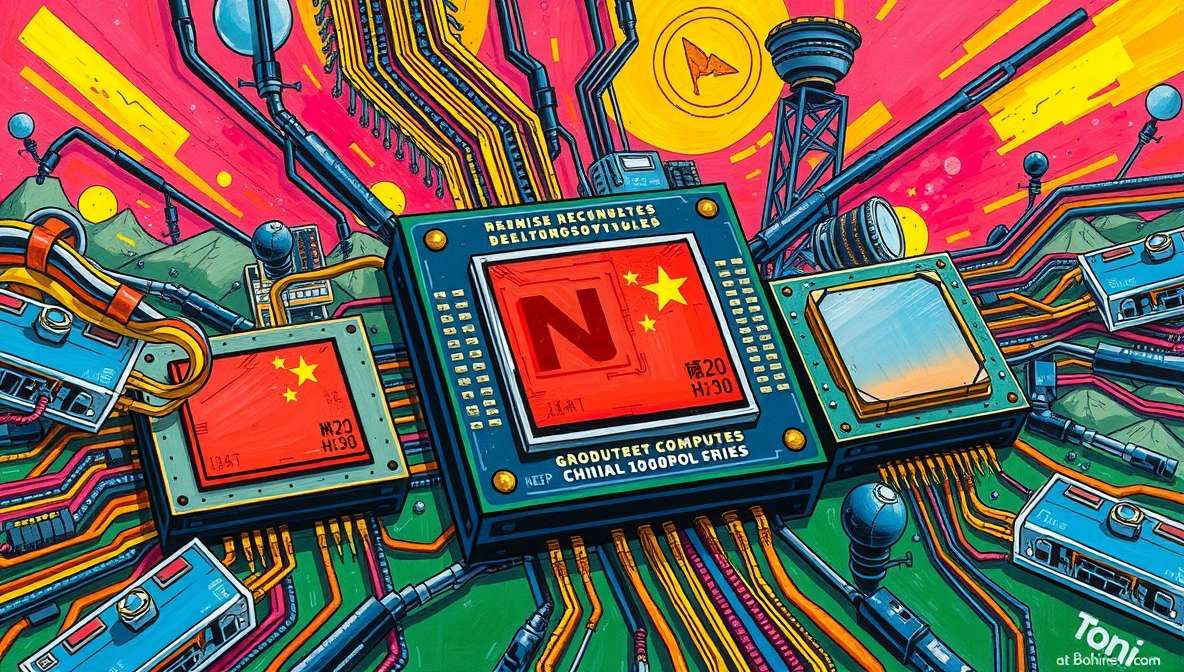
U.S. Considers Lending Nvidia H200 Chips to China — Because Why Not Share Our Brainpower?
Imagine a world where the U.S. government is sitting around a poker table — but instead of poker chips, they’re holding AI chips. And now they’re awkwardly asking, “Hey China, want to borrow some?” According to Reuters, the U.S. is considering allowing Nvidia, the world’s top AI chipmaker, to sell its newest H200 chips to China — the country that has, until now, mostly been banned from accessing this level of computing firepower.
What Are H200 Chips, Anyway?

For readers not already fluent in “chip nerd,” the H200 is Nvidia’s latest AI processor designed for massive data centers. Think of it as a brain on steroids: it can perform trillions of calculations per second, remember more than your college roommate ever did, and probably dreams in 8K. Its predecessor, the H100, was already a superstar. According to Sunday Guardian, the H200 is roughly twice as powerful, meaning it can crunch AI workloads faster than you can say “machine learning.”
The chips are highly sought after because they can train large AI models — the kind behind everything from chatbot assistants to image generators. In other words, whoever controls H200s has the power to basically teach computers how to think … or at least calculate faster than the U.S. Congress can argue.
The Background: U.S.–China Tech Wars
Over the past few years, U.S.-China relations have often looked like a competitive chess match played on very expensive electronics. Washington has restricted exports of advanced AI chips to China, fearing that these chips could be used in military drones or surveillance systems. Meanwhile, China has poured billions into building its own chip industry, determined not to fall behind.
Nvidia has been caught in the middle. The company has argued, as Yahoo Finance notes, that without access to China, it risks losing its massive customer base to “rapidly growing foreign rivals.” Translation: if they can’t sell H200s, someone else will sell something almost as good — and Nvidia will lose billions.
Why the U.S. Might Consider Selling
It seems counterintuitive: why would the U.S. hand over chips that could supercharge China’s AI? Analysts and insiders provide a few reasons:
-
Economic Pragmatism: Nvidia argues that it cannot compete in China without the H200 chips. Rutgers Business School reports potential losses in the billions if exports remain restricted.
-
Strategic Leverage: Some officials view controlled sales as a way to influence Chinese tech policy. Selling chips is like lending someone your Ferrari … and keeping a dash cam.
-
Global Competition: If the U.S. doesn’t sell, other countries will. Reddit discussions highlight that China could simply build their own alternative if blocked (r/NVDA).
The Risks: Brainpower and Backdoors
Critics warn that selling H200s could give China an AI advantage. According to AP News, China has already raised concerns about backdoors in Nvidia chips — remote tracking or disabling functions that could compromise sensitive tech. Giving them H200s is like handing over the master key to a very powerful robot army … and hoping they use it only to play Go.
Congress has weighed in, too. A letter from the U.S. Select Committee on the China Challenge warns that allowing sales could accelerate China’s military-grade AI capabilities. Some hawks compare it to lending rocket fuel to a neighbor who already has fireworks.
The Players at the Table
-
Trump and Xi: According to Sunday Guardian, discussions began during meetings brokered between former President Trump and Xi Jinping.
-
Nvidia CEO Jensen Huang: Seen at White House events with global dignitaries, he’s part diplomat, part entrepreneur (Channel News Asia).
-
Tech Competitors: AMD, Intel, and others are quietly plotting how to catch up, likely muttering about missed AI opportunities.
Why Everyone Is Sweating
Selling H200s isn’t just about profits. National security experts warn that China could accelerate its AI arms race. On the flip side, without sales, Nvidia could lose its foothold in the largest AI market in the world.
Some Redditors suggest that it’s not just geopolitics — it’s keeping the AI bubble inflated (r/wallstreetbets). Academic papers like Whack-a-Chip: The Futility of Hardware-Centric Export Controls (arXiv) argue that restricting hardware alone won’t stop innovation; software workarounds and alternative supply chains will always appear.
Final Thoughts: Panicking or Celebrating?
If you’re a fan of Black Mirror, this probably feels terrifying. But if you like capitalism, this is a profit opportunity wrapped in geopolitics. Here’s a cheat sheet for reactions:
-
Nvidia: Gains billions if the sale goes through.
-
U.S. Government: Gains leverage, and maybe some revenue.
-
China: Gets access to world-class AI compute.
-
Tech Competitors: Mutter about the AI arms race.
-
Redditors: Either cheering or doomscrolling.
The takeaway: exporting H200s is like lending someone your Ferrari while insisting they promise not to street-race — theoretically safe, practically nerve-wracking.
Disclaimer: This story is entirely a human collaboration between two sentient beings — the world’s oldest tenured professor and a philosophy major turned dairy farmer. Auf Wiedersehen!
PRESS COVERAGE
https://chat.deepseek.com/share/mqnrssc75d27a17jpu
https://gemini.google.com/share/884dacf07c2b
https://chatgpt.com/s/t_6921bb304e9081919ed502f1e9eccb47
https://claude.ai/share/90fa4e7e-42b2-4b86-936c-45d67d89ce82
https://grok.com/share/c2hhcmQtNQ_f8ffcec4-f473-4eee-9726-c121669da7a8