

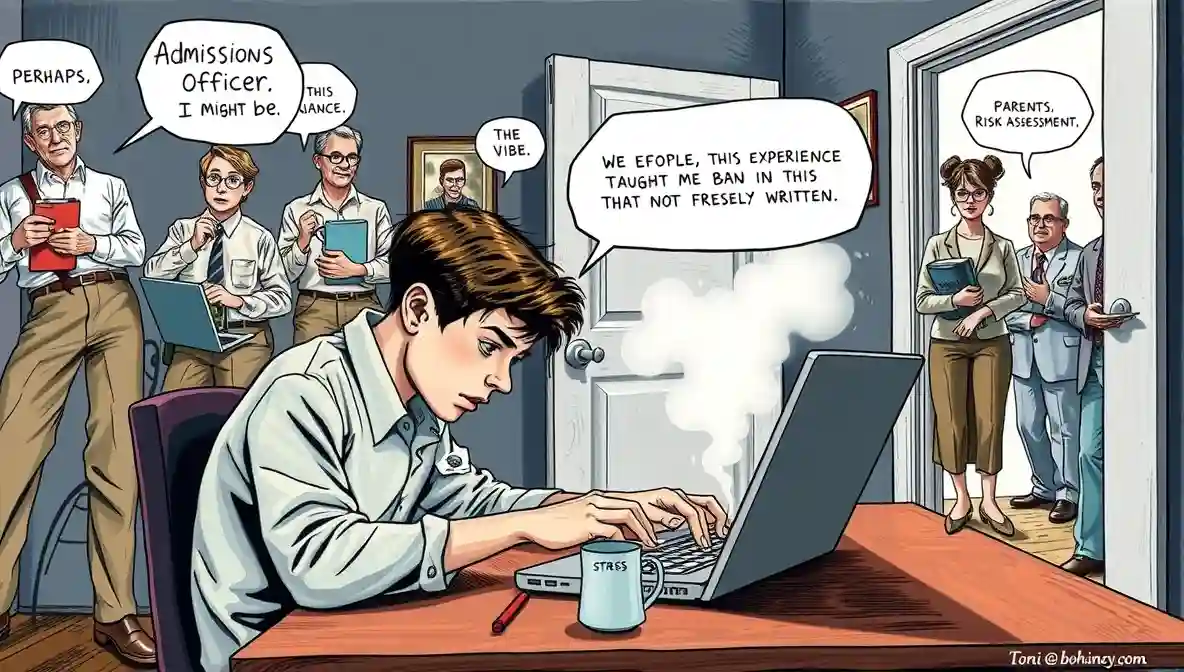
College Essays, Now Written Entirely in a Whisper
There was a time when a college admissions essay was a bold declaration of self. A young person stood on the page, chest out, saying, “This is who I am, this is what I have lived, and this is why I belong at your institution with the ivy and the endowment the size of a small NATO country.”
That time has passed.
Today’s seniors are writing essays the way you tiptoe past a sleeping bear while holding a tray of glassware. Carefully. Apologetically. With a tone that says, “I am here, but not too here. Please do not perceive me.”
The modern college essay is no longer a story. It is a risk assessment memo written by a 17-year-old who has already learned that self-expression is best enjoyed privately, like crying in the shower or Googling “am I normal” at 2 a.m.
The Identity Essay That Dares Not Speak Its Name

Students are still mentioning their race, immigration background, gender, or trauma. But only in the way you mention a weird smell in a rental apartment. Briefly. Vaguely. With plausible deniability.
One student writes about standing in a historic cemetery and being inspired by technology. This is a safe choice. Cemeteries are quiet. They do not argue back. The dead are famously bipartisan. You can be Black in a cemetery, but only if you are also very interested in archival software.
Another student considers mentioning immigrant parents, then deletes it like an unsent text to an ex. Not because it is untrue, but because it feels like it might be misinterpreted by someone in an admissions office who once forwarded an email to legal with the subject line “just flagging this.”
The essay has become a game of emotional Minesweeper. Every sentence could explode. Every metaphor must be cleared by an imaginary compliance officer living in the student’s head, wearing khakis and a haunted expression.
Trauma, But Make It Neutral
There is now an unspoken rubric. You may write about hardship, but only if it is neatly framed, politely resolved, and does not suggest that society played any role whatsoever.
Tourette’s syndrome is acceptable. Doctors love it. It comes with paperwork. Immigration trauma is trickier, unless you strip it of context and present it as a vague atmosphere, like humidity.
Gender identity is considered an extreme sport. Students who once planned essays about transition now pivot to interpersonal skills, which is admissions code for “I can survive group projects without committing arson.”
Somewhere between guidance counseling sessions and the autosave function in Google Docs, students absorb the quiet lesson of the era: it’s better to enter college a victim than not enter college at all. Not a slogan anyone printed, not a rule anyone announced, just a vibe that settled over the process like dust on a participation trophy.
This is not censorship. This is preemptive self-editing, the most advanced skill taught in American high schools. By senior year, students can silence themselves faster than any government ever could. That is efficiency.
Parents, The Original Crisis Managers
Parents hover nearby like risk consultants who work exclusively in vibes. One mother advises her daughter not to mention trips abroad. Another says, “Oh, do not put that.” No explanation needed. The phrase contains multitudes.
These parents survived earlier eras of admissions insanity. They remember when everyone pretended to play the oboe. They remember service trips that somehow all involved the same orphanage. Now they are veterans of a new war, one where the enemy is ambiguity and the battlefield is a Google Doc.
They do not ask, “Is this honest?” They ask, “Is this survivable?”
The College Counselor As Bomb Squad
Somewhere in America, a college access coach calmly tells students that D.E.I. is now an I.E.D. This is the most honest metaphor in modern education. Essays are not written. They are defused.
Counselors do not encourage expression. They encourage maneuvering. They speak in phrases like “political winds” and “this cycle.” Nothing says youthful self-discovery like being told your identity is seasonal.
Every generation, we are told, faces this. That is true. Every generation also believes it is uniquely screwed. That is also true. Both things can be true, like college being a place for free thought that requires twelve forms and a trigger warning.
The Box You Check But Nobody Sees
Students can still check a box reporting their race. Admissions officers do not see it. The government eventually does. This system is the perfect metaphor for modern transparency. You tell the truth into a void, and someone somewhere keeps a spreadsheet.
More students are leaving the box blank. Not out of rebellion. Out of exhaustion. They are tired of being symbols. They would like to be boring for four pages, double-spaced.
One student removes her middle name. Another deletes her grandparents. By the end of the process, some essays read like they were written by a friendly ghost who enjoys volunteering and has never been perceived by history.
Achievement Is Fine, As Long As It’s Not Political
Colleges now prefer a diversity of perspectives, which is great news for anyone whose perspective is “I like independent study.” This is the safest worldview available to a teenager. It threatens no one. It requires no footnotes.
Students are learning that it is safer to be impressive than meaningful, safer to be adaptable than honest, safer to write about leadership than life.
This is framed as maturity. It is actually advanced anxiety with spellcheck.
What the Funny People Are Saying
“At 17 I did not know who I was. These kids know who they are, but they are not sure if it is allowed,” said Jerry Seinfeld.
“When I applied to college, I just wrote, I am drunk and I want to learn. Worked out fine,” said Ron White.
“Nothing prepares you for adulthood like learning to erase yourself politely,” said Amy Schumer.
Helpful Advice For The Next Generation Of Essay Survivors
Be proud, quietly. Be honest, strategically. Tell your story, but imagine a lawyer is reading it over your shoulder eating almonds.
Remember that colleges say they want authenticity, but what they mean is a curated vulnerability that demonstrates resilience without implying injustice.
Write the essay you need to write. Then write the one you submit. These can be different people. That is called adulthood.
Disclaimer
This satirical commentary is entirely a human collaboration between two sentient beings — the world’s oldest tenured professor and a philosophy major turned dairy farmer. Any resemblance to real admissions essays, living students, or emotionally exhausted guidance counselors is not coincidental but inevitable.
Auf Wiedersehen, amigo!