

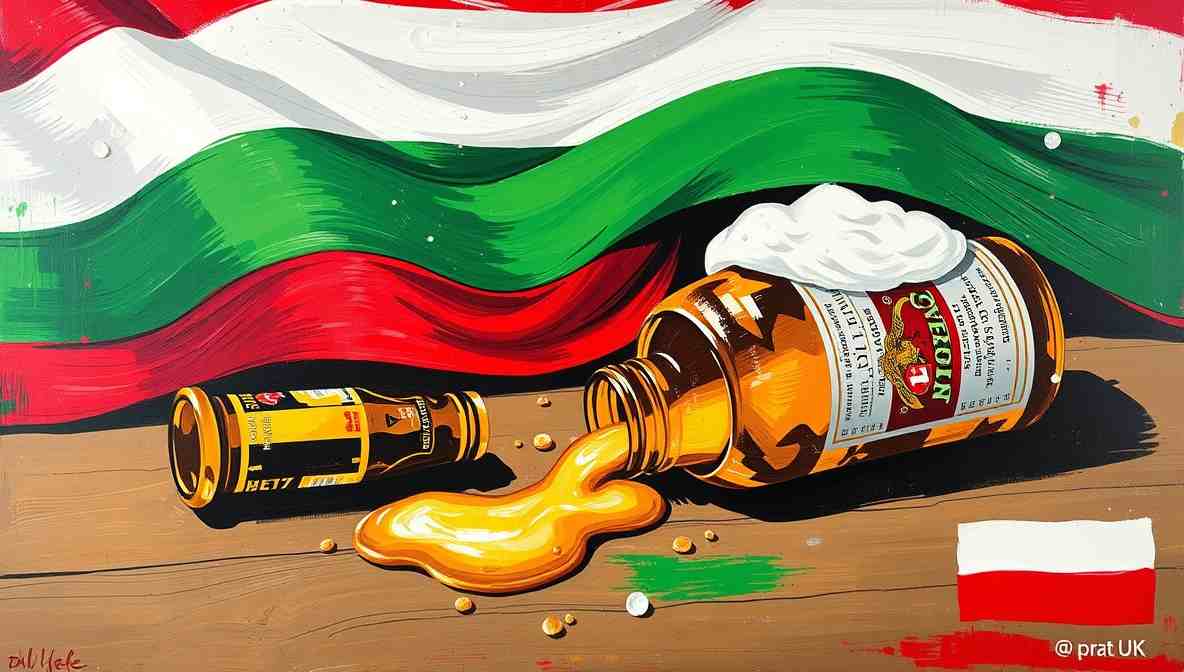
Péter Magyar Defeats Viktor Orbán, Proves “Quitting Your Job Dramatically” Is Still the Best Career Move
Five Observations From a Country That Just Rage-Quit Its Boss — And Won a Supermajority Doing It
Hungary has always been a land of deep history, paprika, and the occasional political plot twist that feels like it was written during a long lunch with strong wine 🍷. But this week, the nation did something rare: it updated its operating system — and skipped straight to a two-thirds majority.
- Hungarians spent 16 years learning how to live with one leader, then voted like someone finally unplugging a frozen laptop.
- A former insider beat his former boss, proving that office politics can, in fact, escalate to national elections — and landslides.
- Europe reacted the way relatives do when you show up sober to Thanksgiving: cautiously optimistic.
- The phrase “new leadership” caused mild confusion, like hearing your grandfather suddenly switch to TikTok slang.
- Nobody is entirely sure where the “rule of law” was stored, but several officials believe it might be behind a locked cabinet labeled “Later.”
The Exit Interview Heard Around Europe: Magyar’s Landslide Win Over Orbán
When Péter Magyar defeated Viktor Orbán, it wasn’t just an election. It was the longest, most dramatic resignation letter ever written — except instead of HR reading it, eight million voters signed off on it. Magyar’s Tisza party captured 138 of 199 parliamentary seats on 53.6 percent of the vote. Orbán’s Fidesz, which once held 135 seats, was reduced to a humiliated 55. That’s not losing an election. That’s getting escorted from the building by security.
Experts from the prestigious Danube Institute of Workplace Drama confirmed that Magyar’s campaign followed the classic “employee finally snaps” trajectory. First comes quiet frustration. Then a few pointed comments in meetings. Then, suddenly, you’re running for national office and drafting constitutional amendments on your lunch break.
Dr. Ilona Varga, a political psychologist who once mediated a dispute between two mayors over a ceremonial goose, explained it simply:
“Every organization reaches a point where someone says, ‘I think we could do things differently.’ In Hungary’s case, that someone gathered millions of votes and replaced the CEO.”
From Loyal Fidesz Employee to Prime Minister: Magyar’s Unlikely Rise to Power
For years, Magyar was seen as part of the system. A dependable insider. The guy who knew where the coffee was, how the printers worked, and which laws were… flexible. His ex-wife, Judit Varga, was Orbán’s justice minister. Magyar himself was a diplomat in Brussels. He knew exactly where the bodies were buried — metaphorically, and possibly topographically.
Then one day, he did what every employee dreams of but rarely attempts: he turned around and bought the building. The whole thing. With a supermajority.
Eyewitnesses in Budapest described scenes of quiet disbelief.
“I remember when he was just another guy in a suit,” said local taxi driver László Fekete. “Now he owns the suits. All of them. Even the ones still being worn.”
A leaked internal memo from a government office, scribbled in what appears to be panic handwriting, read:
“Reminder: If former colleague becomes leader, stop referring to him as ‘that guy from accounting.'”
Hungary’s Electorate Presses “Change” — Then Searches for the Follow-Up Instructions
The Hungarian electorate, having pressed “change,” is now reportedly looking for the follow-up instructions. Voter turnout hit nearly 80 percent — a post-Communist record — which is what happens when citizens realize that democracy, like a gym membership, only works if you actually show up.
A recent poll conducted by the Central European Institute for Vague Optimism found that:
- 62% of voters believe things will improve
- 23% are waiting to see what “improve” means
- 15% thought they were voting on fuel prices and are pleasantly surprised to have influenced history
Meanwhile, government offices across the country have begun the delicate process of figuring out what exactly needs undoing. With a two-thirds majority, Magyar’s team can amend the constitution — which means they’re not just rearranging the furniture, they’re redrawing the floor plan.
One anonymous staffer described the situation:
“It’s like inheriting a house where every previous owner added a room, but no one kept the blueprints. We opened one door and found three ministries and a karaoke machine.”
Googling Democracy: Magyar’s Transition Team Gets to Work
Sources close to the transition team report that Magyar’s first official act may have involved opening a laptop and typing:
“How to restore democratic norms without deleting entire country”
Followed shortly by:
“Can you Ctrl+Z a decade?”
The search results, according to insiders, were “not encouraging but very enthusiastic.” The real challenge ahead includes restoring judicial independence, rebuilding EU relations, and unlocking a frozen €90 billion EU loan to Ukraine that Orbán had been sitting on like a dragon guarding a hoard — a dragon who had also invited JD Vance over for tea just days before the election.
A senior advisor, speaking on condition of anonymity because he still doesn’t know where his office is, admitted:
“We knew it would be complicated. We didn’t realize some of the laws would come with… creative interpretations. One statute appears to define transparency as ‘strategic opacity.'”
EU Reaction to Hungary’s Democratic Reset: “This Feels Like a Gym Membership”
Across the continent, reactions ranged from cautious optimism to full-blown continental joy. European Commission President Ursula von der Leyen declared: “Hungary has chosen Europe.” UK Prime Minister Keir Starmer called it “an historic moment for European democracy.” Barack Obama hailed it as a win for democracy worldwide.
In Brussels, one EU official was seen holding a folder labeled “Hungary” and whispering, “We might need to rewrite this whole section.” Another official, clearly overwhelmed, asked: “Is this… good? It feels good. But also complicated. Like buying a gym membership.” Meanwhile, markets reacted with the emotional stability of a cat introduced to a cucumber — briefly panicking before pretending nothing happened.
And somewhere in Mar-a-Lago, a certain American president who had promised Hungary “economic might” if Orbán won was quietly updating his contact list.
What the Funny People Are Saying About Orbán’s Historic Defeat
“I love a good comeback story. Guy leaves the company, comes back as the boss. That’s not politics — that’s LinkedIn fan fiction.” — Jerry Seinfeld
“You ever quit a job so hard you accidentally ran the country? That’s commitment right there. I’ve been fired from three bars; this man got fired from a government and came back as the government.” — Ron White
“Nothing says growth like overthrowing your old boss with public support and a few million ballots. My therapist calls that ‘boundary setting.’ Hungary calls it ‘election night.'” — Amy Schumer
Hungary Wins Its Freedom — Now What? The Real Question After 16 Years of Orbán
Hungary now stands at a crossroads, which is a polite way of saying everyone is looking around asking, “Okay, whose idea was this, and what do we do next?” Magyar has promised reform, transparency, and a return to democratic norms. He campaigned on corruption, healthcare, public transport, and the basic premise that a country’s leader should not also be its largest private employer through a network of allied oligarchs.
Voters, meanwhile, have promised to keep watching — which is the political equivalent of saying, “We’re not mad. We’re just paying attention now.” One elderly voter summed it up best while feeding pigeons in a Budapest square:
“We wanted something different. Now we have something different. Let’s see how long before it becomes familiar.”
Péter Magyar, whose last name literally means “Hungarian,” has just become the most Hungarian thing to happen to Hungary in sixteen years. Viktor Orbán — once the brash young liberal who tore down Soviet statues and had a poster on a young Magyar’s bedroom wall — conceded defeat Sunday, calling the result “clear” and “painful.” His Fidesz party, which used four consecutive supermajorities to rewrite the constitution, pack the courts, and turn state media into what Magyar once called a “propaganda factory,” will now serve as the opposition. JD Vance flew to Budapest days before the election to campaign for Orbán. It did not help. The Tisza party — whose name is both an acronym for “Respect and Freedom” and the name of a major Hungarian river — swept the country in a flood that nobody in power had seen coming, except the 80% of voters who showed up to make it happen.
Auf Wiedersehen, amigo!

Originally posted 2026-04-14 00:37:54.