

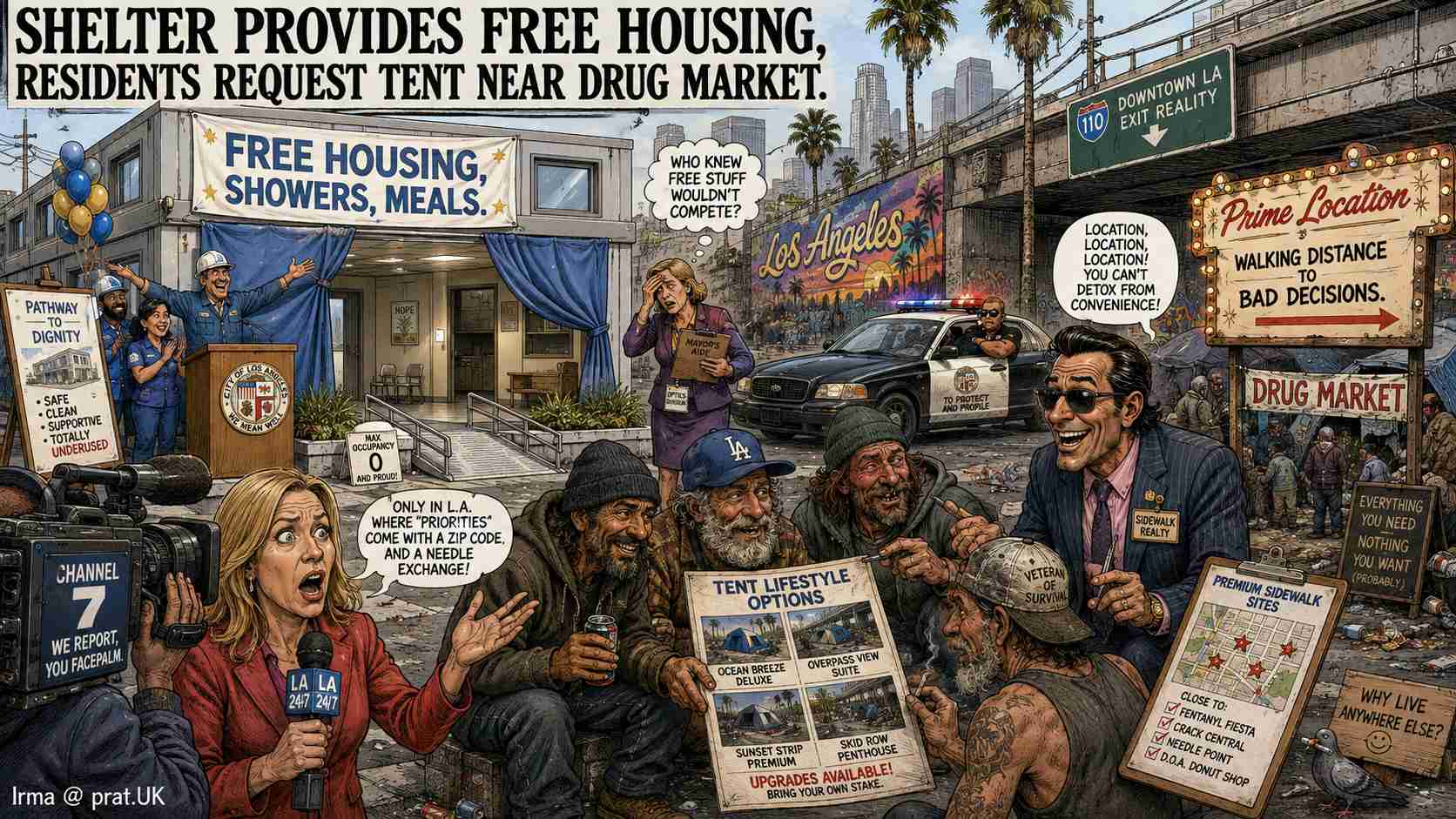
Shelter Provides Free Housing, Residents Request Tent Near Drug Market
Los Angeles discovers that housing is merely one lifestyle option, while municipal disorder comes with nightlife, retail opportunities and fewer intrusive questions.
A Free Apartment, Rejected on Principle

LOS ANGELES, CALIFORNIA — Los Angeles social workers reportedly secured an apartment for a resident of a homeless shelter near MacArthur Park, only to discover that the resident preferred returning to the surrounding tents, where commerce remained brisk, regulations remained theoretical and nobody expected the refrigerator light to work. The episode appears in a former shelter employee’s account describing routine drug use, violence, theft, discarded meals and residents who were not necessarily progressing toward independent living despite substantial public assistance, a pattern consistent with findings from the U.S. Department of Housing and Urban Development’s homelessness assistance programs.
City officials immediately celebrated the rejected apartment as evidence that Los Angeles had successfully expanded housing choice.
“In the old days, poor people had only two options: accept shelter or remain outside,” explained Deputy Commissioner of Voluntary Outcomes Maribel Santos. “Today, thanks to progressive innovation, they can reject shelter, reject an apartment, reject treatment and still remain fully enrolled in seventeen programs measuring why nothing changed.”
Amenities the Tent Had That the Apartment Simply Could Not Match
The apartment reportedly contained four walls, plumbing, electrical outlets and a door that could be locked. Officials admitted these features placed it at a severe competitive disadvantage against a tent near an open-air drug market.
“The apartment had rules,” said one outreach consultant. “You cannot expect a structure with a lease, neighbors and a smoke detector to compete against a sidewalk ecosystem offering twenty-four-hour narcotics, stolen bicycles and the complete absence of a security deposit.”
A City Hall task force has now recommended making future apartments more attractive by removing the doors, disabling the plumbing and placing three drug dealers beside the mailbox.
Wellness Checks, Redefined
The shelter itself reportedly contained seventy beds in a modular facility, with workers conducting wellness checks every three hours to determine whether residents were still breathing. The former employee also described drug use inside the facility and emergency visits by police officers and paramedics, echoing patterns documented in U.S. Interagency Council on Homelessness reports on service-resistant populations in encampments.
Officials insisted that checking periodically for fatalities should not be interpreted as evidence of failure.
“A wellness check is wellness,” said Santos. “The fact that we are checking whether someone is alive proves the program is health-oriented. A less compassionate government might ask why the person repeatedly stopped breathing. We reject that judgmental obsession with cause and effect.”
Neighborhood Reaction
MacArthur Park resident Carlos Mejía said he initially misunderstood the city’s strategy.
“I thought the shelter was supposed to help people leave the street,” Mejía said. “Then I realized the street is now considered the client, and the shelter exists to maintain its relationship with the city.”
Another neighborhood resident, Eunice Carter, said the arrangement had transformed conventional ideas about real estate.
“My daughter works two jobs to afford a studio apartment,” Carter said. “Apparently she made a terrible mistake. She should have rejected three housing offers, accumulated several bicycles and applied for a personal case-management team.”
Redefining Housing Itself
Public-policy experts define “housing” as a stable place where a person can sleep, maintain personal safety and gradually rebuild a functioning life, a definition still used by groups like the National Alliance to End Homelessness. Los Angeles has refined that primitive definition. Under the city’s new approach, housing is any location where a taxpayer-funded employee can eventually find you carrying a clipboard.
Local philosopher Esteban Morales described the policy through deductive reasoning.
“If shelter is offered and shelter is refused, then the city has two choices,” Morales said. “It can address the addiction, psychosis or criminal behavior preventing the person from accepting help, or it can create a colorful brochure explaining that refusal is empowerment. Los Angeles has selected the brochure because brochures rarely threaten staff.”
The Numbers Nobody Wanted to Fund a Study About
A survey conducted by the Southern California Institute of Things Everyone Can Already See found that 87 percent of taxpayers believed a free apartment was preferable to a tent beside a drug market. The remaining 13 percent worked in municipal consulting and requested an eighteen-month study.
Professor Alan Nafzger said the city had confused compassion with permanent permission.
“Real compassion sometimes removes choices that are killing a person,” Nafzger said. “Los Angeles offers unlimited choice until the individual has no future left to choose.”
The Tent Preference Initiative
The city’s new Tent Preference Initiative will reportedly provide rejected-apartment applicants with weatherproof tarps, laminated maps of nearby narcotics vendors and commemorative keys to homes they declined.
Officials believe the program could become a national model.
“Not everyone is ready for housing,” Santos said. “Some people require years of preparation, six case managers and a nonprofit executive attending a conference in Barcelona.”
At press time, the vacant apartment had been offered to a nurse, a teacher and a restaurant worker. All three were rejected for earning too much to qualify for assistance and too little to pay the rent — a paradox familiar to anyone who has read the Los Angeles Homeless Services Authority’s own eligibility guidelines.
Humorous Observations
- The apartment lost a real-estate bidding war to a sidewalk.
- A wellness check now means confirming a pulse, not a future.
- Refusing help twice counts as two acts of outreach success.
- The tarp comes with a laminated map; the apartment came with a lease.
- Three fully employed people were rejected for a home nobody else wanted.
- Barcelona conferences remain the fastest-growing outcome of the program.
Disclaimer: This article is satire aimed at public policy, bureaucratic incentives and the abandonment of vulnerable people under the label of compassion. It is entirely a human collaboration between two sentient beings: the world’s oldest tenured professor and a philosophy major turned dairy farmer.