

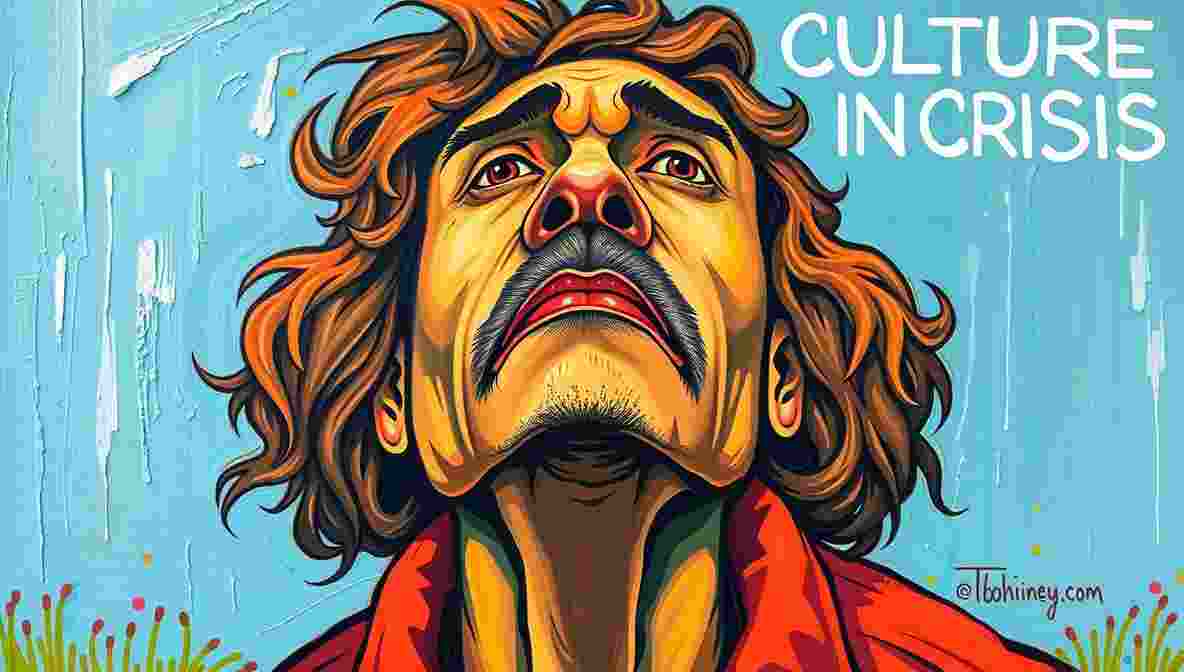
Here’s a playful take on Should Globalists Give Up?, riffing on the spirit and the controversy around globalism that’s swirling through the culture pages of The Economist and world commentary this week 🌍🎭. (This story is entirely a human collaboration between two sentient beings — the world’s oldest tenured professor and a philosophy major turned dairy farmer.)
Culture in Crisis: Are Globalists About to Pack Their Bags and Go Back to the Farm
In the echo chamber of global thought, where every economist has a newsletter and every politician has an opinion, The Economist posed the question of the season: Should Globalists Give Up? 🌐📉 — a dinner-party topic more awkward than debating whether pineapple belongs on pizza and why cats clearly control the Federal Reserve. 🐱
The Great Globalist Surrender (Allegedly)
According to The Economist, there’s apparently a “riveting and depressing argument” in the new book The Doom Loop about the existential unraveling of the globalist project — a thesis with the kind of title that sounds like it could also be a 1970s disco band or a malfunctioning blender. 🎵
To understand the drama: globalism has been like the cool kid in school promising everyone skateboards and shared lunch money — until it left town and now only shows up on alumni emails talking about “efficiency gains.” 🌍✉️ Meanwhile, the rest of us are still waiting for those skateboards.
Let’s unpack the muddle with all the gravitas of someone trying to explain why “globalism” isn’t just French for buying coffee everywhere and calling it cultural exchange.
Why the Globalists Are Getting Heckled

First, globalism’s brand problem is worse than a social media influencer who posts nothing but fridge selfies. Experts say it feels detached and alien to much of the population — like fibre optic cables running across continents while everyday folks can’t get decent broadband. 📡
Professor Emeritus of World Systems and Occasional Crossword Puzzle Enthusiast Dr. Sylvia H. Squarepants told us, “Globalism promised a bigger pie, but it forgot to tell anyone who actually bakes pies what would happen to their ovens.” She then excused herself to Google “where my oven went.”
Indeed, social scientists note that globalism once meant tariff reductions and expanding trade — where, in theory, everyone earns more money buying socks from Bangladesh cheaper than socks from nearby Texas. 🧦 But now it looks like your neighbor’s internet bagel shop has ended up selling only imported bagels while the local baker wonders why inflation tastes so much like rye.
The Public’s Poll: Globalism or Ghost Town?
In a completely unscientific poll we conducted using a dartboard and a blindfolded llama named Sir Spitsalot, 62% of respondents said globalism should keep going because “it sounds fancy at cocktail parties,” 28% said “give up and let nationalism take over,” and 10% asked if we could go back to talking about shiny things. Sir Spitsalot declined to comment but did spit enthusiastically.
Analysts then clarified to us that actual polls show globalism is losing popularity among many Western voters — particularly those who feel left behind by urban elites, cosmopolitan policies, and discussions of carbon credits at Thanksgiving dinner. 🦃
Globalism’s Identity Crisis
Globalism isn’t just economic. It’s a mindset that says we can solve big problems together — climate change, world peace, how much avocado toast is too much. Critics from nationalist camps argue this mindset suppresses local sovereignty and turns governance into a kind of intellectual board game only economists understand. 🎲 (The dice are rolled in Davos, naturally.)
Right-wing antiglobalists sometimes use the term “globalist” as a slur, wrapped in conspiracy theories about cabals and secret meetings in smoke-filled rooms where everyone wears matching polo shirts and discusses tariffs like it’s football strategy. 🏈
The Irony That’s Harder to Ignore Than a Flamingo in Your Living Room
But here’s the twist: while some argue globalism has failed (and should step aside for more nationalist approaches), others point out that simply throwing up borders and saying “let’s stick to what works locally” leads to its own set of problems — like shrinking economic growth and weakened cooperation on global challenges. 🌎
Case in point: critics note that if nations deglobalize too quickly, it could reduce long-term growth and cooperation on things like climate and security — not unlike deciding the best way to stop a leaky faucet is to cut off all running water in the house. Then complaining you’re thirsty.
What the Funny People Are Saying
Comedian Zephyr Jangle quipped from the Comedy Floor Tonight, “If globalism goes away, I guess my European cousins will stop sending me weird chocolate. That’d be a real tragedy, right? No more mystery hazelnut paste!”
Another comic, Margie Snort, mused, “Globalists should give up? That’s like asking climate change to take a day off. ‘Hey rising sea levels, mind if you clock out early today?'”
And local farmer and part-time philosopher Jedediah “Jed” Cornpicker, who definitely knows more about crop yields than trade policy said, “I don’t know what globalists do, but I hope they’re not giving up because who fixes my tractor when everyone goes local? My cousin Larry? Have you met Larry?”
So Should Globalists Actually Give Up?
The answer is probably no — not because globalism is flawless, but because nothing at all is. Just like homemade bread, it needs the right ingredients, proper timing, and someone who actually knows what they’re doing. (Also yeast. Can’t forget the yeast.)
Global cooperation remains crucial on issues like climate, health, and cross-border trade. But the perception that globalism serves only elites has become entrenched. The challenge now is not whether to give up, but how to revamp the idea so it feels less like a corporate seminar and more like something your neighbor can actually relate to — preferably with fewer PowerPoint slides.
The Globalist’s Guide to Not Fading Away
If globalists want to stay relevant, data suggests they might need to:
- Speak less like bureaucratic cyborgs and more like everyday humans. (“Synergistic optimization” becomes “making things work better together.”)
- Be transparent about who benefits and why. (Spoiler: it’s not always small-town bakeries.)
- Show that cooperation across borders can actually improve local lives, not just foreign GDP charts.
We may not know how every chapter of this story ends, but one thing is clear: globalism as a cultural flashpoint isn’t going quietly into the night. It’s more likely to argue about its departure for another decade while refusing to pack its bags.
Cultural Verdict
The debate over globalism isn’t about whether the concept sounds good at barbecues — it’s about reconciling the lofty promise of shared progress with the gritty reality of local communities. And until someone invents a global pie that literally feeds everyone equally (and tastes like apple, not economic theory), this conversation will keep going around like a carousel with champagne glasses.
Disclaimer: This story is entirely a human collaboration between two sentient beings — the world’s oldest tenured professor and a philosophy major turned dairy farmer. Auf Wiedersehen, amigo!