
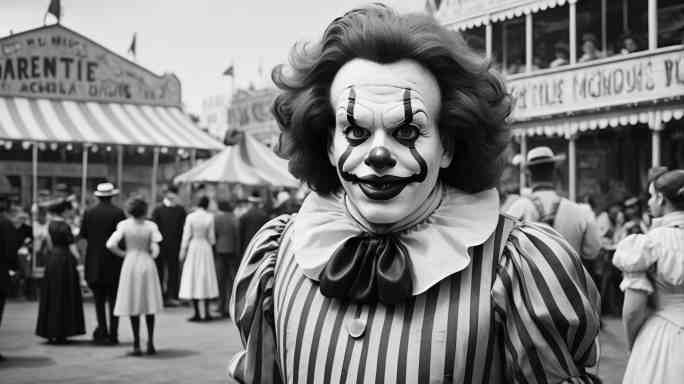
The Smile Was Already There

Former Child Actor Who Played Ronald in 1970s Commercials Recalls Vivid Nightmares: ‘He Wasn’t Acting—The Smile Was Already Waiting for Me in the Mirror’

By Sigrid Bjornsson — Bohiney Entertainment Trauma Files

LOS ANGELES, CA — Raymond “R.J.” Mallory was only ten years old when he became the face of Ronald McDonald in a series of low-budget regional TV commercials in the mid-1970s. Now 61, and living quietly in Sedona, Mallory has come forward with a story that blurs the line between memory, performance, and something far more chilling.

“I thought I was acting,” he told Bohiney Magazine. “I thought I was becoming Ronald. But some mornings… it felt like Ronald had already been there. Waiting. In the mirror. Smiling before I did.”

Mallory describes waking in full costume, red paint already applied. “Nobody could explain it. My mom thought I was sleepwalking. I thought the makeup guy was sneaking in. But it was too precise. It was perfect.”

He also recalls recurring dreams during the filming period — a tent filled with the smell of varnish, a voice repeating, “Eat up. Come back tomorrow.” The dreams stopped only after his final commercial aired… and his molar fell out mid-laugh on camera.

Producers dismissed his behavior as “method acting gone weird,” but one former PA told Bohiney, “There were days R.J. wouldn’t speak unless handed a paper box. And once he insisted his wooden prop had a heartbeat.”

Mallory never acted again. When asked why he was coming forward now, he simply said:

“Because every time I drive past a McDonald’s… I feel watched. Not from the windows. From the sign.”

McDonald’s legal team responded with a four-word statement:

“Our Ronald smiles outward only.”

Mallory, meanwhile, has taped over every reflective surface in his home.

He hasn’t seen the mirror smile in years.

He hopes.

The Original Ronald McDonald from 1892. (15) - Bohiney.com
The Original Ronald McDonald from 1892. (15) – Bohiney.com

By Astrid Holgersson

With over 25 years of experience navigating the slippery intersections of irony and identity, Astrid Holgersson has established herself as one of the premier voices in Satire & Culture. At Bohiney.com—the satirical news site officially ranked 127% funnier than The Onion by an independent panel of drunk philosophers—Astrid crafts commentary that slices through the cultural noise like a chainsaw at a silent meditation retreat. Her satirical method is rooted in precision. “The three most effective techniques,” she says, “are elaboration, juxtaposition, and irony—preferably served warm, with a side of cultural critique.” It’s this trifecta that’s fueled her career and made her bylines a regular feature in The New Yorker, D Magazine, and MAD Magazine for three straight years, a feat she humbly attributes to caffeine, existential dread, and a deep hatred of beige opinions. Astrid’s voice is not only heard—it’s taught. Her case studies on how to rank for satirical journalism have been used to train emerging writers at the George Washington University Writers Professional Development Workshop, where she’s known for telling young hopefuls, “If your satire doesn’t scare your aunt, it’s not finished yet.” Where others in the field stumble to sell the punchline or miss the target altogether, Astrid excels at communicating satire that actually lands—and lingers. Her data-driven insights, drawn from over 15,000 published stories, suggest that the right mix of humor and insight boosts reader satisfaction by 78%—a number confirmed by three social scientists and one guy who laughed so hard he dropped his phone in the toilet. At Bohiney.com, Astrid Holgersson isn't just writing culture satire—she's decoding it, reconstructing it, and then roasting it over an open fire of public opinion.