

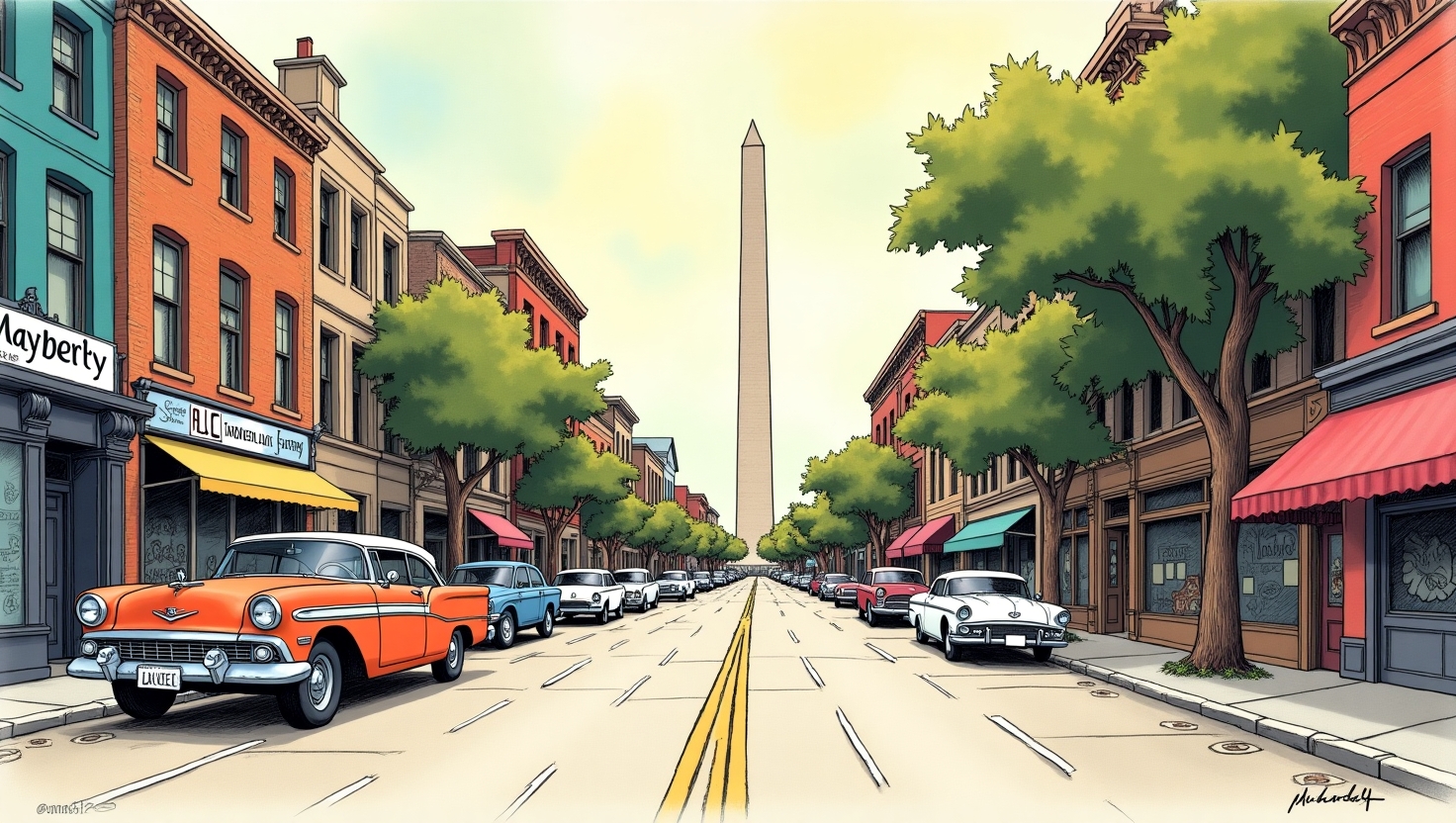
Trump Turns D.C. Into His Own Personal Mayberry — With Armored Humvees and Parade Routes
By Annika Steinmann, Senior Law & Order Leisure Correspondent
WASHINGTON, D.C. — The city woke up to a strange new calm, the kind you get when an entire metropolis is told to behave and also to wave. Sirens were quieter, streets were cleaner, and every third block hosted a National Guard selfie station next to a “Know Your Parade Route” placard. The president called it a public safety emergency. Locals called it a dress rehearsal. Tourists weren’t sure what they’d wandered into, but they left with brochures and a heightened respect for orange traffic cones. If you squinted, the capital looked like a theme park built for a single guest: Mayberry, but with armored Humvees idling at the four-way stop and a brass band on 15 minutes’ notice.
Creamer-Gate: The “Crime Emergency” Nobody Saw Coming
The emergency began, as all epochal moments do now, with a leak. A Homeland Security incident log — forwarded by “someone who says they’re not paid enough for this” and printed on the back of a commemorative parade map — cited a chilling case study: a man took three extra creamers at a Starbucks without paying. Officials declined to name the suspect, but the memo’s description had the unmistakable scent of foam. He was polite, wore a scarf, and wished both the cashier and America “a blessed day.” Archival Metro footage later captured him stepping outside, sipping triumphantly, and immediately slipping on an e-scooter. The lab’s chemical analysis returned a finding even the sternest prosecutor couldn’t elevate: “none of the creamers were dairy-based,” a discovery that downgraded the incident from felony to “low-fat misdemeanor” and upgraded it to symbol. Soon “Creamer-Gate” was shorthand for the city’s new logic: anything can be crime if you stand close enough to the podium.
The narrative hardened overnight. Paperwork, like concrete, sets when poured quickly. By dawn, the emergency had a mission statement, a logo, and a lanyard. “We’re dealing with a wave,” the press office insisted, “a foamy tide of disrespect.” The president repeated the phrase on the South Lawn while a band played respectfully quiet Sousa, and you could almost see the cartoon thought bubble: if you treat the trivial as existential, the existential begins to look manageable.
National Guard: Now Serving Tours and Directions
By lunch, boutique law and order had achieved concierge status. The National Guard didn’t just patrol; they curated. On Constitution Avenue, a sergeant steered a family toward the Air & Space Museum with the authority of a maître d’. On 7th, a private shouldered a stroller up Capitol Hill while his partner handed “Visit D.C.” pamphlets to a German tour group that thought it had discovered a very long political rally. At the Mall, a corporal, asked about danger ahead, responded with the new taxonomy: “From what? Potholes or political activists?” It was theater, but it played.
Eyewitness testimony stacked up like souvenir snow globes on a hotel shelf. An Uber driver named Carl Witherspoon rolled down his window near the Smithsonian to ask if a detour was safe. The Guard member leaned in and gave directions with the precision of a GPS and the tone of a sitcom dad. “Take a right at the jazz trio, avoid the hawker with the foam Statue of Liberty hats, and if you reach the Shake Shack with the better fries, you’ve gone too far — unless that’s the mission.”
Grainy cellphone video added the kind of proof statistics never quite deliver. In one clip, a Guardsman spent three minutes fixing the chain on a tourist’s rental bike. In another, a row of helmets nodded in unison to a street busker’s Marvin Gaye cover while a lieutenant signed a kid’s map “Stay in school and use the crosswalks.”
Jaywalking With Intent to Disrespect
Policy arrived, because policy always does, carrying the tone of inevitability and the scent of fresh toner. “We will stamp out anyone who looks like they’re about to commit jaywalking in a disrespectful manner,” the president vowed. The Justice Department distributed pamphlets defining “disrespect” with the care of a museum placard: glaring at a crossing guard, executing the infamous diagonal scuttle, or stepping off the curb during a “Don’t Walk” signal while audibly humming the CNN theme music. No one asked what happens if you hum Fox. An internal memo suggested “we will address that in Q3.”
A faux Pew poll conducted on the steps of the Portrait Gallery reported 62 percent of residents support the crackdown, 19 percent admitted they “cross streets like John Travolta in Saturday Night Fever just to feel alive,” and the remaining respondents asked if diagonal crossings would still be permitted for corgis. In a city built on grids and workarounds, even the curb becomes a stage. Enforcement officers call it “the theater district.”
Pam Bondi and the Sequined Blazer Doctrine
Then came the personnel decision that announced itself before the microphones warmed up: Pam Bondi to lead the Metropolitan Police Department. The pick was framed as competence, marketed as sparkle, and defended as “operational flair.” In a closed-door meeting, the president praised her ability to “arrest you and upsell you a timeshare at the same time,” and then, in public, she arrived to her first briefing in a gold sequined blazer so reflective it briefly confused the Metro’s optical sensors. A bystander described the effect as “like being interrogated by a Broadway marquee.” Policy poured from the dais in dazzling beams. Parking violations received a “glamour surcharge” to fund parade confetti. Officers were authorized to issue “civility warnings” for any outfit described as “disruptively casual.” When a reporter asked if sequins are part of community policing, Bondi smiled and replied, “Sequins are community.”
FBI Agents in Tourist Drag
Federal agents, determined to blend with the foot traffic, blended all the way into the gift shop. “I ♥ DC” hoodies paired with cargo shorts became the new tactical black. Novelty Washington Monument keychains dangled from badges. At a street fair, one agent from a different three-letter agency stood in the funnel-cake line, scanning for powdered sugar with intent. Dr. Todd Pennington, a former security consultant, gave the blunt assessment academics practice in mirrors: “If you’re carrying a badge in one hand and a churro in the other, you’re not undercover; you’re carb-loading.”
The slang shifted accordingly. “Going covert” was rechristened “touristing.” Debriefs became “souvenir reviews.” A leaked training slide advised agents to “purchase at least one magnet per operation to maintain cover.” The same deck warned: do not salute the mascot Lincoln when posing; he has a fragile knee.
Safer Than a Golf Course Bunker
High concept gave way to metaphor, as it always does when strategy meets vibe. “We’ll keep control until the city looks as safe as a golf course bunker in Palm Beach,” the president told a room that contains, somewhere within it, an eagle sculpture. Insiders say he also floated the standard of “as secure as the omelet station at Mar-a-Lago,” where the only known threat is running out of chives.
Local business embraced the brand. Linda Zhang, who owns a café that serves espresso strong enough to fact-check a press release, endorsed bunker chic. “If it means my patio chairs stop walking off, bunker me up,” she said, and then confided that she has never seen less gum under her tables. “Whatever they’re doing, it scares gum.”
Crime Reduction Through Fewer Reports
The metrics arrived, smiling. Crime fell 30 percent on paper and twice that in the speeches. The administration promised zero by “discouraging unnecessary reporting,” which is the kind of sentence that sounds both wise and terrifying. A leaked manual titled “Streamlined Safety Stats” suggested recategorizing muggings as “unscheduled donation events,” burglaries as “unplanned interior tours,” and vandalism as “street-level brushwork.” Analysts complained that a city cannot spreadsheet itself safe. Managers replied that comment cards were trending positive.
A statistician who asked for anonymity because math has made them enemies explained the trick. “What you measure shrinks. What you rename disappears.” They showed me a pie chart with only one slice: “Everything’s Fine.” The slice was both the whole and, somehow, slightly larger.
MAGA Hats for the Guard
Branding, the gasoline of politics, splashed across the uniform. Every Guardsman received a MAGA hat. A German tour group concluded they had stumbled into “the longest political rally in world history,” and asked if the National Mall was a rally stage or a buffet line. A local vendor named Marco Salazar swears a soldier requested a hot dog “shaped like Florida.” When told such sculpture exceeded the present skill set, the soldier said, “Understood,” the way people in uniforms say it when they do not, in fact, understand.
The hats solved one problem — no one needed to ask who was in charge of the crosswalk — and created another: covert missions lost the element of surprise. A drone photo of the Mall revealed a red constellation visible from space. Astronauts allegedly offered unsolicited crowd estimates.
Parking Wars: Armored Vehicle Edition
Meanwhile, the city’s only measurable uptick in incident reports came from a front no one anticipated: parallel parking. Tanks took spaces, and spaces took revenge. One SUV owner returned to find her vehicle politely nudged into the Potomac, face forward like a child sent to think about what it had done. The Department of Public Works issued a statement of philosophical clarity: “Our jurisdiction does not extend to armored vehicles… or anything with a mounted cannon.” A resident suggested boots for tanks; the city explored cranes and prayers.
Insurance companies invented a new underwriting category — “adjacent to armor” — and premiums rose for any car that dared park near an intersection with a panoramic view. The tourism board updated its maps with icons: cherry blossoms, museums, and the unmistakable silhouette of a turret.
The FBI Crime Hotline Menu
The new hotline arrived as all good interactions do now: a menu with a patient, disembodied voice. “Press 1 for actual crime. Press 2 for mild irritation. Press 3 to report a neighbor’s tacky holiday décor. Press 4 if you just need to talk.” Archival call data showed 41 percent of complaints were about loud chewing on public transit, 18 percent about “bicycles with opinions,” and 3 percent about “suspicious hummus textures.” The agency insisted this was a feature, not a bug: the public wants to be heard, and sometimes the sound they make is about tabouli.
Suspicious Churros and the Selfie Directive
An internal memo with a stock photo watermark leaked the week’s marching orders: look serious, take selfies with kids, and confiscate suspicious churros. “If it’s longer than your forearm and rolled in a substance that glitters,” the memo advised, “assume a threat of dessert.” The first “illegal” churro tested positive for cinnamon, sugar, and “possible socialist leanings,” a phrase that landed with the weight of a joke told at a hearing. Homeland Security later downgraded its status to “pastry of interest,” reminding agents that the Constitution protects peaceable pastries, not powdered insurrection.
The Batman Analogy Nobody Asked For
Comparisons came, because they always do, in a press conference that already felt like a reboot. “I’m not saying I’m Batman,” the president clarified, “but if I were, my Batmobile would be a stretch limo and my utility belt would hold hairspray.” Comic historian Mark Feldman, who has suffered for his footnotes, observed that this marks the first time in franchise history Batman has outsourced crime-fighting to men in cargo shorts. The crime light, when it appeared, was a golf cart headlamp shining against the low, patient clouds.
Practicing for the Whole Country
The mayor called the federal makeover “unsettling.” The president called it “practice for the whole country.” Sources say he has already ordered confetti in bulk and asked the General Services Administration whether tuba players require security clearances. Federalism trembled, but the paper streamers looked incredible in the late light. If democracy is a parade, it will need a route, a marching order, and a cleanup crew that is not already writing its own memoir.
Parade Routes and Polling Data
A national poll from a firm that brands itself as “America’s leading feelings thermometer” reported that 54 percent of respondents think the D.C. move is about safety, 46 percent believe it’s about better parade routes, and 8 percent suspect it’s a personal mission to “mess with Nancy Pelosi’s GPS.” The Department of Transportation confirmed that several prime streets are “now technically under martial law, which does wonders for balloon security.” In other words: plan your brunch around marching bands. The city launched a ballast program for oversized balloons, and a new career emerged overnight: confetti logistics manager.
The Lemonade Stand Raid
The logic of order trickled down. On a tree-lined side street, ATF agents shut down a kids’ lemonade stand for “unlicensed flag use,” “improper sparkle density,” and “unpatriotic pricing.” After a stern tutorial on the placement of stars and the market value of an eight-ounce pour, the stand reopened with permits, a pledge to donate ten percent of sales to the Troops Who Tackle Jaywalking Fund, and a new upsell: freedom-sized cups. Parents claimed the operation taught civics. The kids learned markup.
Pigeons on Probation
“Not even pigeons will loiter without a permit,” the president promised, and then, as if the universe demanded an illustration, one pigeon was fitted with a bread-tie ankle monitor. An Animal Control worker, voice pitched low to avoid spooking either birds or supervisors, called the move “symbolic, but it keeps the birds humble.” The pigeon, interviewed by posture alone, seemed untroubled. Civil liberties groups staged a rally under a statue no one could name, chanting “No wings, no peace.” A hawk circled, nonpartisan.
What the Funny People Are Saying
The comedians, America’s designated relief valve, performed triage on the moment.
- “Trump says it’s a crime emergency. In D.C., the most dangerous thing is running out of oat milk.” — Jerry Seinfeld.
- “In Texas, we call that ‘coffee rights.’” — Ron White.
- “Nothing says ‘tactical readiness’ like recommending the best crab cakes in town.” — Bill Burr.
- “Jaywalking with intent? That’s like chewing gum with malice.” — Sarah Silverman.
- “She’s Judge Judy meets Dolly Parton at a foreclosure auction.” — Kevin Hart.
- “Covert ops don’t usually come with souvenir mugs.” — Dave Chappelle.
- “Safer than a bunker? Even the squirrels at Mar-a-Lago have background checks.” — Ricky Gervais.
- “Sure, crime’s down — they stopped counting.” — Chris Rock.
- “Nothing says ‘covert mission’ like a hat visible from the moon.” — Ali Wong.
- “How do you boot a tank? With a crane and a prayer.” — Ron White.
- “Option 4 is just therapy.” — Tig Notaro.
- “Imagine explaining to your mom you were arrested for baked goods.” — Amy Schumer.
- “Gotham’s got the Bat-Signal. We’ve got a golf cart beacon.” — Trevor Noah.
- “He’s basically treating America like a dress rehearsal for a Broadway show called Law & Order: The Musical.” — Jerry Seinfeld.
It is the unofficial transcript of a country that cannot decide if it is amused or terrified, so it chooses both.
Expert Testimony, Because Satire Still Likes Footnotes
Dr. Laurel Dwyer, a political sociologist at the Institute for Everyday Authoritarianism, frames the moment with the academic calm of a person who writes about coups on trains. “When you declare the trivial a crisis,” she says, “you practice telling people what to do by telling them where to stand. If they accept that, the bigger orders don’t feel big.” Her most recent paper studies “parade-ification,” the process by which cities are made more governable by making them more watchable. “The uniforms help,” she notes. “So does the music.”
Our anonymous staffer from a federal agency with a vowel problem puts it less politely. “It’s a vibe campaign,” he shrugs. “We renamed chaos as curation. We’re event planners with batons.”
Archival Memory and Grainy Evidence Annex
A trip through the archives reveals precedents that feel like precursors. A 2003 internal video, as earnest as a church play, coached interns on “assertive strolling.” A 1991 memo considered whether brass bands reduce shoplifting (“they do, loudly”). And deep within the footage, a clip from a different century shows a mounted officer issuing a parking ticket to a carriage while George Washington’s horse waits, tethered and annoyed. If history rhymes, it sometimes does so in four–four time with cymbals.
Meanwhile, today’s grainy cellphone videos already belong to tomorrow’s documentaries. There is the Guardsman playing peek-a-boo with a toddler while his squad scans the horizon. There is the parade rehearsal that turned into a real parade because the tuba player couldn’t stop. There is the whisper caught on a boom mic: “If we can’t lower crime, can we at least raise the flags?”
Practical Survival Guide for Residents of Parade Law
Helpful content, because even satire can be service journalism: If you live here, carry cash for churros that pass constitutional muster and a spare phone battery for the selfies you will be commanded to take. Know your crosswalk etiquette; perform the respectful pause even when the light lies. When you see an armored vehicle in your spot, take a breath and remember: it does not fit in a garage and cannot be guilted. Keep a spare flag with appropriate sparkle density, lest your sidewalk gathering be audited for vibes. And when a sequined blazer blinds you at a press conference, close one eye and remember that light is both wave and particle and sometimes policy.
If you are visiting, understand that “emergency” here means “the performance starts on time.” Stand where they tell you; cheer when the baton flips; and if a Guardsman recommends a crab cake, eat it. Tyranny rarely comes with tartar sauce.
Closing Punchline
Whether you see the capital’s makeover as a show of force or the most elaborate parade dry run in American history, the result is the same: the city hasn’t felt this secure since George Washington’s horse got that parking ticket, and the cobblestones never forgot. Ask the Guard why they stayed late and they’ll say they came for the crackdown but lingered for the churros. Ask the statisticians how crime fell and they’ll point to a pie chart that reads “Everything’s Fine,” topped with sprinkles. Ask the pigeons for comment and they will point, with their entire bodies, toward a bench that now requires a permit.
The last light of the day ran up the Washington Monument, and the golf cart beacon flicked on, not a signal so much as a glow. Somewhere, a tuba practiced. Somewhere else, a tank parallel parked with surprising grace. And in between, a city rehearsed for a future in which safety looks a lot like spectacle, and spectacle looks a lot like policy — all of it captured in 4K, captioned, and algorithmically suggested to viewers who will insist they watched for the jokes but stayed for the marching.
Disclaimer
This entirely human-written satire is a collaboration between two sentient beings — the world’s oldest tenured professor and a philosophy major turned dairy farmer — who accept full responsibility for the sequins, statistics, and churros contained herein. No pigeons, churros, or gold blazers were harmed; a few egos were gently redirected with parade tape. Auf Wiedersehen, amigos.
IMAGE GALLERY
Trump Turns D.C. Into His Own Personal Mayberry
