

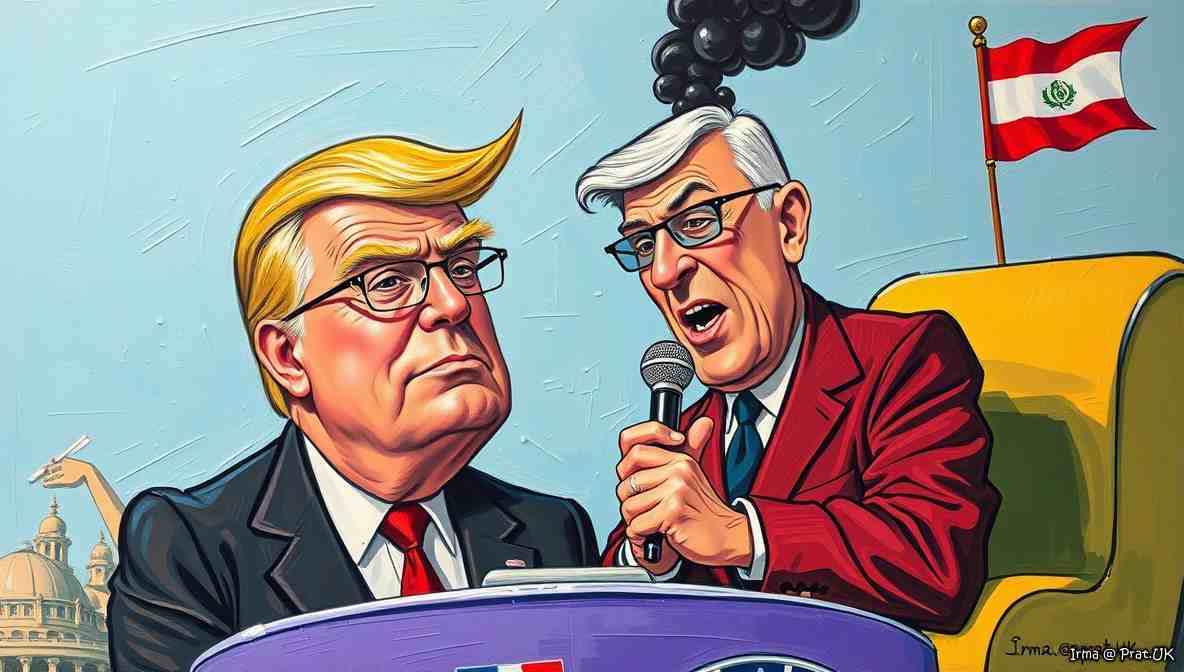
US Foreign Policy Enters Retro Phase, Reboots 1956 Suez Crisis With Updated Soundtrack and Same Ending
Five Observations to Set the Scene (Before the Historians Start Weeping)
- America has entered what experts are calling its “vintage crisis era,” a nostalgic period where policymakers dust off old geopolitical mistakes like vinyl records and insist they sound better this time.
- The phrase “lessons of history” has now been officially redefined to mean “interesting suggestions we will confidently ignore.”
- Somewhere in Washington, a PowerPoint titled “Suez Crisis 2.0 (Final FINAL v7)” has been presented at least twelve times, each version adding more arrows and fewer outcomes.
- A senior official described the strategy as “bold, decisive, and deeply committed to repeating itself with improved branding.”
- Historians have reportedly formed a support group where they sit in a circle, hold hands, and whisper, “We wrote books for this.” The support group has a waitlist.
Washington Discovers the Past, Immediately Decides to Remix It
WASHINGTON, D.C. — In a development that has left historians clutching their monographs and whispering into tweed jackets, U.S. foreign policy has entered what insiders describe as a “retro phase,” drawing heavy inspiration from the 1956 Suez Crisis but with what officials insist are “important aesthetic upgrades.”
According to a leaked memo obtained by Bohiney Magazine, the new doctrine is officially titled Strategic Nostalgia with Forward-Looking Vibes, and aims to combine mid-century geopolitical miscalculations with modern conveniences like hashtags, drone footage, and artisanal coffee during briefings. The coffee is single-origin. The mistakes are not.
“We’re not repeating history,” said Dr. Leonard P. Swerdlow, a senior fellow at the Institute for Selective Memory. “We’re honoring it. There’s a difference. One is a mistake, the other is a tribute.”
Dr. Swerdlow pointed to a detailed chart comparing the original Suez Crisis to the current situation. The chart was nearly identical in both columns, except for a third column labeled “Now With Better Fonts.” When asked about the fourth column, he said there wasn’t one. When pressed, he admitted there wasn’t supposed to be a third column either.
The Soundtrack Is New, the Plot Is Familiar — and Still Terrible
The administration has reportedly invested heavily in what one anonymous staffer described as “vibe management,” ensuring that this geopolitical déjà vu feels fresh to the public.
“There’s a playlist,” the staffer confirmed, speaking on condition of anonymity while adjusting a tie decorated with tiny globes. “Last time it was radio broadcasts. This time it’s curated Spotify diplomacy. Totally different energy.”
The playlist, titled Containment but Make It Chill, includes tracks such as “Pressure Rising (Sanctions Remix)” and “Blockade Boogie,” a song insiders say is “great for morale, terrible for outcomes.” There is also a six-hour ambient track called “Strategic Ambiguity” that is reportedly just wind sounds.
A Pentagon spokesperson emphasized that this time, messaging would be key.
“In 1956, you had confusion, miscommunication, and global backlash,” the spokesperson explained. “Now we have confusion, miscommunication, and global backlash, but with real-time analytics.” He added that the dashboard is very clean. Very clean dashboard. Excellent fonts.
Experts Urge Caution, Are Immediately Ignored — Again, Still, Forever
Professor Elaine Gutierrez, a historian specializing in mid-20th-century foreign policy disasters, has been attempting to warn officials for weeks. Her warnings have been described by one staffer as “historically viby.”
“The Suez Crisis demonstrated that overreach, miscalculation, and underestimating international response can lead to swift embarrassment,” she said during a press conference attended mostly by journalists checking their phones.
When asked how her warnings were received, she paused.
“They thanked me for my ‘historical vibes’ and asked if I could condense 400 pages into a tweet.”
She could not. She did try. The tweet ended with “…and that’s why empires fall” which received eleven likes and a comment saying “lol.”
A recent poll conducted by the Center for Strategic Guesswork found that 63% of Americans believe “this time will be different,” while 27% admitted they “thought Suez was a type of jacket.” The remaining 10% believed it was a cryptocurrency.
The Role of Technology: Same Mistakes, Now Faster and More Shareable
One of the key differences between 1956 and today, officials insist, is the role of technology. In 1956, it took weeks for a bad decision to embarrass a nation. Today, that timeline has been compressed to roughly eleven minutes, including retweets.
“In the past, bad decisions took time to unfold,” said tech analyst Brandon Kline. “Now they can scale globally in minutes. It’s what we call efficiency.”
Kline demonstrated a simulation showing how a single miscalculation could ripple across markets, alliances, and social media platforms simultaneously. The simulation was correct. Nobody in the room was happy about that.
“In 1956, you had diplomatic cables,” he said. “Today, you have viral threads. Same panic, just more likes.”
Meanwhile, a leaked Pentagon dashboard reportedly includes metrics such as “Narrative Control Index,” “Allied Confusion Levels,” and “Number of Times Someone Said ‘This Isn’t Another Suez.'” That last metric is described in the report as “trending upward.”
The Council on Foreign Relations notes that the original crisis demonstrated how financial leverage — not just military posture — determines outcomes in international standoffs. Washington has reportedly acknowledged this finding by creating a task force to study it, which will report back after the situation is already over.
Eyewitness Accounts From the Ground (The Denny’s Parking Lot, Specifically)
In a Denny’s parking lot just outside Arlington, Virginia, local resident Gary H. claimed to have witnessed the unfolding crisis firsthand.
“I saw a guy in a suit yelling into his phone,” Gary said, sipping coffee from a mug that read World’s Okayest Observer. “He kept saying, ‘No, it’s not Suez, it’s… Suez-inspired.’ That’s when I knew things were serious.”
Gary, who describes himself as “geopolitically curious,” has been tracking developments using a combination of cable news, social media, and what he calls “gut instinct.”
“My gut says this ends the same way,” he added. “But with better lighting.”
Gary’s gut has an 80% historical accuracy rate, which, he points out, is better than the Center for Strategic Guesswork.
Anonymous Staffers Reveal the Mood Inside Washington: Confident, Uncertain, and Ordering Lunch
Behind closed doors, the mood among policymakers has been described as “confidently uncertain,” which is Washington for “nobody knows what they’re doing but everyone has a lanyard.”
“We know how it ended last time,” one anonymous staffer admitted. “But we also know we have better slides.”
The staffer described internal meetings where phrases like “controlled escalation” and “strategic ambiguity” are used frequently, often in the same sentence, sometimes in the same breath, occasionally while someone is simultaneously ordering a sandwich.
“At one point, someone suggested we just do the opposite of 1956,” the staffer said. “We spent two hours debating what that meant and ended up ordering lunch.”
Lunch was reportedly a Cobb salad. The strategic implications of the Cobb salad remain unclear.
The International Response: A Familiar Chorus of Historically Informed Side-Eye
Global reactions have ranged from cautious concern to outright déjà vu.
European leaders have reportedly exchanged glances that diplomats describe as “historically informed side-eye,” while Middle Eastern officials have issued statements that translate roughly to “we’ve seen this movie.” One official reportedly added, “We didn’t like the ending the first time.”
A British diplomat, speaking off the record, summed up the situation succinctly.
“It’s like watching someone remake a classic film,” he said. “You appreciate the effort, but you already know the ending, and frankly, the original wasn’t that great.” He then straightened his collar, stared into the middle distance, and said nothing further, which is a known British diplomatic technique called “eloquent silence.”
It is worth noting that historians widely regard the original Suez Crisis as the moment Britain definitively stopped being a superpower — a fact that British officials continue to describe as “a temporary setback.”
What the Funny People Are Saying (Because Somebody Has To)
“This isn’t foreign policy, this is a rerun. The only thing missing is a laugh track.” — Jerry Seinfeld
“I don’t mind history repeating itself, I just wish it wouldn’t pick the same dumb moments.” — Ron White
“America said, ‘What if we made the same mistake, but branded it as a lifestyle choice?'” — Amy Schumer
“You ever notice how every bad idea sounds smart if you put it in a briefing?” — Chris Rock
“This whole thing feels like a sequel nobody asked for, but it got a bigger budget anyway.” — Trevor Noah
The Science of Repeating Yourself (Now Peer-Reviewed)
According to a study by the Institute for Behavioral Irony, humans have a 78% tendency to repeat mistakes when those mistakes are accompanied by confident language and attractive charts. The study itself was presented in a very attractive chart, which several officials reportedly repeated back incorrectly.
Lead researcher Dr. Nina Patel explained the phenomenon.
“When decision-makers frame repetition as innovation, it creates a cognitive loophole,” she said. “People think, ‘It looks new, therefore it must be new.'”
The study also found that adding terms like “2.0” or “reimagined” increases public acceptance by up to 42%. The phrase “with better fonts” was not tested but is believed to perform similarly.
Cause and Effect: A Domino Story You’ve Already Seen
Analysts warn that the current strategy may lead to a familiar chain reaction: initial confidence, unexpected resistance, rapid reassessment, and eventual realization that history books were not merely decorative.
“It’s like a domino effect,” said policy analyst Marcus Lee. “Except we’ve already seen the dominoes fall, and we’re setting them up again anyway.”
Lee emphasized that the outcome is not predetermined, but he did note that “the script is suspiciously similar.” He was asked to elaborate. He sighed, which took eleven seconds. No one timed it officially but multiple witnesses agree on the number.
A Helpful Guide to Not Repeating History (That Will Be Ignored, Laminated, and Filed)
Experts have offered several practical suggestions to avoid a repeat of 1956, compiled by people who have studied what happens when these suggestions are not followed:
- Listen to historians before making decisions, not after. Before. Before.
- Consider long-term consequences instead of short-term optics.
- Avoid assuming that different circumstances automatically lead to different outcomes.
- Do not name your strategy after a Spotify playlist.
These suggestions have been compiled into a report titled Common Sense: A Brief Overview, which sources say has been placed in a drawer labeled “For Later.” The drawer also contains a granola bar from 2019 and a broken pen.
The Final Scene: Same Ending, Different Credits, Longer Runtime
As the situation continues to unfold, officials remain cautiously optimistic that this time, the ending will be different.
“We’ve learned a lot since 1956,” said one spokesperson. “Mostly about presentation.”
Whether those lessons translate into different outcomes remains to be seen. For now, the world watches as history prepares for what appears to be its most ambitious reboot yet — with a bigger budget, a tighter timeline, and a third-act twist that everyone saw coming except the people writing the script.
The historians’ support group has added a second weekly meeting. Attendance is strong. The tweed is impeccable.
This satirical article is the result of a fully human collaboration between the world’s oldest tenured professor and a philosophy major turned dairy farmer. Any resemblance to real events, policies, or PowerPoint presentations is purely coincidental, although deeply suspicious. Readers are encouraged to consult actual historians before attempting to reboot global crises at home. Auf Wiedersehen, amigo!
The 1956 Suez Crisis began when Egyptian President Gamal Abdel Nasser nationalized the Suez Canal, prompting a secret military coalition between Britain, France, and Israel to invade Egypt. The intervention collapsed under pressure from both the United States and the Soviet Union, forcing a humiliating withdrawal that effectively ended Britain’s status as a global superpower. The episode is now studied as one of the defining case studies in geopolitical overreach, miscalculation, and the gap between stated strategy and actual consequences — a pattern critics argue remains visible in contemporary U.S. foreign policy decisions across the Middle East, where confidence in technological and messaging superiority has repeatedly outpaced diplomatic foresight.
