

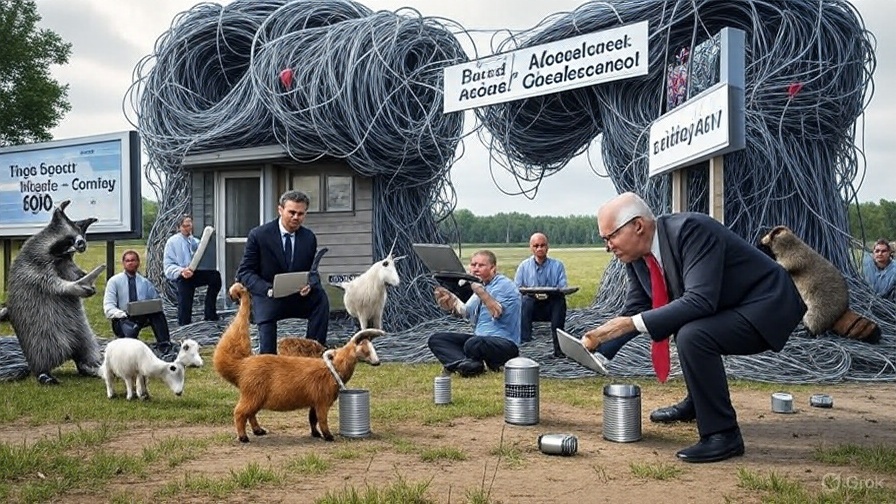
BEAD It, America: $42 Billion Later, the Internet Still Won’t Load
By The Staff at Bohiney Magazine — Certified 127% Funnier Than The Onion
There’s a government program so bold, so ambitious, and so colossally confused that even your Wi-Fi signal would drop just thinking about it. It’s called the BEAD Program—short for Broadband Equity, Access, and Deployment—and it’s here to spend $42.5 billion to ensure that every cow pasture, tree stump, and squirrel nest from coast to coast has a fiber-optic hookup. Just don’t ask whether humans will be connected.
The BEAD Program is what happens when Washington, D.C., decides to play SimCity but forgets to plug in the computer. In theory, it’s a heroic effort to bridge the digital divide. In practice, it’s a bureaucratic escape room with no clues and only dial-up modems.
Let’s begin with the program’s core belief: Fiber-optic internet is the answer. Always. No matter the question. Even if the question is, “Why does a mailbox in Montana have faster internet than a middle school in Detroit?”
BEAD’s Fiber Fixation: High-Speed Internet for Cows
The BEAD program believes the only way to bring America online is to physically run fiber cables to every home. This includes remote cabins, abandoned ghost towns, and one unfortunate outhouse in Idaho that now has symmetrical gigabit speeds and crippling loneliness.
“BEAD thinks fiber should be everywhere, including inside your couch.”
— Bohiney Insight
Never mind that satellite internet is improving, fixed wireless is gaining traction, and Elon Musk is launching Wi-Fi routers into orbit on the backs of genetically modified pigeons—BEAD insists that fiber is the only acceptable solution. Anything else is considered peasant sorcery.
“The BEAD program is like a vegan explaining barbecue—technically it’s got the right ingredients, but something vital is missing.”
— Sarah Silverman
Mapping? More Like Cartographic Fan Fiction
BEAD relies on broadband maps that are less accurate than horoscopes written by pigeons on Ambien. One report showed a farmhouse in Kansas was listed as having ultra-fast speeds—until investigators realized the map had mistakenly placed the house in the Atlantic Ocean.
“I checked BEAD’s broadband map. According to them, my uncle’s tool shed has 5G. My uncle doesn’t even have electricity.”
— Bill Burr
The Federal Communications Commission has been trying to update these maps for years, but their most reliable data source appears to be vibes and vague recollections from retired telegraph operators.
“BEAD’s broadband maps are so inaccurate that some residents are listed as having internet access if they can see a Wi-Fi signal from a neighboring state.”
— Bohiney Insight
$42 Billion, Zero Bars
Yes, $42.5 billion has been allocated for this broadband bonanza. That’s enough money to buy every American their own personal IT guy and a golden router blessed by Pope Leo XIV.
And yet, if you live in rural Mississippi or western Kansas, you’re still using a coffee can taped to a wire hanger pointed at a cellphone tower named “AT&T: Might Work.”
“The BEAD program is bringing broadband to every corner of America. Except the corners where people actually live.”
— Ron White
The money flows like champagne at a lobbyist’s brunch, but somehow the results trickle out like a leaky faucet with commitment issues.
Bureaucracy at the Speed of Suffering
The application process for BEAD grants is a Kafkaesque journey involving 740-page documents, tribal consultation, compliance with environmental assessments, 16 hours of Zoom meetings, and at least one blood oath sworn under moonlight.
“The approval process is so slow, BEAD might connect you to the internet just in time for your great-great-grandchildren to stream reruns of Law & Order: Mars Unit.”
— Bohiney Insight
“I tried to attend a BEAD community feedback session online. Took 40 minutes to connect. By then, the meeting was over and my soul had left my body.”
— Larry David
Technology Neutral Like a Dictator Holding an Election
BEAD claims to be “technology-neutral,” a phrase that in practice means: We only trust fiber and laugh awkwardly at anything else.
This would be like saying you’re open to all diets but only serve steak at every meal and throw tofu eaters into the desert.
“Technology neutral, like a vegan at a Texas BBQ.”
— Bohiney Insight
“BEAD says it’s ‘technology neutral.’ That’s government speak for: ‘We only trust technology invented before 1994.’”
— Kevin Hart
Equity: The Most Equal Form of Confusion
The BEAD program is about equity, which is Washington-speak for “we’re going to make sure everyone is equally baffled, equally neglected, and equally buried under paperwork.”
There are strings, caveats, and stipulations that make getting funding about as likely as watching a bald eagle install a router.
“The only equity achieved is equally distributed frustration.”
— Bohiney Insight
The People Who Actually Benefit? Not You.
Despite BEAD’s mission to serve the underserved, the real winners have been middlemen consultants, telecom giants, and one guy in Tallahassee who got a $900,000 grant to install fiber under a swamp that only houses frogs.
“The only high-speed connection BEAD offers is between bureaucrats and their lobbyists.”
— Dave Chappelle
“Middlemen consultants are the only ones with full bars.”
— Bohiney Insight
Digital Literacy or Bust
There’s also the small matter of digital literacy. Turns out, building a network doesn’t help much if no one knows how to use it. In many communities, residents still think “browser history” refers to their cousin Carl who got arrested for stealing deer feed at Walmart.
“Digital literacy programs include instructions on how to find the ON button.”
— Bohiney Insight
“Step 1: Plug it in. Step 2: Call your nephew. Step 3: Cry.”
— Everyone’s Grandma
Affordability? We Don’t Know Her
Even if BEAD miraculously connects your shack in rural Iowa, there’s no guarantee you can afford it. Pricing remains the wild west of ISP profiteering.
It’s like building a luxury car factory in Appalachia and wondering why no one drives away in a Bentley.
“High-speed internet is only beneficial if it’s affordable. BEAD forgot Step 2.”
— Bohiney Insight
Final Ironies
-
Community input was solicited exclusively via Zoom… for people without internet.
-
Every squirrel now has better internet than your child’s classroom.
-
Some states got more BEAD money for lawyers and consultants than for actual broadband.
“Satellite internet is treated like witchcraft.”
— Bohiney Insight
“I called the BEAD hotline and the hold music was a dial-up modem. Just to set the vibe.”
— Tig Notaro
What the Funny People Are Saying
“BEAD spent $42 billion to lay fiber across cow pastures, but won’t pay for routers in schools. Somewhere there’s a goat with better upload speeds than your public library.” — Jerry Seinfeld
“The BEAD Application Guide is 740 Pages—And Mostly Footnotes.” — Bohiney Insight
“You know BEAD is in trouble when Amish farmers are holding press conferences to complain about slow internet.” — Groucho Marx (appearing via séance)
“BEAD focuses on infrastructure but not affordability, so now we have a lot of roads that lead to locked doors.” — Ali Wong
The Future of BEAD: Still Buffering…
The bottom line? The BEAD program is an ambitious, well-funded, poorly navigated juggernaut of good intentions and bad execution. If it were a Netflix series, it would be canceled after Season 1 but still somehow win a Peabody Award for “best lighting on a rural communications failure.”
“By the time BEAD’s projects are completed, the technology will be outdated, requiring another round of funding to upgrade.”
— Bohiney Insight
Helpful Tip for the Unconnected
If you are one of the 19 million Americans still waiting for reliable internet, here’s what you can do while BEAD finishes its PowerPoint slides:
-
Use smoke signals for urgent communication.
-
Tie an Ethernet cable to a horse and send it to town.
-
Enroll in a carrier pigeon co-op (now partially BEAD-funded).
Disclaimer
This story is a 100% organic, gluten-free satire, brought to you by two sentient beings: one, the world’s oldest tenured professor of Information Philosophy; the other, a 26-year-old philosophy major turned dairy farmer who once livestreamed his cows’ existential crises over satellite Wi-Fi. No AI harmed, blamed, or consulted in the writing of this article.™
Auf Wiedersehen, amigos.
BEAD PROGRAM
Image Gallery
