

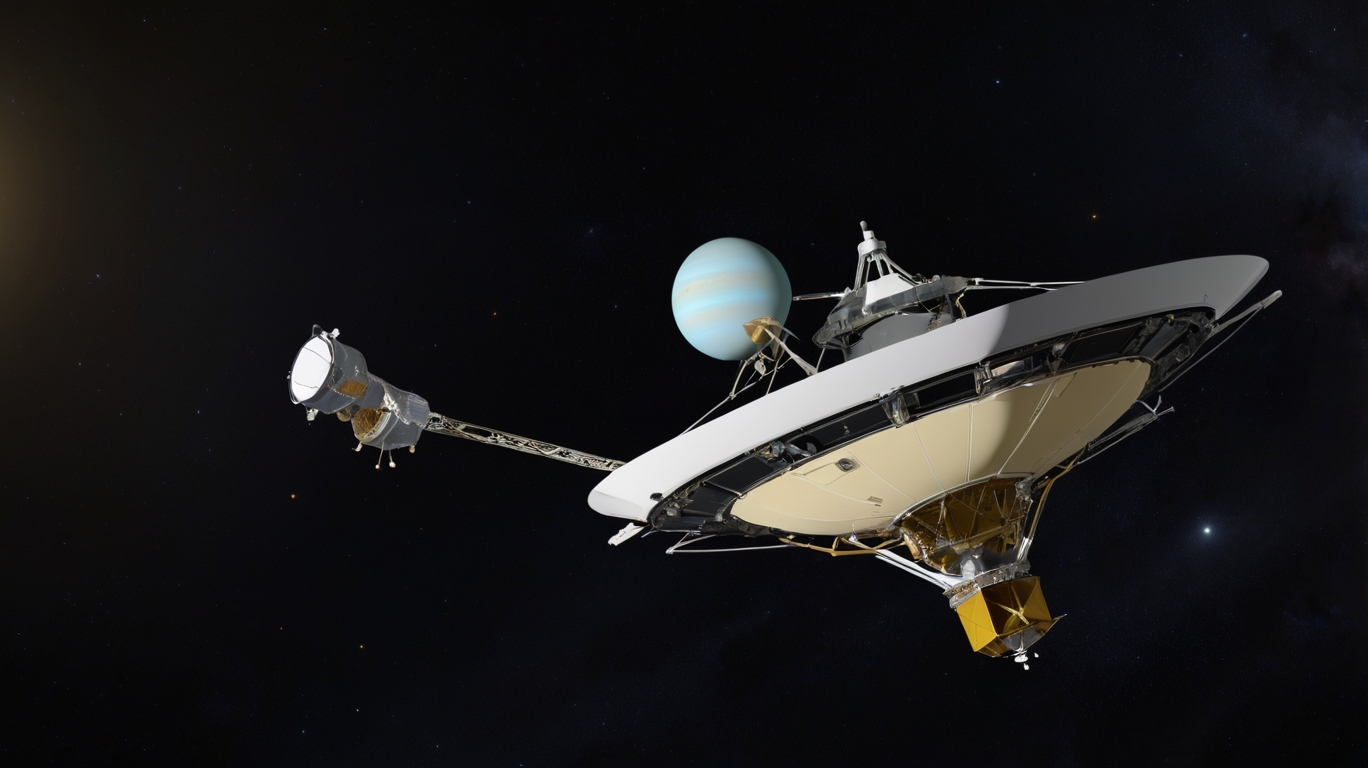
Voyager 1 to Exit Solar System in 300 to 30,000 Years — NASA Proudly Announces It’s Not in a Hurry
Dateline — Pasadena, CA:
In a press conference that could only be described as “optimistically glacial,” NASA officials have confirmed that Voyager 1, humanity’s most famous interstellar probe, will either reach the edge of our solar system in a breezy 300 years or, if it hits “light interstellar traffic,” a leisurely 30,000 years. The range, officials say, “is not so much a calculation as a vibe.”
The news has sparked global debate, with reactions ranging from mildly fascinated to already asleep. But in the tradition of great satirical journalism, we went deep—interviewing astrophysicists, long-haul truckers, medieval historians, conspiracy podcasters, and at least one guy selling churros outside NASA headquarters—to bring you the full picture.
A Race Against Nobody
NASA insists Voyager 1 is “right on schedule,” despite having left Earth in 1977, the same year Fleetwood Mac released Rumours. In fact, NASA Jet Propulsion Laboratory director Dr. Corinne Ellsworth told reporters, “There’s no rush. Space is big, empty, and has terrible Yelp reviews. We’ll get there when we get there.”
Voyager’s mission has become a kind of interstellar equivalent to the guy who leaves a party, spends 45 minutes saying goodbye in the driveway, and then remembers he left his jacket inside.
“Thirty thousand years is nothing in cosmic time,” said Dr. Hugo Patel, a cosmologist we reached via a suspiciously fuzzy Zoom call. “Of course, it’s everything in human time. Your great-great-great-great-great—keep going for another hundred greats—grandkids will still be reading status updates from Voyager. Assuming Facebook hasn’t rebranded as SkyMind by then.”
The Great 300 vs 30,000 Debate
NASA’s range of 300 years vs 30,000 years has left the public confused.
“That’s not a range, that’s a hostage negotiation,” complained Janice Lemming, a self-described “space enthusiast” who runs the Facebook group Voyager Watchers: The Slow Burn. “It’s like telling me my Uber will arrive in ‘three minutes or maybe next month.’”
According to leaked memos from inside NASA—slipped under our newsroom door by “an anonymous intern who definitely isn’t high right now”—the reason for the vague timeline is part science, part budget math. The memos reveal engineers arguing over whether “exiting the solar system” means crossing the Oort Cloud or just waving at it from a polite distance.
Comedian Corner — What the Funny People Are Saying
- “300 years? I’ve had airline connections in Atlanta that took longer.” — Ron White
- “30,000 years? Voyager’s just trying to beat my grandmother’s estimated time of arrival to Thanksgiving dinner.” — Jerry Seinfeld
- “NASA’s like that friend who says they’re on their way but hasn’t even showered yet.” — Bill Burr
- “At this rate, Voyager’s gonna pass Pluto, turn around, and ask if it left the oven on.” — Sarah Silverman
- “The probe’s not lost, it’s just emotionally unavailable.” — Ricky Gervais
- “Voyager’s the only thing slower than a group text deciding on a restaurant.” — Ali Wong
- “30,000 years? That’s how long my wife takes to get ready to leave the house. Love you, honey.” — Kevin Hart
- “The Oort Cloud isn’t a place—it’s a punchline.” — Trevor Noah
- “Voyager is basically an interstellar couch surfer, overstaying its welcome.” — Chris Rock
- “NASA could’ve sent me with a jetpack. I’d be there by now.” — Dave Chappelle
- “Space is the only place where being fashionably late is measured in millennia.” — Tig Notaro
- “Voyager’s not on a mission; it’s on a gap year that’s gotten way out of hand.” — Larry David
Public Reaction: “Wake Me Up When It Gets There”
A recent poll conducted by the Filibuster the Obstruct Magazine Institute for Pointless Metrics found that 68% of Americans assumed Voyager 1 had already left the solar system, 21% thought it was a clothing brand, and 11% believed it was a “sci-fi Netflix thing with that guy from Stranger Things.”
In Manila, a local radio caller summed it up: “If Voyager is supposed to represent humanity, it’s doing a good job—wandering aimlessly, sending mixed signals, and taking forever to commit.”
A Timeline That Defies… Timelines
To better understand Voyager’s journey, we consulted Dr. Lila Stern, a historian of human procrastination.
“By the time Voyager reaches the Oort Cloud, civilizations will have risen and fallen, languages will have evolved, and whatever TikTok is by then will be run entirely by plankton,” Stern said. “It’s the perfect metaphor for humanity: ambitious, inspiring, and pointlessly slow.”
Her department at the University of Chicago is reportedly planning a “Welcome Home Voyager” committee for the year 32,025. Their motto: Assuming Humans Still Exist, Which is Optimistic.
The International Angle
France has offered to throw Voyager a going-away party—next century—complete with wine made from grapes not yet planted. Meanwhile, China has promised to overtake Voyager with a “faster, better, cheaper” probe by 2085, or “whenever we feel like it.”
Russia, for its part, claimed Voyager 1 is “probably spying” and offered to tow it out of the solar system for a “modest fee.”
The Budget Question
Critics have questioned whether it’s worth continuing to fund communications with a probe that will take longer to leave the solar system than it took for modern humans to evolve.
NASA Administrator Dr. Anita Graves dismissed concerns, saying, “For the price of a single Hollywood blockbuster, we can keep pinging Voyager for another decade. Besides, half our scientists would quit if they couldn’t start meetings by saying, ‘As Voyager approaches interstellar space…’”
The Human Side of Voyager
We tracked down 93-year-old Henry Sloane, one of the original engineers who worked on Voyager’s launch. Speaking from his retirement home, he said: “We built Voyager to last. We didn’t build it to hurry. If you want speed, talk to Elon Musk. He’s probably working on a probe with leather seats and a cupholder.”
Henry added, “If Voyager were my kid, I’d tell it, ‘Don’t rush. The edge of the solar system isn’t going anywhere.’ Then again, neither are you.”
The Conspiracy Theories
Inevitably, conspiracy theories have emerged. One popular online forum insists Voyager isn’t leaving at all—it’s circling back to deliver “space mail” to the Illuminati. Another claims it will trigger “the Big Reset” upon hitting the Oort Cloud, causing all Wi-Fi to reboot.
We asked one self-proclaimed “ex-intelligence officer” about the 30,000-year figure. He leaned in and whispered, “That’s just what they tell you. In reality, the Oort Cloud is classified as a private golf resort for billionaires.”
NASA’s PR Strategy: Lean Into the Slow
Rather than shy away from criticism, NASA has embraced Voyager’s sluggishness. They’ve started selling merch with slogans like:
-
“Voyager 1: See You in 30,000!”
-
“Proud to Be Late.”
-
“Oort or Bust (Eventually).”
At the press event, an intern handed out T-shirts that read: I waited 30,000 years and all I got was this lousy probe.
Relationship Analogy
If Voyager 1 were a romantic partner, it would be the kind who texts “on my way” but hasn’t left the house. It’s committed—sort of. It sends you mixtapes (data) and postcards (images of Saturn)—but you can’t help wondering if it’s ever really going to show up where it promised.
NASA insists this is “healthy space dating.” Critics call it “ghosting at light-hours.”
In the End, It’s About Perspective
Whether it’s 300 years or 30,000, Voyager 1 represents a rare human moment: we flung something into the void, and it’s still going. It’s out there, surviving, humming along, sending little beeps to say, Hey, I’m alive—like the world’s slowest Instagram influencer.
Will we be around to see it leave? Probably not. But somewhere, 30,000 years from now, some alien teenager might stumble across it and say, “Who left this junk here?” And that, friends, will be our legacy.
IMAGE GALLERY
