

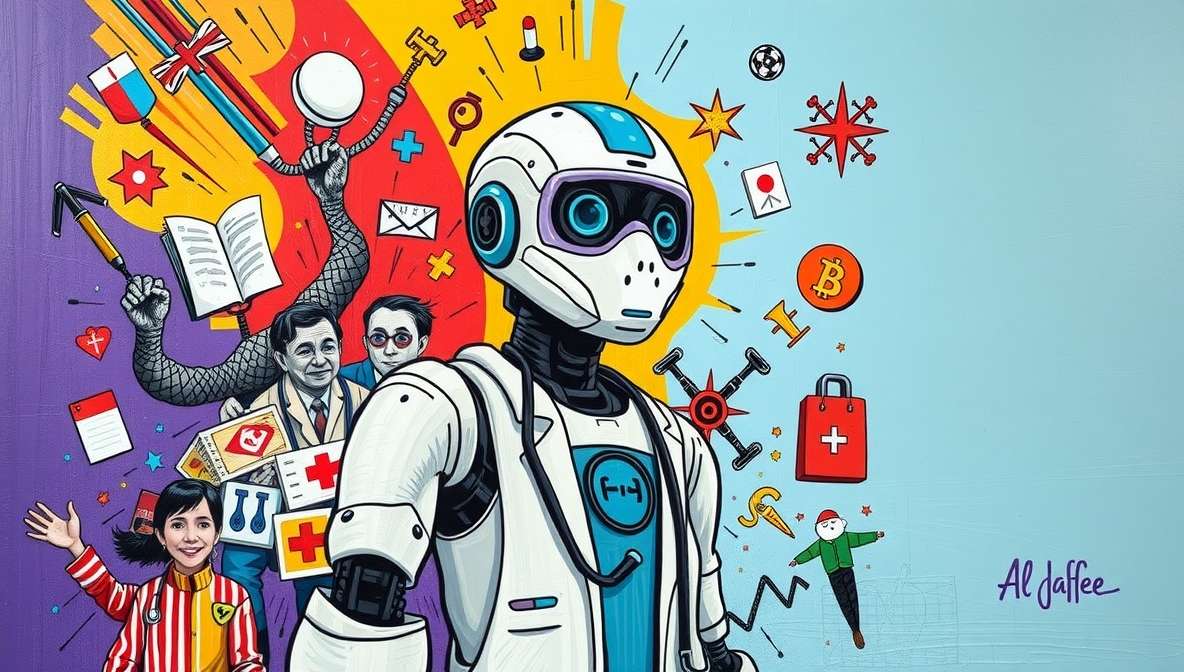
OpenAI Launches Health Assistant: Because WebMD Anxiety Wasn’t Quite Enough
OpenAI announced plans this week to develop a personal health assistant powered by artificial intelligence, promising to revolutionize how Americans convince themselves they are dying from minor symptoms. The new tool will analyze medical data, summarize health records, and provide personalized wellness insights without technically diagnosing anything, maintaining plausible deniability while maximizing hypochondria.
AI Enters Healthcare Without Medical License
The company claims its health assistant will help users understand complex medical information without crossing into diagnostic territory, which sounds suspiciously like asking someone to explain car problems without admitting the engine is broken. Tech industry analysts suggest this careful wording reflects OpenAI’s desire to avoid the regulatory nightmare that comes with actually practicing medicine.
Jerry Seinfeld said, “An AI health assistant that can’t diagnose is like a weather forecaster who can’t predict weather. What’s the point? ‘Your symptoms suggest something, but I’m legally not allowed to say what. Good luck with that!'”
WebMD Competition Intensifies
The announcement positions OpenAI in direct competition with WebMD, the internet’s reigning champion of convincing healthy people they have rare tropical diseases. While WebMD has spent decades perfecting the art of symptom panic, OpenAI brings the added benefit of conversational AI that can explain, in excruciating detail, all the terrible things that might be wrong with you.
Dave Chappelle said, “OpenAI wants to compete with WebMD? That’s bold. WebMD already has Americans convinced every headache is a brain tumor. What’s OpenAI going to do, add footnotes and citations to the panic?”
Responsible Use Cases Carefully Defined
Company officials emphasize they are building partnerships and internal teams to explore “responsible use cases,” which in healthcare technology typically means “ways to make money without getting sued.” The AI will retrieve medical knowledge, simplify communication with doctors, and empower users with actionable health data, assuming users do not immediately panic and schedule unnecessary emergency room visits.
Amy Schumer said, “Empowering users with health data sounds great until you realize most people use that power to diagnose themselves with everything they find on the internet. It’s like giving a toddler a loaded weapon and calling it ‘responsible parenting.'”
Privacy Concerns Meet Healthcare Regulations

Entering the healthcare sector means navigating HIPAA regulations, privacy laws, and the general minefield of handling sensitive medical information. OpenAI must convince both regulators and users that their AI will protect health data while simultaneously analyzing it in ways that definitely sound like they are reading your medical diary.
Bill Burr said, “You’re going to give your medical history to an AI company? What could go wrong? Next thing you know your hemorrhoid cream purchases are being used to train the next generation of chatbots. Fantastic.”
The company promises robust data protection, though recent history suggests tech companies view privacy agreements the way most people view terms of service: something to click through quickly before accessing the actual product.
Google and Apple Already in Healthcare Game
OpenAI’s entry into healthcare puts them in competition with Google DeepMind and Apple Health, companies that have spent years convincing users to share intimate health details in exchange for pretty charts and occasional fitness reminders. The market for AI health assistants appears crowded, though apparently there is always room for one more company promising to revolutionize medicine without technically practicing it.
Chris Rock said, “Tech companies all want to fix healthcare now? Where was this energy when we actually needed affordable insulin? Oh right, there’s no subscription model for insulin. My bad.”
Diagnostic Territory Carefully Avoided
OpenAI stresses that its health assistant will not provide diagnoses, maintaining a legal distinction roughly as meaningful as claiming a fortune teller provides “entertainment purposes only.” The AI will analyze symptoms, suggest possible explanations, and recommend consulting a doctor, which is basically a diagnosis with extra steps and better lawyers.
Ricky Gervais said, “Not providing diagnoses? So it’s like having a really educated friend who knows exactly what’s wrong with you but refuses to say it out loud. Brilliant. Nothing frustrating about that at all.”
Telemedicine Integration Planned
The system will reportedly integrate with telemedicine platforms, allowing users to share AI-generated health summaries with actual doctors who spent eight years in medical school and probably do not appreciate being second-guessed by a chatbot. Physicians have expressed mixed enthusiasm, ranging from “cautiously optimistic” to “please god no more patients showing up with printouts from the internet.”
Kevin Hart said, “Doctors are excited about AI health assistants the same way cab drivers were excited about Uber. Which is to say, not at all. Nobody wants a robot doing their job, especially when that robot never went to medical school.”
Pharmaceutical Companies Watch With Interest
Drug manufacturers are monitoring OpenAI’s healthcare push with interest, seeing potential opportunities to advertise medications through AI recommendations. Imagine an AI health assistant that not only identifies your symptoms but conveniently suggests specific brand-name treatments, complete with friendly reminders that you should “ask your doctor” about them.
Trevor Noah said, “An AI health assistant sponsored by pharmaceutical companies? So it’ll tell me I have social anxiety disorder and then recommend the most expensive treatment available? At least WebMD makes me panic for free.”
Mental Health Features Raise Eyebrows
Plans include mental health support features, which raises fascinating questions about whether AI therapy constitutes actual therapy or just very expensive journaling with a robot. Mental health professionals note that while AI can provide supportive conversations, it cannot replace human therapists, though it may successfully replace the friend who always says “have you tried yoga?”
Sarah Silverman said, “AI therapy sounds perfect for people who want all the emotional vulnerability of therapy without the inconvenience of human connection. Finally, technology that lets us be sad and alone together!”
Insurance Companies Explore Integration Options
Health insurance providers are investigating whether AI health assistants could reduce costs by encouraging preventive care or, more likely, by finding new creative ways to deny claims. The technology promises to identify health issues early, assuming users can afford to address those issues once the AI points them out.
Jo Koy said, “Insurance companies love AI healthcare? Of course they do. Now they can use algorithms to tell you you’re sick and also why they’re not covering the treatment. Efficiency!”
Accuracy Concerns Remain Unaddressed
Critics note that AI systems occasionally hallucinate information, a problematic feature in healthcare contexts where accuracy matters slightly more than in casual conversation. OpenAI insists its health assistant will be rigorously tested, though they have yet to explain how they will prevent the AI from occasionally inventing medical conditions that sound plausible but do not exist.
Tiffany Haddish said, “AI that hallucinates medical information? So it’s like that friend who went to nursing school for one semester and now diagnoses everyone at parties. Except worse because people might actually believe it.”
Wellness Recommendations Based on Data Analysis
The AI will provide personalized wellness recommendations based on individual health data, which sounds helpful until you realize it is essentially a very sophisticated nag about diet and exercise. Users can expect helpful suggestions like “eat more vegetables,” “exercise regularly,” and “stop staying up until 3 AM watching reality television,” advice that humans have been successfully ignoring for decades.
Nate Bargatze said, “An AI telling me to exercise and eat better? I already have a doctor for that. And a mom. And a spouse. And that one coworker who won’t shut up about CrossFit. How many voices of disappointment does one person need?”
Liability Questions Complicate Rollout
Legal experts wonder who bears responsibility when AI health advice goes wrong. If the assistant suggests something that harms a user, does OpenAI face liability? The doctor who trusted the AI summary? The user who followed the advice? All of the above? Healthcare attorneys are presumably salivating over the billable hours this technology will generate.
Tom Segura said, “Nobody knows who’s responsible when AI healthcare fails? Perfect. That’s exactly the kind of legal ambiguity I want when dealing with my health. Really inspires confidence.”
Data Training Raises Privacy Questions
OpenAI must train its health AI using vast amounts of medical data, raising questions about where that data comes from and whether users know their health information is teaching robots to identify illnesses. The company promises ethical data sourcing, a phrase that inspires roughly the same level of confidence as “military intelligence” or “jumbo shrimp.”
Bert Kreischer said, “They need medical data to train the AI? So somewhere my embarrassing health questions are being used to teach a computer about humanity’s grossest problems. At least I’m contributing to science, I guess.”
Subscription Model Almost Certainly Coming
While OpenAI has not announced pricing, industry observers expect a subscription model similar to ChatGPT Plus. Nothing says “accessible healthcare” quite like charging monthly fees to access medical information, continuing America’s proud tradition of putting price tags on basic human needs.
Ron White said, “A subscription for health advice? So now we’re paying monthly fees to be told we’re unhealthy? I can get that for free from my mirror every morning. But sure, let’s add another subscription to the pile.”
Doctors Express Cautious Skepticism
Medical professionals remain divided on AI health assistants. Optimists see potential for reducing physician workload and improving patient education. Pessimists envision waiting rooms full of patients clutching AI-generated symptom lists demanding specific tests for conditions they definitely do not have.
Gabriel Iglesias said, “Doctors are skeptical about health AI? Smart. They already deal with patients who diagnosed themselves on Google. Now those patients will have an AI co-signer on their bad ideas. Double the misinformation, double the fun!”
The American Medical Association has issued guidelines for AI healthcare tools, essentially saying “this could be helpful or disastrous, so please be careful.” This diplomatic statement satisfies nobody but avoids taking any controversial position that might age poorly.
Launch Timeline Remains Vague
OpenAI has not specified when the health assistant will launch, using the classic tech company strategy of announcing products years before completion to gauge market reaction and scare competitors. Early access will likely go to select partners, meaning actual users will see the product sometime between next year and the heat death of the universe.
Hasan Minhaj said, “OpenAI announced a health assistant but won’t say when it launches? That’s the medical equivalent of ‘I’ll call you’ after a bad first date. We’ll believe it when we see it, and even then we’ll be skeptical.”
As AI continues creeping into every aspect of daily life, healthcare seems inevitable. Whether OpenAI’s health assistant becomes a useful tool or simply WebMD with better conversation skills remains to be seen. Either way, Americans can look forward to a future where computers join doctors, Google, and concerned relatives in the time-honored tradition of telling people what might be wrong with them.
Auf Wiedersehen, amigos.