

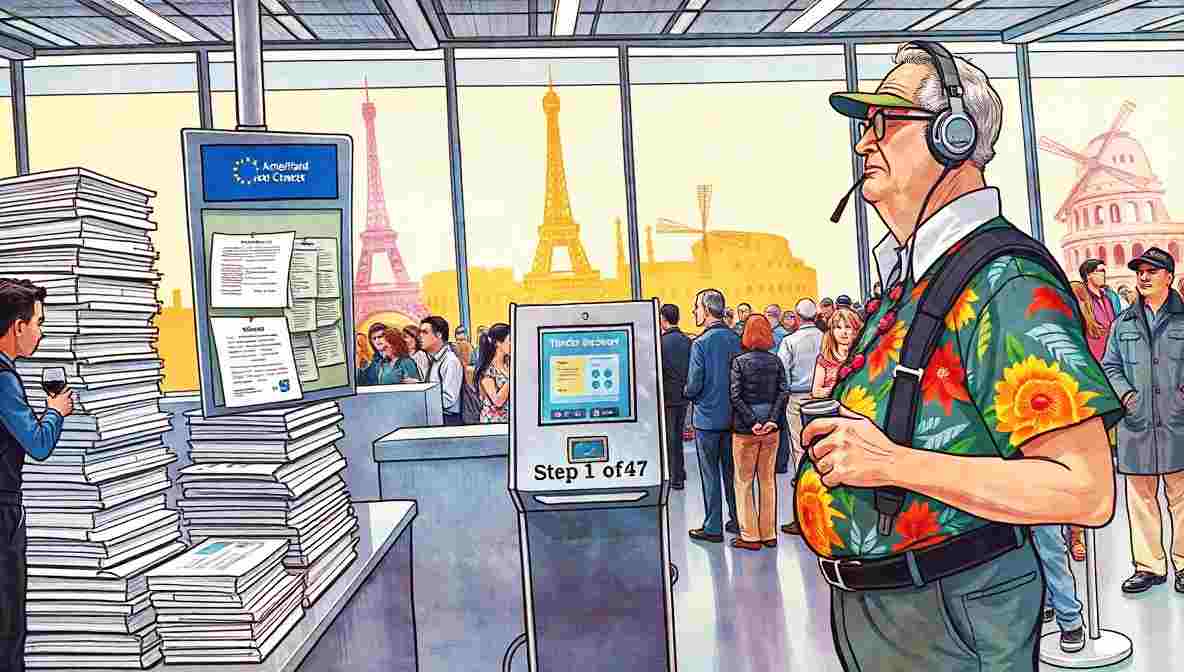
America’s Favorite Vacation Destination Just Made It Harder to Show Up With a Fanny Pack
Europe’s New Biometric Border System Is Here, and It Already Has a Seven-Hour Line
For seventy years, the deal between Americans and Europe was beautifully simple: show up, flash a passport, find a café, pretend to understand the menu. No appointments. No fingerprint kiosks. No government database quietly filing your face next to your entry date like a very sophisticated hall monitor.
That era is over.
The European Union has launched the Entry/Exit System (EES) — a fully automated biometric border tracking apparatus that replaces passport stamping with digital fingerprint scans, facial recognition, and an EU database that will store your travel history for three years. The rollout began October 12, 2025. Full mandatory compliance kicked in April 10, 2026. And the early results, as any traveler stranded at Lisbon Airport for seven hours can confirm, have been spectacular.
What Americans Are Now Required to Do Just to Eat Pasta in Rome

Here is the new American tourist experience, as designed by European committee:
According to the U.S. State Department, American visitors to Schengen Zone countries must now submit fingerprints, a facial scan, passport details, and entry and exit dates into the EU’s centralized database upon arrival. No fee is charged for this — Europe is collecting your biometrics as a courtesy. The fingerprint data is stored for three years. Future border crossings will match your face against stored records, which officials describe as “faster,” and which travelers describe as “unsettling.”
And that is only Phase One.
Phase Two — the European Travel Information and Authorization System (ETIAS) — launches in late 2026. Americans will then be required to apply online before departure, pay a €20 fee, answer security questions, submit personal and travel history information, and wait up to 96 hours for approval. Some applications may take thirty days. Officials describe this as “streamlined.” Travelers describe it as “applying for a job you didn’t want.”
To summarize: Americans, who have traveled to Europe visa-free for over seven decades, will soon need a biometric border scan on arrival and a pre-approved digital travel permit before they board. Europe calls this a modernization. Cancún calls it a marketing opportunity.
The Seven-Hour Line Nobody Warned You About
If European officials hoped the rollout would be invisible to tourists, Lisbon did not cooperate.
Reports from February 2026 confirmed queue times of up to seven hours at Lisbon Airport, five to six hours at Geneva, and three-hour backups at Madrid, Barcelona, Paris Charles de Gaulle, and Prague. Lisbon temporarily suspended EES processing entirely after the lines became medically inadvisable. Border processing times increased by up to 70 percent compared to pre-EES checkpoints, according to industry group ACI Europe. Officials say software updates are underway. Travelers say they missed their connections.
Ohio tourist Mark Bender, attempting to upload his passport to three separate government websites at O’Hare International, was philosophical about the situation.
“I thought Europe was the place where you just show up and drink wine,” Bender said. “I didn’t realize I had to apply for permission to eat pasta.”
A family from Texas had a similar realization while attempting biometric registration on a smartphone at the gate. “We were trying to plan a vacation,” said traveler Lisa Caldwell. “Now it feels like we’re applying for NATO membership.” Her husband quietly booked Cancún. He is not sorry.
EES vs. ETIAS: Europe’s Two-Headed Bureaucracy Dragon
Americans navigating the new system face an important distinction that Europe has done very little to make obvious.
EES and ETIAS are entirely separate systems doing entirely different things. EES captures your biometrics when you arrive. ETIAS pre-screens you before you leave home. Americans will eventually need both. EES is already operational. ETIAS launches late 2026. Travelers visiting the UK also need a separate UK Electronic Travel Authorization — the British, never ones to be left out of paperwork — which became mandatory for Americans on February 25, 2026, costs £16, and is valid for two years.
To enter Europe by late 2026, an American tourist will need: a valid biometric passport, a UK ETA if visiting Britain, an ETIAS authorization before departure for the EU, and EES biometric enrollment upon Schengen arrival. Four separate systems. Three separate databases. One vacation.
Dr. Ingrid Halvorsen, a travel policy researcher at the Nordic Institute for Administrative Complexity, offered historical context.
“European governments have a long tradition of solving simple problems with complicated forms,” Halvorsen said. “It is part of the cultural heritage.” She noted the system will definitely create jobs. Mostly for airport queue managers. And chiropractors treating people who stood in line for seven hours.
The Biometric Passport Problem Nobody Mentioned Until Now
There is one additional detail burying itself in the fine print: EES self-service kiosks require a biometric passport — one containing a chip with embedded data. Americans without a biometric passport cannot use the self-service lanes and must queue for manual processing, which is currently running somewhere between “inconvenient” and “you are going to miss dinner.”
The U.S. State Department estimates that a significant portion of American travelers are carrying older, non-chip passports. These travelers will discover their error approximately forty-five minutes into a Frankfurt arrival queue, at which point the discovery will feel less like a minor administrative issue and more like a personal betrayal by the entire concept of international travel.
Passport renewal offices are, predictably, booked solid through August.
The Economics of Making Your Best Customer Fill Out More Forms
Economists observing the situation have begun doing the math that tourism ministers have been avoiding.
Professor Claudia Rinaldi of the European Tourism Economics Council explained the risk bluntly. “The average American tourist brings several thousand dollars in spending to Europe,” she said. “If that tourist must complete fourteen digital forms and attend a biometric appointment, some will simply choose Italy’s competitor… Florida.” She noted that just 36 percent of long-haul travelers have locked in European plans for 2026, down from 39 percent in 2025. Analysts say the new requirements are “a contributing factor.” Florida’s governor issued no formal response but was seen smiling broadly at a press conference unrelated to Europe.
Tourism consultant Patrick Doyle summarized the core miscalculation: “Tourists don’t mind security. They just prefer security that doesn’t feel like filing taxes in another language.” Europe, for its part, insists the experience will improve once the software stabilizes, the kiosks multiply, and airport staff finish training. Officials project this will be “soon.” They have been projecting “soon” since 2021, when ETIAS was first announced and then delayed five consecutive times.
What the Funny People Are Saying About Europe’s Biometric Vacation Experience
“Europe invented bureaucracy the way Italy invented pasta. They just kept adding layers until nobody knew where it started.” — Jerry Seinfeld
“Europe is the only place where a vacation requires more paperwork than a mortgage.” — Ron White
“If Americans need biometric clearance to visit Europe, I assume Europeans need a personality test to visit Texas.” — Bill Burr
“Nothing says ‘welcome to our culture’ like a retinal scan and a government portal that crashes in three languages.” — Ricky Gervais
The New American Pre-Trip Checklist for Europe 2026
Travel insiders say the modern American vacation to Europe now begins approximately six weeks before departure. Step one: confirm you have a biometric passport with a chip. Step two: apply for a UK ETA if your itinerary includes Britain. Step three: apply for ETIAS before departure once it launches in late 2026. Step four: arrive at the airport three hours early to account for EES biometric processing. Step five: locate the correct government kiosk, which will be either broken, occupied, or located in a terminal you are not in. Step six: successfully register your fingerprints, facial scan, and existential fatigue. Step seven: board the plane. Step eight: arrive in Europe, receive a cappuccino, and immediately forgive the entire experience. Step nine: tell everyone it was smooth. It was not smooth. You blocked it out.
Keywords
EES, biometrics, ETIAS, Schengen, Americans, border delays, fingerprints, travel authorization, passport reform, airport queues, tourism 2026, American tourists, European travel, biometric passport, travel chaos
This article is satire and commentary intended to explore the absurdities of modern travel bureaucracy. The story is entirely a human collaboration between two sentient beings: the world’s oldest tenured professor and a philosophy major turned dairy farmer, who together have spent decades studying the strange relationship between tourism, government paperwork, and the universal human desire to skip the forms and go straight to the beach.
Auf Wiedersehen, amigo!