

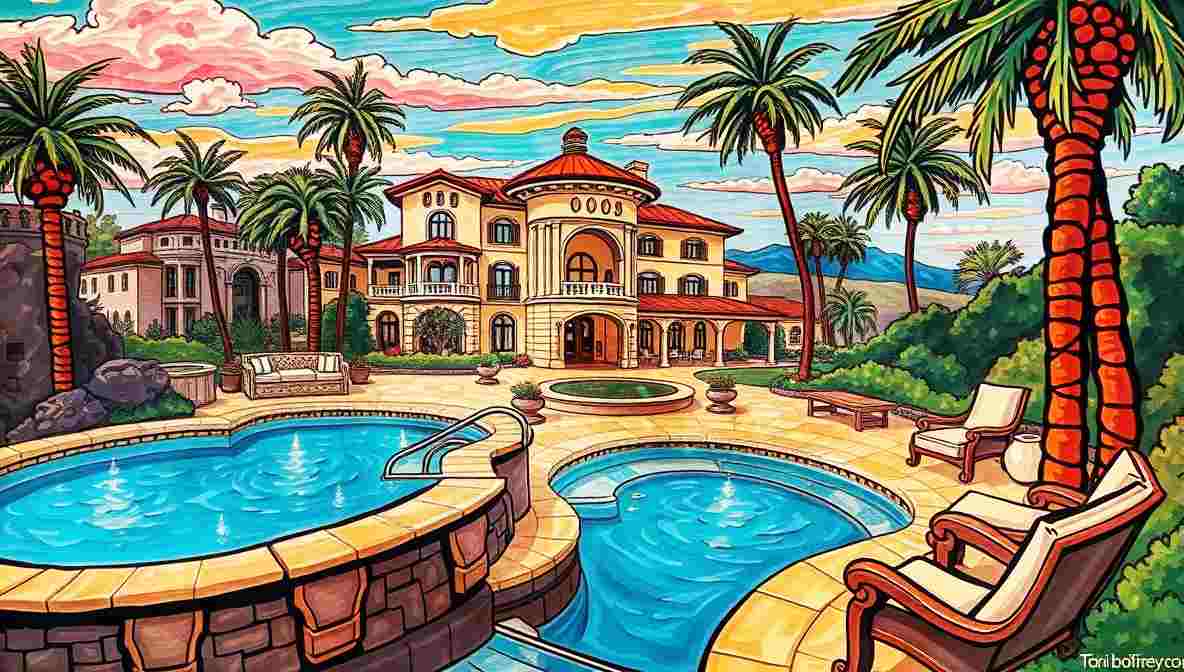
Fifteen Humorous Observations About Billionaires and Their Decorative Castles
The Observations Themselves, Presented Without Apology
- Zuckerberg bought a house so expensive that even the mosquitoes in Indian Creek now carry private equity.
- A $170 million waterfront compound is what happens when a man says, “I just want something modest,” and nobody nearby is brave enough to laugh.
- Every luxury house in America now comes with the same three amenities: a dock, an elevator, and enough bathrooms to avoid sincerity forever.
- Indian Creek is called the Billionaires’ Bunker because “Tax-Deductible Atlantis” was apparently too honest.
- A 27,889-square-foot mansion is less a home and more a polite refusal to ever accidentally see your family.
- Ivana Trump’s townhouse sold for $14 million, proving that in Manhattan even grief gets appraised by the square foot.
- The phrase “hefty discount” only appears in real estate when rich people lose $12 million and still call it a classy Tuesday.
- David Lynch’s compound selling for $13 million suggests America still believes a house should either contain a breakfast nook or a portal to spiritual confusion.
- The Walter White house finally sold because nothing says “dream home” like suburban stucco plus a lingering sense of federal investigation.
- Sean Hannity listing a $44.9 million estate confirms that outrage remains one of the most reliable cash crops in America.
- Chris Hughes selling a Kalorama mansion proves that even former Facebook founders eventually tire of living in a building with more bathrooms than political principles.
- Luxury listings always mention “fire pit,” as if billionaires gather around flames to discuss mortality like normal campers with a trillion-dollar hedge.
- Real estate agents never say “house.” They say “compound,” which is what you call a property when the gate is bigger than a public school.
- The ultrawealthy love South Florida because it offers the three things every billionaire needs: sunshine, seawalls, and a state government that asks no follow-up questions.
- Ordinary Americans read celebrity real estate stories the way medieval peasants watched passing carriages: with awe, suspicion, and a strong desire to check the price of bread.
Mark Zuckerberg Breaks the Miami Real Estate Record, and America Breaks Into Nervous Laughter
Welcome to the Billionaires’ Bunker: Where Palm Trees Guard the Tax Efficiency
South Florida awoke this week to discover that Mark Zuckerberg and Priscilla Chan have reportedly purchased an unfinished waterfront compound on Indian Creek for $170 million, a number so large it should be delivered by foghorn. The sale reportedly makes it the most expensive home sale in Miami-Dade County history, which in Florida is really saying something, because that state treats enormous real-estate transactions the way Nashville treats acoustic guitars: common, loud, and almost always near the water.
Indian Creek, naturally, is not just an island. It is a concept. It is a mood. It is a gated parable about modern inequality with palm trees. Locals call it the Billionaires’ Bunker, which sounds less like a neighbourhood and more like the final level in a video game where hedge fund managers hide from property tax conversations.
The compound itself, still under construction, sits on 1.8 acres with 200 feet on Biscayne Bay. The planned mansion is nearly 28,000 square feet, with nine bedrooms, 11 full bathrooms, four powder rooms, and an elevator. That is not a house. That is an airport terminal for a family that occasionally wants pancakes.
A real-estate scholar from the Institute for Defensive Luxury, Dr. Winifred Gable, explained that the American upper class no longer buys homes for shelter. They buy them for emotional zoning. “At a certain level of wealth,” she said, “a mansion becomes less about comfort and more about proving that no one, under any circumstances, will ever hear you sneeze.”
The Modern Billionaire Mansion as a Philosophical Statement About Square Footage
There was a time when a rich man bought a house to show success. Now he buys a limestone peninsula fortress designed by a celebrity architect to show that success has become a private weather system. Ferris Rafauli designed the main residence, which is a detail that reassures everyone that this isn’t vulgar wealth. This is curated wealth. This is wealth with a design vision and several hidden refrigerators.
The mansion will reportedly be completed this year, at which point it will finally be ready for the essential tasks of modern domestic life: holding sun-drenched meetings, ignoring society from the pool deck, and wandering from one wing to another wondering where the meditation room went.
Witnesses say the estate has already transformed local wildlife. One pelican allegedly landed on a construction beam, stared into the bay, and whispered, “This used to be about fish.”
A local dock worker, Raymond “Skip” Moralez, said he saw the site and immediately understood the national mood. “My cousin got excited because his landlord fixed the mailbox,” he said. “Then he read about a four-powder-room mansion. That’s what I love about America. Every day it gives you a new way to feel decorative.”
Luxury Real Estate Is Just Feudalism With Better Kitchens
The New York Times article, with the deadpan calm of a butler announcing a meteor strike, moved briskly from Zuckerberg’s purchase to a parade of luxury listings and sales involving Chris Hughes, Ivana Trump’s old townhouse, Christian Candy, Sean Hannity, Justin Baldoni, the Walter White house, a Brooklyn penthouse, and David Lynch’s compound. At some point the piece stopped reading like a real-estate roundup and started sounding like a board game called Succession Monopoly.
Ivana Trump’s five-story townhouse sold for $14 million after first being listed at $26.5 million. That is the kind of markdown that would make an ordinary family cry in a car park. In luxury real estate, however, it is described as if the seller bravely accepted a minor inconvenience, like being handed still water instead of sparkling.
The house itself featured marble, gold, chandeliers, Chinese murals, custom paneling, and leopard print, which is less a decorating scheme than the final boss battle in an Upper East Side opera. It had five bedrooms, five and a half bathrooms, and a 700-square-foot garden. Manhattan brokers described it as “well-proportioned,” a phrase that in New York means, “The rich person had room for a chair.”
Then there was Christian Candy’s townhouse, which sold for $55 million and included a sauna, a steam room, a massage room, a dog wash station, and a rooftop terrace. That isn’t a home. That is a private nation with better towels. Somewhere in London, a terraced-house owner read that sentence while drying socks over a radiator and muttered words not printable in a family newspaper.
America Has Turned Celebrity House Shopping Into a Spectator Sport
One of the funniest things about these luxury stories is the way they are consumed by ordinary readers. Nobody reading about a $170 million compound thinks, “Yes, this is relevant to my mortgage options.” No, people read them the way Victorian naturalists studied exotic birds. Look at the plumage. Marvel at the mating rituals. Observe the powder room count.
A recent poll from the Center for Applied Envy found that 68 percent of Americans read celebrity real-estate coverage “to see how ridiculous it gets,” 21 percent read it “while pretending to be inspired,” and 11 percent accidentally clicked while trying to refinance something with wheels. The margin of error was plus or minus one chandelier.
Professor Elwood Snipe, a housing sociologist and part-time jacuzzi ethicist, says these stories satisfy a deep national hunger. “Americans no longer have aristocracy in the European sense,” he noted. “So we read about celebrities buying coastal fortresses and pretend that this is somehow healthier.”
It is not healthier. It is just brighter and better photographed.
Even Fictional Houses Have Entered the Luxury Real Estate Madness
Perhaps the most perfect detail in the entire saga was the sale of the Albuquerque house used as Walter White’s home in Breaking Bad. It ultimately sold for $1.3 million after a bidding war, which proves that America will pay a premium for almost anything, provided it has enough cultural residue attached to it.
A normal home can sit unsold for months. But let the public imagine a television meth king once stood near the driveway, and suddenly the market wakes up like a Labrador hearing cheese. Real estate is no longer about schools, commute times, or structural integrity. It is now about lore.
David Lynch’s compound also sold, of course, because even surrealism has carrying costs. His hillside property included multiple structures and enough bedrooms and bathrooms to comfortably house an avant-garde cult, a film school, or one emotionally complicated brunch.
The Rich Have Compounds, the Rest of America Has Passwords
The lesson in all this is not that billionaires are frivolous, though obviously they are. The lesson is that America now has two housing markets. One market features normal people asking whether the roof leaks. The other features magnates asking whether the bay frontage adequately reflects their inner narrative.
In one America, a couple celebrates finding a two-bedroom place with a working garbage disposal. In the other, a media personality lists a Mediterranean estate with private dockage and “several terraces.” In one America, you worry whether your rent will rise. In the other, your house has so many bathrooms the guests require orientation.
Still, there is something weirdly comforting about it all. Luxury real-estate journalism has become our national bedtime story. Once upon a time there was a billionaire. He wanted peace, privacy, and tax efficiency. So he bought a limestone compound on a guarded island and called it home. The end.
Or maybe not the end. Because next week another titan of commerce will buy another palace with another pergola and another wine cellar, and America will once again gather around the glowing screen to ask the only sensible question left:
Who needs four powder rooms, exactly?
What the Funny People Are Saying About Billionaire Real Estate
“A rich guy doesn’t buy a house anymore. He buys a place where Amazon gets confused halfway down the driveway.” — Ron White
“I like how every mansion has a fire pit. Because nothing says humble family living like gathering around flames in a resort you own.” — Jerry Seinfeld
“Eleven bathrooms? That’s not a home. That’s a gastrointestinal contingency plan.” — Sarah Silverman
Auf Wiedersehen, amigo!
This satirical news article is a work of humour and commentary inspired by public reporting and the timeless spectacle of rich people arranging themselves into larger and shinier rectangles. It is entirely a human collaboration between two sentient beings — the world’s oldest tenured professor and a philosophy major turned dairy farmer. Any resemblance to common sense is purely accidental. Mark Zuckerberg and Priscilla Chan purchased a $170 million waterfront mansion on Miami’s Indian Creek Island in March 2026, setting a new Miami-Dade County sales record. Joining neighbors Jeff Bezos, Ivanka Trump, and Tom Brady on the ultra-exclusive enclave known as the Billionaire Bunker, Zuckerberg’s 28,000-square-foot limestone compound features nine bedrooms and 200 feet of Biscayne Bay frontage. Also in the celebrity real estate roundup: Ivana Trump’s Manhattan townhouse sold for $14 million (down from $26.5 million), David Lynch’s Los Angeles compound fetched $13 million, and the Walter White house from Breaking Bad sold for $1.3 million after a bidding war.