

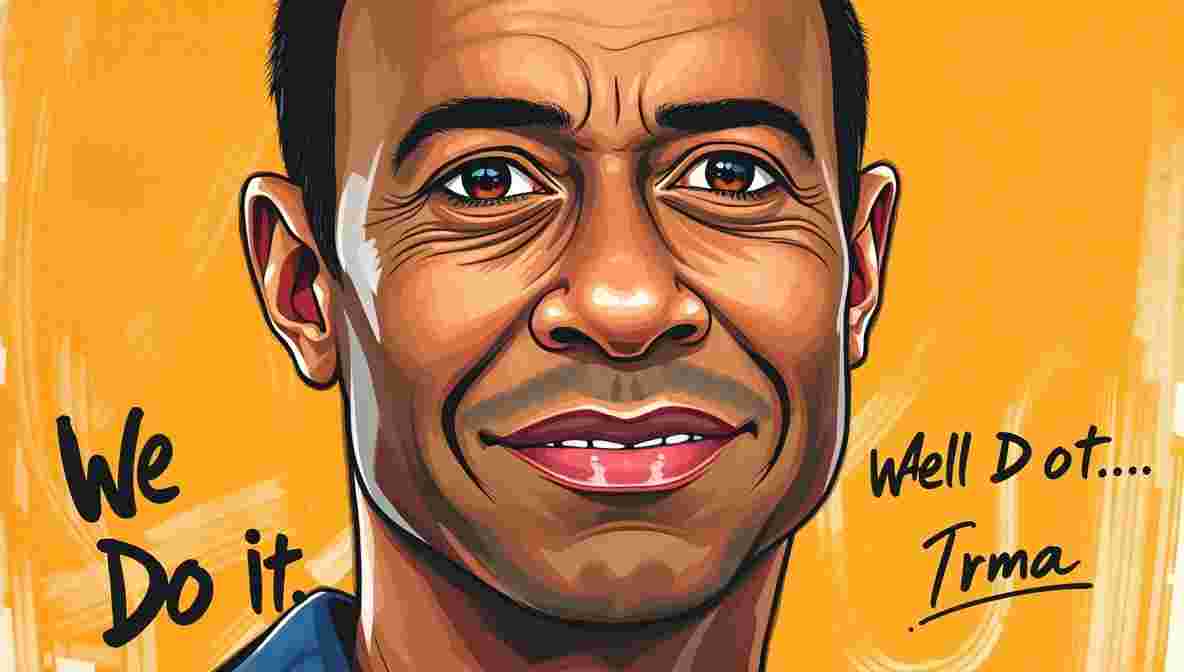
Tiger Woods Admits Entire Legal Defense Runs on “We All Do It”
Five Things We Noticed Immediately About the Most Relatable Criminal Defense in Golf History
He didn’t deny anything, which in 2026 counts as radical transparency. The phrase “we all do it” has quietly replaced both “not guilty” and “my lawyer will speak.” Somewhere, a traffic cop felt personally attacked and didn’t know why. Half the country nodded in agreement, the other half nodded while texting. The steering wheel is now just a suggestion with cup holders. And Woods told the deputy he was looking at his phone and adjusting the radio when he hit the truck — meaning he wasn’t distracted, he was productively distracted, which in America is practically a resume line.

Experts Confirm: Phone Use While Driving Is Now a Core Personality Trait, Not a Crime
PALM BEACH, FL — In a development that sociologists are calling “inevitable but still disappointing,” a panel of behavioral experts has confirmed that glancing at your phone while driving is no longer considered reckless behavior, but rather “a core personality trait, like being left-handed or thinking you’re good at parallel parking.”
Dr. Elaine Putterman of the Institute for Advanced Excuses explained in a leaked memo that distracted driving has become “so normalized that it has crossed the boundary from crime into lifestyle branding.”
“We surveyed drivers,” she said, adjusting her glasses like someone who has given up. “Eighty-seven percent said they only check their phone when it’s important, and the remaining thirteen percent said everything is important.”
An eyewitness, Gary Mullins, a 54-year-old HVAC technician, confirmed the findings while actively merging across three lanes without signaling. “Listen, I only look at my phone when I’m driving,” he said. “If I wasn’t driving, I’d have more time to focus.”
The room nodded. The road did not.
For context: the NHTSA reports that in 2024, 3,208 people were killed in crashes involving distracted drivers — a statistic that has yet to make it onto anyone’s personality vision board.
Tiger Woods Argues DUI Should Rank Below “Eating While Driving Like a Maniac”
According to sources close to the situation, Woods’ legal team is attempting to introduce a new classification system for driving offenses, one that better reflects what Americans consider “actually annoying.”
In this proposed hierarchy, DUI falls somewhere between “driving slow in the left lane” and “using speakerphone in a drive-thru,” while “eating a full plate of spaghetti while steering with your knees” remains a felony in the court of public opinion.
A confidential staffer described the strategy bluntly: “The goal is relatability. Nobody wants to defend DUI. But everybody wants to defend the moment they spilled coffee and blamed the universe.”
New Sobriety Test: “Can You Scroll Instagram Without Crashing?”
Law Enforcement Adapts to the Digital Coordination Era
Law enforcement agencies are already adapting. In several pilot programs, officers have replaced the traditional walk-and-turn test with what’s being called the “Digital Coordination Assessment.”
Drivers are now asked to scroll through social media, like three posts, ignore two notifications, and avoid commenting something they’ll regret — all while maintaining lane discipline.
“If they can do that, they’re probably fine,” said Officer Derek Halvorsen. “Honestly, it’s harder than walking in a straight line.”
Early results show that most drivers fail not because they crash, but because they accidentally open a video and get emotionally invested.
Worth noting: the Insurance Institute for Highway Safety confirms that over a fifth of drivers report using smartphones for social media on most or all of their trips — which means the new sobriety test has an extraordinarily large talent pool to work with.
Woods Says He Was “Just Changing the Song” — Playlist Now Charged as Accomplice
In a statement that legal analysts are calling “bold but musically coherent,” Woods clarified that he was not distracted, but rather “curating a vibe.” The Martin County Sheriff’s Office noted that Woods told a deputy he was looking down at his phone and changing the radio station when his Land Rover clipped a truck and rolled onto its side.
Authorities have since subpoenaed his playlist, which now faces charges of “aiding and abetting poor decision-making.”
A musicologist consulted on the case noted, “If the transition between songs wasn’t smooth, that could explain everything. Nobody drives well through a bad shuffle.”
New Driving Law Proposed: Casual Admission Means Half the Sentence
The “Casual Admission Act” Could Decriminalize Conversational Crimes
Lawmakers, sensing an opportunity to align policy with reality, have introduced a bill that would decriminalize certain driving behaviors if the driver acknowledges them in a relaxed, conversational tone.
Under the proposed “Casual Admission Act,” statements like “Yeah, I glanced at my phone real quick” would carry significantly less weight than defensive silence.
Polling data shows overwhelming support, with 92.4 percent of respondents saying, “That seems fair, honestly.”
Distracted Driving Statistics Americans Would Prefer Not to Think About
Study Finds Drivers Prefer “Relatable Excuses” Over Actual Responsibility
A nationwide survey conducted by the Center for Situational Accountability found that drivers are far more likely to forgive dangerous behavior if the excuse feels familiar.
When presented with two scenarios — “I was intoxicated” versus “I was trying to skip a song I hate” — participants overwhelmingly chose the latter as “understandable.”
Lead researcher Dr. Kevin Lutz summarized the findings: “Americans don’t want perfect drivers. They want drivers who remind them of themselves, just slightly worse.”
The hard data is less forgiving: 93% of drivers know phone use while driving is dangerous, yet 27% admit to sending texts and 38% admit to reading them — a gap between knowledge and behavior that social scientists are calling “very on-brand.”
Tiger Woods Accident Sparks Debate: Is Multitasking the Real Victim Here?
Public discourse has quickly shifted from the incident itself to a broader philosophical question: is multitasking being unfairly blamed?
At a recent panel discussion, one speaker argued that modern life requires constant attention splitting. “If you’re only doing one thing at a time, are you even trying?” she asked, before checking her phone mid-sentence.
The audience applauded, then immediately looked down at their laps.
America’s Official Hierarchy of Driving Sins: A Public Service Ranking
Citizens Demand Clear Answers on What’s Actually Worse Than What
The debate has now reached kitchen tables, comment sections, and group chats nationwide. Citizens are demanding a definitive ranking of driving sins, one that reflects both legality and irritation.
Preliminary results from an informal poll show the following order:
- Most offensive: Not waving when someone lets you merge
- Second: Watching videos at a stoplight and missing the green
- Third: Group texting while turning left across traffic
- Somewhere below that: Everything else, including, apparently, reality
Woods’ Defense Team Files the “Just Checking Something Real Quick” Clause
In what legal scholars are calling a “watershed moment for vague excuses,” Woods’ attorneys have formally requested recognition of the “Just Checking Something Real Quick” clause.
If approved, the clause would allow drivers to briefly disengage from reality without full legal consequences, provided they genuinely believed it would only take a second.
An anonymous judge reportedly sighed upon reading the filing and whispered, “We are all so tired.”
For the record: reading or sending a text takes an average of five seconds — equivalent to driving the length of a football field blindfolded at 55 mph. But sure, “real quick.”
Scientists Confirm: 92% of Drivers Believe Their Distractions Are “The Good Kind”
Perhaps the most troubling revelation comes from a recent study showing that nearly all drivers consider their own distractions to be reasonable, necessary, and, in some cases, heroic.
“Everyone thinks they’re the exception,” said Dr. Putterman. “They’re not texting. They’re communicating. They’re not distracted. They’re optimizing.”
As traffic continues to flow like a loosely organized suggestion, one thing is clear: the road is no longer just a place to drive. It’s a place to justify.
What the Funny People Are Saying
“I don’t text and drive. I text, then I drive toward wherever the text told me to go.” — Jerry Seinfeld
“I saw a guy eating cereal while driving. Not a bar. Not a snack. A full breakfast with commitment.” — Ron White
“We’ve reached a point where people think the dangerous part of driving is the driving.” — Amy Schumer
This story is a work of satirical journalism, built entirely through a human collaboration between the world’s oldest tenured professor and a philosophy major turned dairy farmer, both of whom have absolutely checked their phones at a stoplight and immediately felt judged by the universe. No playlists were harmed in the making of this article, though several were questioned. If you feel personally implicated, that’s purely coincidental and statistically inevitable.
On March 27, 2026, golf legend Tiger Woods was arrested on DUI charges after his Land Rover SUV clipped a truck and rolled onto its side on a residential road in Jupiter Island, Florida. Woods, who blew 0.00 on a breathalyzer but refused a urine test, told deputies he had been looking at his phone and changing the radio station at the time of the crash. He pleaded not guilty, demanded a jury trial, and subsequently announced he would step away from golf to seek treatment. The incident — his second DUI charge and fourth vehicle incident since 2009 — occurred just days before the 2026 Masters, which Woods will not attend. His defense attorney previously represented him in a 2017 DUI case that was reduced to reckless driving. Florida’s “Trenton’s Law,” which increased penalties for impaired driving, applies to this case.
Auf Wiedersehen, amigo!